
Fresh Nutrition is what survives the journey.
Freshness is something you can taste, see and smell. Time after harvest also affects certain nutrients. Growing at home lets you shorten that journey and pick your greens when you are ready to eat.
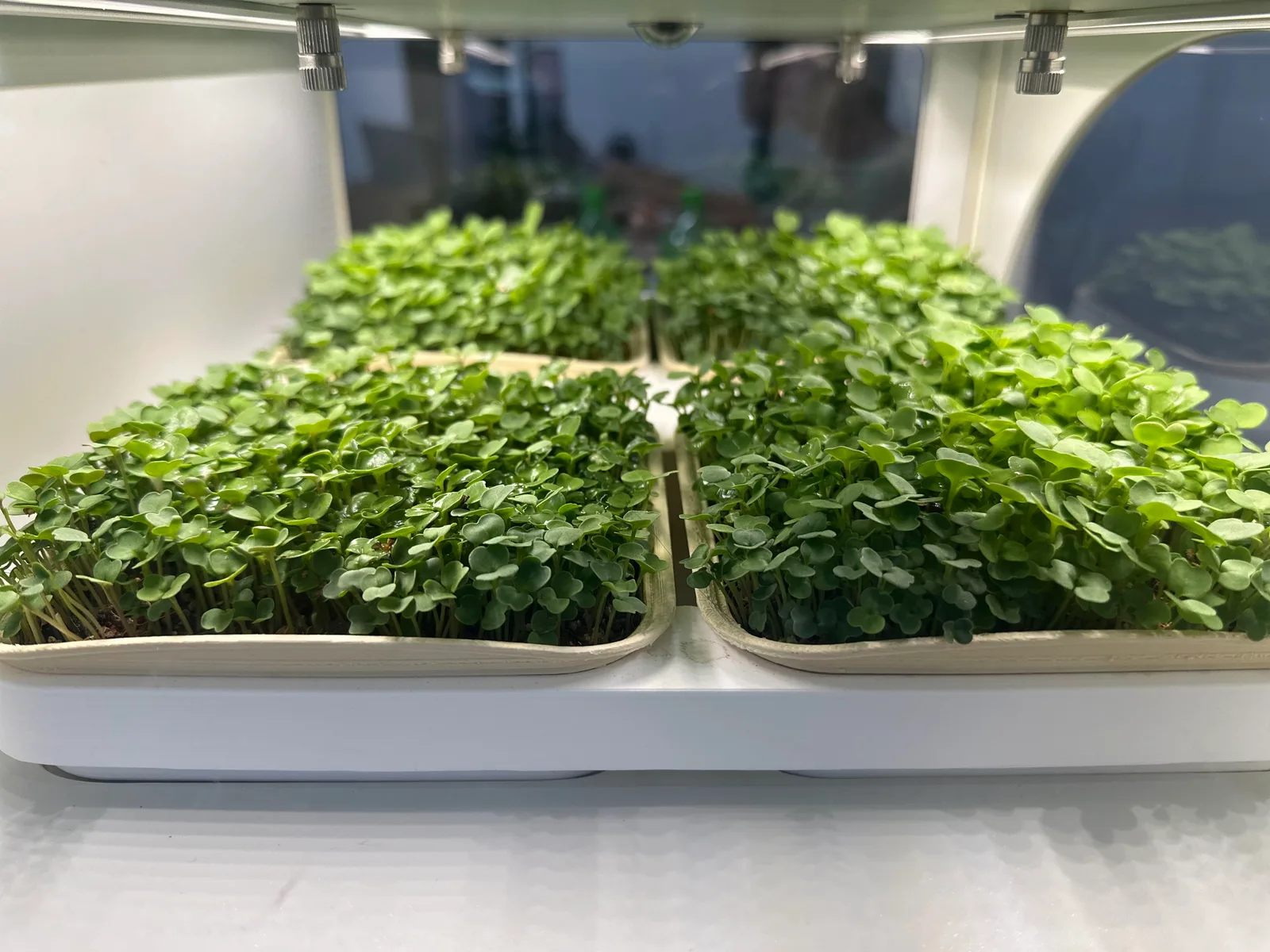
What reaches your plate matters.
We use Fresh Nutrition to mean one specific thing: the nutritional and sensory quality of food at the moment it is eaten, after harvest, transport and storage have had their effect.
It is not a health claim and not a medical concept. It is a way of asking a practical question: how much of what was grown is still there when you eat it?
Six steps sit between the field and your fork.
Harvest → cooling → packing → freight → retail shelf → your refrigerator. Each step protects the food, and each step costs time.
Some nutrients are stable through all of it. Others are not: water-soluble vitamins such as vitamin C decline measurably during storage, with the rate depending on the crop, the temperature and how long the chain is. [2]
- Distance is real
- Fresh produce in developed food systems is routinely transported long distances before sale, and produce is among the more transport-intensive food categories. [4]
- Time is the variable
- Loss is driven by elapsed time and temperature, not by any single villain in the supply chain. [2]
- It varies by nutrient
- Vitamin C and folate are sensitive; minerals and fibre are largely unaffected. Blanket claims about 'nutrient-free supermarket produce' are not supportable.
Five ways to experience freshness.
Reducing freshness to a single vitamin figure misses most of what people actually experience.
- Time
- Minutes from harvest to plate, instead of days.
- Experience
- You see it grow, you cut it, you eat it.
- Habit
- Food that is visible in the kitchen gets eaten.
- Taste & texture
- Try a freshly cut handful and notice its aroma, bite and texture.
- Control
- You know when it grew and when it was cut.
One part of the plate moves to the start of the chain.
LUYA does not replace the grocery store, and it does not grow a full diet. It moves a small, nutrient-dense category, microgreens, from a multi-day supply chain to a countertop where the harvest time is yours to choose.
That is the whole proposition. Everything else on this site is an attempt to make that reliable enough to be ordinary.
What we can say, and what we cannot.
- Supported by published research
- Nutrient levels in microgreens have been measured and are, for several crops, high relative to their mature counterparts by weight. [1] Storage time reduces certain vitamins. [2]
- Not yet established by LUYA
- We have not run controlled studies on nutrient retention in LUYA-grown crops, or on health outcomes in households using the system. Those studies are what Luya Lab exists to do.
- Out of scope entirely
- No claim that microgreens prevent, treat or cure any condition. Food is food.
- [1] Xiao et al. (2012). Assessment of vitamin and carotenoid concentrations of emerging food products: edible microgreens. J. Agric. Food Chem.
- [2] Lee & Kader (2000). Preharvest and postharvest factors influencing vitamin C content of horticultural crops. Postharvest Biology and Technology.
- [4] Weber & Matthews (2008). Food-miles and the relative climate impacts of food choices in the United States. Environmental Science & Technology.