
The last hundred years took food out of the home. The next hundred bring it back.
We imagine homes where growing something fresh is as familiar as making coffee. Microgreens are where we begin; bringing people closer to their food is the longer journey.
A series of reasonable trades, and one hidden price.
For nearly all of human history food was local, seasonal and alive. The industrial century rewrote that contract, and it worked: more people are fed, more cheaply and more safely, than at any point on record. That is not a failure to be undone.
But every step (refrigeration, long-haul freight, preservation, packaging, processing) solved a real problem by paying the same currency. Distance. Distance in miles, and distance in days.
The system became superbly good at delivering food that lasts. It was never designed to deliver food that is fresh.
- Long supply chains
- Fresh produce in the U.S. typically moves through harvest, cooling, freight and distribution before it reaches a shelf, a chain measured in hundreds to thousands of miles. [4]
- Nutrients decline with time
- Vitamin C in leafy greens falls measurably during refrigerated storage; how much depends on crop, temperature and handling. [2]
- The default shifted
- Ultra-processed foods now supply a little over half of daily calories for U.S. adults, and more for children. [6]
The kitchen spent a century bringing the world indoors.
The refrigerator brought preservation home — from a small minority of American households in the 1930s to the overwhelming majority within two decades. [7] The stove brought cooking home. The washing machine brought the laundry home. The espresso machine brought the café home. Piece by piece, the kitchen absorbed the outside world.
One piece is still outside: the growing of the food itself, on farms most of us will never see.
A home nutrition system is that last piece coming home. Not a gadget added to the kitchen; the kitchen finishing what it started a hundred years ago.
We tried to solve it in a bottle.
When food got further away, nutrition became something to buy back. Isolate the compound, measure the dose, put it in a capsule. It is an honest idea and, for genuine deficiencies, a medically important one — nobody should read this as an argument against supplementation their clinician recommends.
But a supplement optimises for what can be printed on a label. Food does several things a label cannot hold: taste, texture, variety, satiety, the act of preparing it, and the daily relationship a household has with what it eats.
Nutrition can be measured on a label. Freshness has to be experienced.
LUYA is food, not medicine. Nothing here is a claim to treat, prevent or cure any condition, and nothing here is a reason to stop a supplement or medication.
Fresh Nutrition: the part that has to be produced where it is eaten.
Freshness is the one dimension of food quality a supply chain structurally cannot ship. Every logistics improvement makes food last longer; none of them makes it younger.
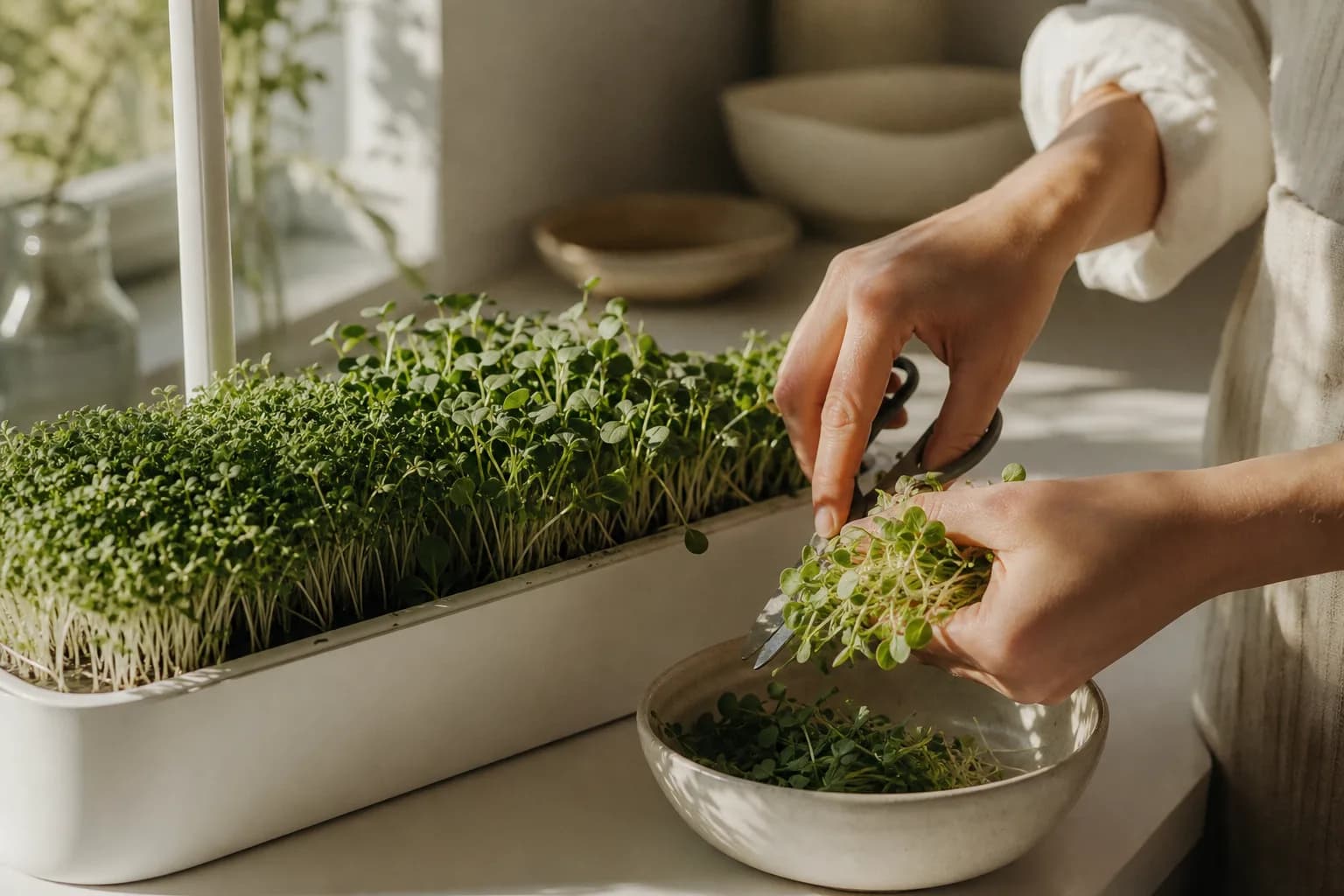
So we build for the only place freshness can be created: the home. A household will never grow its own grain, and does not need to. But a handful of dense, fast-growing greens can grow on a countertop and be cut minutes before a meal — moving the household from the end of the food chain to the beginning of it.
That is the whole idea. Everything LUYA builds is in service of making it reliable enough to become a habit rather than a hobby.
Five beliefs, and what each one costs us.
A belief only counts when it can cost you something. So after each, we name the price we pay for holding it.
- Fresh is fundamentally different
- The cost: we build around real, living, perishable food, far harder than any shelf-stable powder.
- Health should be effortless
- We take care of the growing conditions. You load trays, refill water when prompted, harvest and clean between cycles.
- Technology should move people closer to nature
- The cost: we refuse the cold, sci-fi look, even when it would impress.
- Every household deserves fresh nutrition
- The cost: price, simplicity and reach are moral questions for us, not only commercial ones.
- Daily habits outperform occasional effort
- The cost: we are selling a ritual rather than a gadget, and accept being judged over years instead of launches.
Wherever people go, they still have to eat.
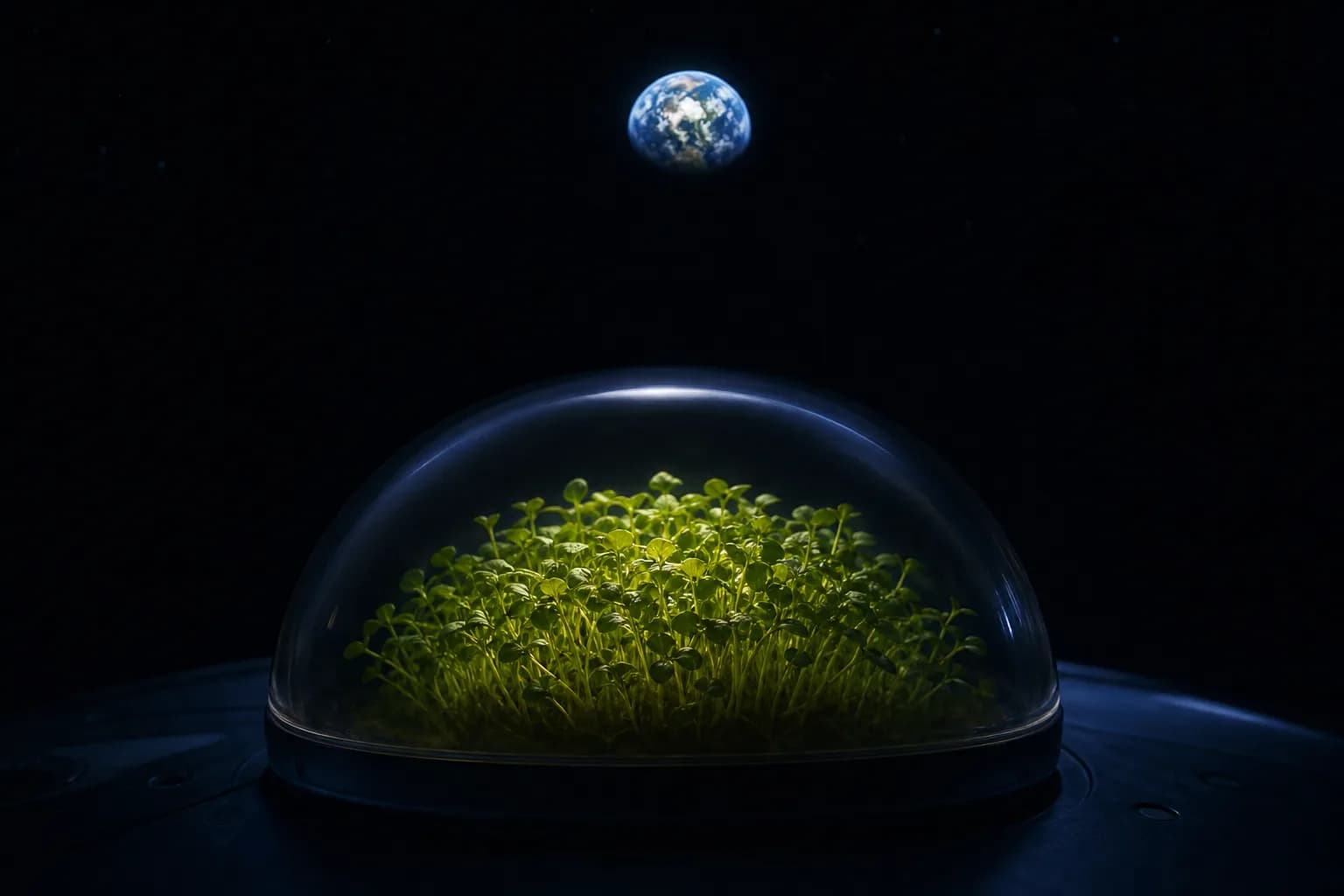
There is a version of the next century in which people spend months in transit and years somewhere that is not Earth. Every serious plan for that future runs into the same unglamorous problem: resupply is slow, expensive, and eventually impossible, and stored rations cannot supply what fresh food supplies. We are not the first to notice — plant scientists have argued the same case for microgreens specifically, on the grounds that food and packaging are a heavy share of mission consumables and that crops grown on board feed morale as well as bodies. [8]
A closed system that reliably turns seed, water, light and air into food a human wants to eat, with no soil, no sunlight and no room for error, is not a different product from the one we are building. It is the same product, tested somewhere unforgiving.
We are honest about the order of things: Earth first, and specifically the kitchen. But we design as though the harder case is coming, because building for it makes the everyday case better.
This section describes a direction, not a programme. The citation above is a peer-reviewed opinion paper arguing the case in general; it is not about LUYA. We have no space-agency contract, mission or flight hardware, and nothing here should be read as one.
Fresh food, closer to everyday life.
We do not measure ourselves by the product we launch, but by the gap we close: the distance, in miles and in days, between a person and food that is still alive.
Microgreens are where that starts. They are dense, fast, forgiving and still growing when you cut them. They are not where it ends.
Where it goes next is written into our address. X is the kitchen, Y is the commercial kitchen, Z is a container at the end of a supply line — three sizes of one problem, with the smallest one teaching the other two. Only X is being built.
Why our domain is luyaxyz.com →- [2] Lee & Kader (2000). Preharvest and postharvest factors influencing vitamin C content of horticultural crops. Postharvest Biology and Technology.
- [4] Weber & Matthews (2008). Food-miles and the relative climate impacts of food choices in the United States. Environmental Science & Technology.
- [6] CDC / NCHS Data Brief No. 536 (August 2025). Ultra-processed Food Consumption in Youth and Adults: United States, August 2021-August 2023. Adults 53.0% of calories; youth 61.9%.
- [7] U.S. Census / historical household-appliance adoption data, as compiled in Our World in Data — Technology Adoption.
- [8] Kyriacou et al. (2017). Microgreens as a Component of Space Life Support Systems: A Cornucopia of Functional Food. Frontiers in Plant Science 8:1587 (opinion article).