
Growing starts with one tray.
No measuring seed, no mixing medium, no deciding on a schedule. Open the sealed tray and place it inside. Scan its QR code in the app to identify the crop.
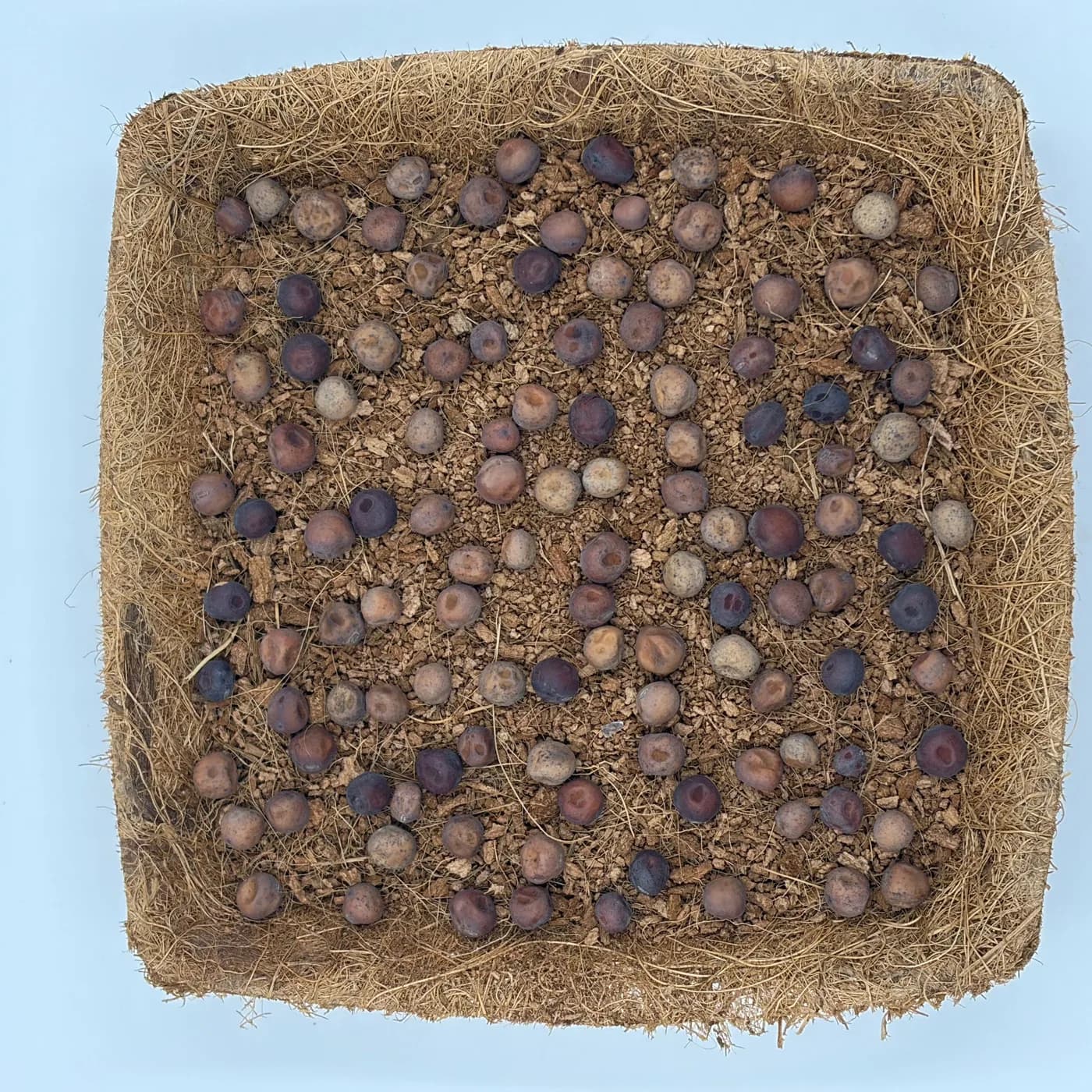
Pre-seeded, sealed, ready to load.
Each tray contains a single variety or a planned mix, pre-seeded in its growing medium. The seal keeps it stable until you use it; scanning its QR code adds it in the app.
The part that makes one machine behave like many.
A growing recipe is the environment program for a crop: what spectrum and intensity of light, at what times; how much water, how often; what climate; and how all of that changes between germination, canopy and harvest.
Recipes are versioned and tested before release. A recipe update can bring the results of that work to the device; it does not mean that every cycle automatically trains a new model or improves its nutrient content.
Light is not a switch.
A grow light that is simply on does not describe what a plant will make. Two findings set the floor under the whole idea of a per-crop recipe.
- Light or no light changes the plant, not just its size
- One survey grew pea tendrils from a single seed lot two ways. Under light they measured 35.0 mg of vitamin E per 100 g and 8.2 mg of beta-carotene; grown in the dark, the same seed gave 4.9 and 0.6 — seven times and thirteen times less, from light alone. [1]
- And no single spectrum is best for everything
- White, red and blue LEDs run on one kale cultivar gave three different profiles: white produced the most carotenoids, blue the most phenolics, and glucosinolates tracked white and blue over red. Asking which light is best has no answer until you say best for what. [2]
- Which is the argument for a recipe rather than a lamp
- If the answer depends on the crop and on the compound, a fixed light setting is the wrong shape of solution. That is why spectrum, intensity and schedule are part of the tray's program and not a hardware constant.
These are published results for these crops under these conditions, not measurements of LUYA produce. They establish that light determines composition — the premise the system is built on. They do not show that our recipes are optimal, and we have not run the trial that would.
Keep a few trays ready for next week.
Each growing cycle starts with a new pre-seeded tray. Plan for this ongoing cost when choosing a device, and check the available varieties and packs before ordering.
- Single purchase
- Trays are bought as you need them. There is no subscription requirement at launch.
- No lock-in for the basics
- The core growing loop is not gated behind a membership tier.
- Tray price
- $2.99 per pre-seeded tray. Pack sizes and final availability will be confirmed before purchase.
$2.99 per pre-seeded tray. Pack sizes and availability will be confirmed before purchase. No subscription is required for the core growing experience.
Storing trays, and when not to use one.
Keep sealed trays cool, dry and out of direct sun, and use them within the date printed on the pack. Do not use a tray whose seal is broken or damaged, or one that shows growth or moisture before it goes into the device.
- [1] Xiao et al. (2012). Assessment of vitamin and carotenoid concentrations of emerging food products: edible microgreens. J. Agric. Food Chem. 60(31):7644-51. Pea tendrils from one seed lot, grown under light and in the dark: 35.0 vs 4.9 mg alpha-tocopherol and 8.2 vs 0.6 mg beta-carotene per 100 g fresh weight.
- [2] Lee et al. (2023). LED lights influenced phytochemical contents and biological activities in kale (Brassica oleracea L. var. acephala) microgreens. Antioxidants 12(9):1686. White, red and blue LEDs on one cultivar produced different carotenoid, glucosinolate and phenolic profiles.