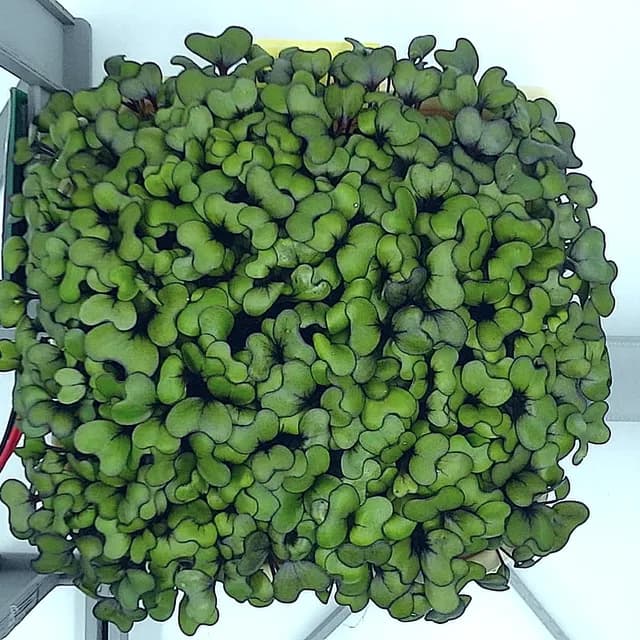
Microgreens, explained plainly.
Young edible plants, harvested days after germination, when the first true leaves appear. Not sprouts, not baby salad: a distinct stage with its own flavour, texture and handling.
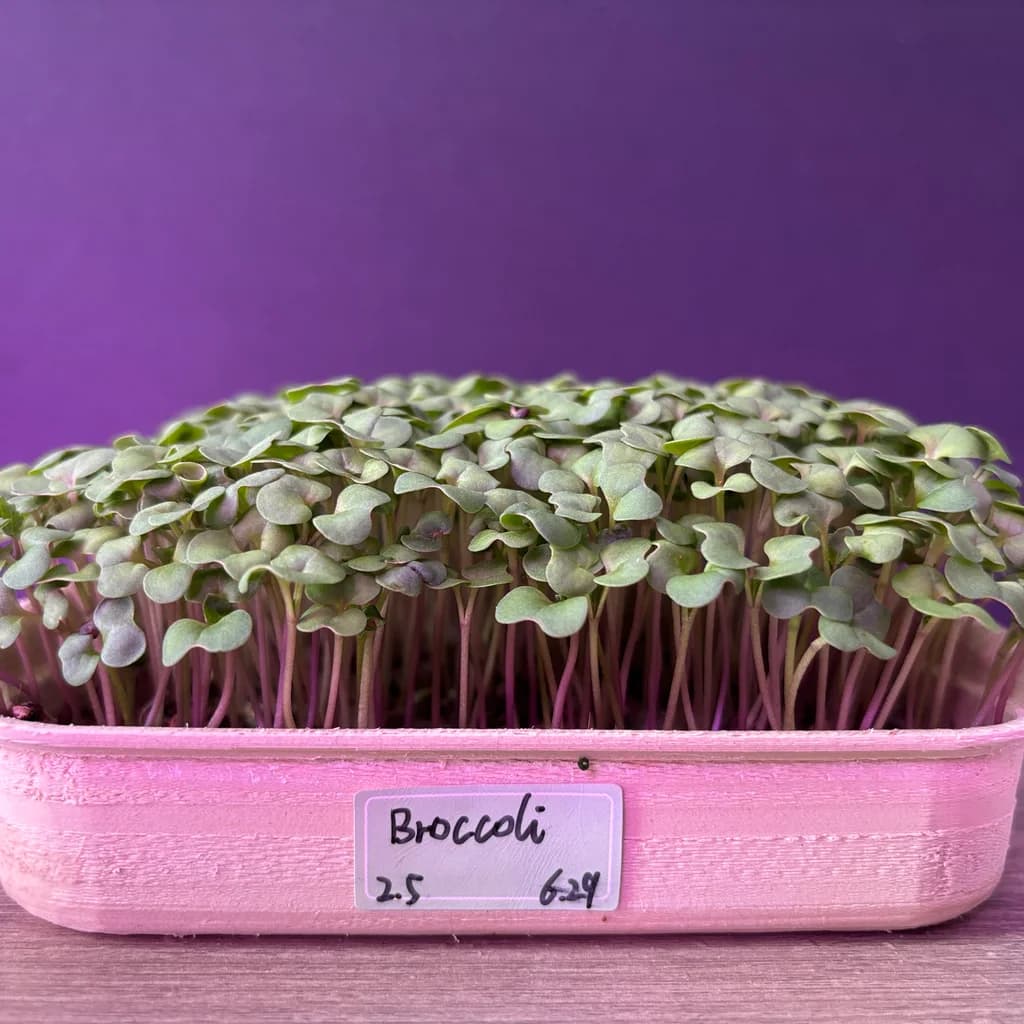
Harvested young, eaten whole above the soil line.
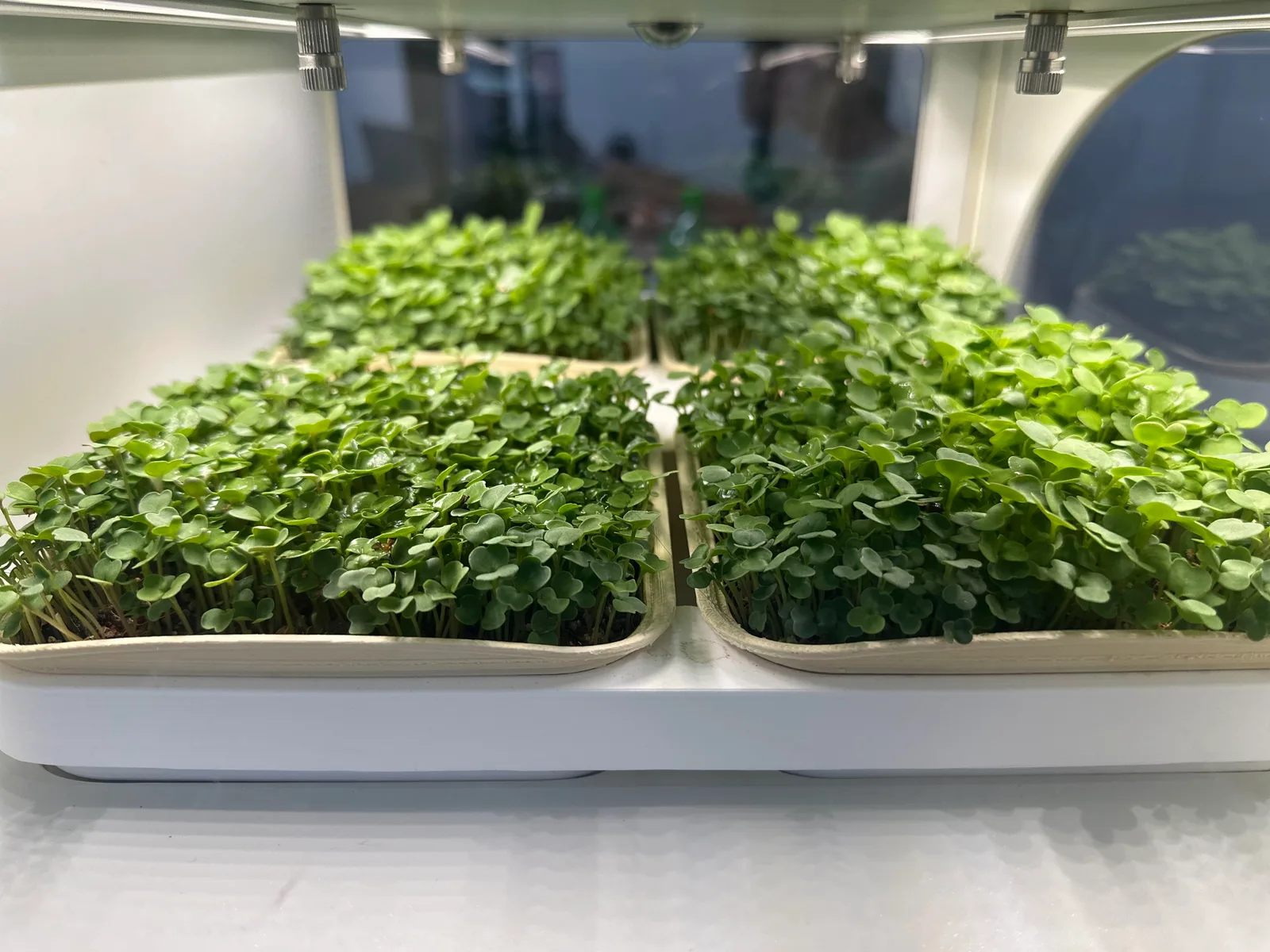
A microgreen is a seedling of an edible vegetable or herb, cut at the stem just above the growing medium, typically 6-14 days after sowing depending on the crop. You eat the stem and the leaves; the root stays behind.
Microgreens, sprouts and baby greens are different.
- Sprouts
- Germinated seeds eaten whole, root included, usually grown in water without light. Because of the warm, humid conditions they require, food-safety authorities treat sprouts as a distinct higher-risk category. [5]
- Microgreens
- Grown in a medium with light, cut above the root, eaten as a fresh green.
- Baby greens & mature vegetables
- Harvested weeks to months later, larger, milder, and generally sold through a longer supply chain.
Explore the nutrients in each crop.
A frequently cited study measured vitamin and carotenoid concentrations across 25 microgreen varieties and found levels that were, per unit weight, often substantially higher than published values for their mature counterparts. [1]
Two caveats matter. First, this is concentration by weight, and a serving of microgreens is small, a garnish is not a portion of vegetables. Second, values vary widely by crop, growing conditions and freshness, so a single multiplier for 'microgreens' is misleading.
- Broccoli
- Studied for glucoraphanin, the precursor that converts to sulforaphane when the plant tissue is chewed or chopped. [3]
- Red cabbage
- Among the highest measured for vitamin C and anthocyanins in the 25-variety comparison. [1]
- Kale
- Measured for lutein and other carotenoids. [1]
Small leaves. A closer look at the research.
Published studies report concentrations of selected nutrients in particular crops. These comparisons use an assumed 150 g fresh portion, not a measured Luya harvest or a recommended serving.
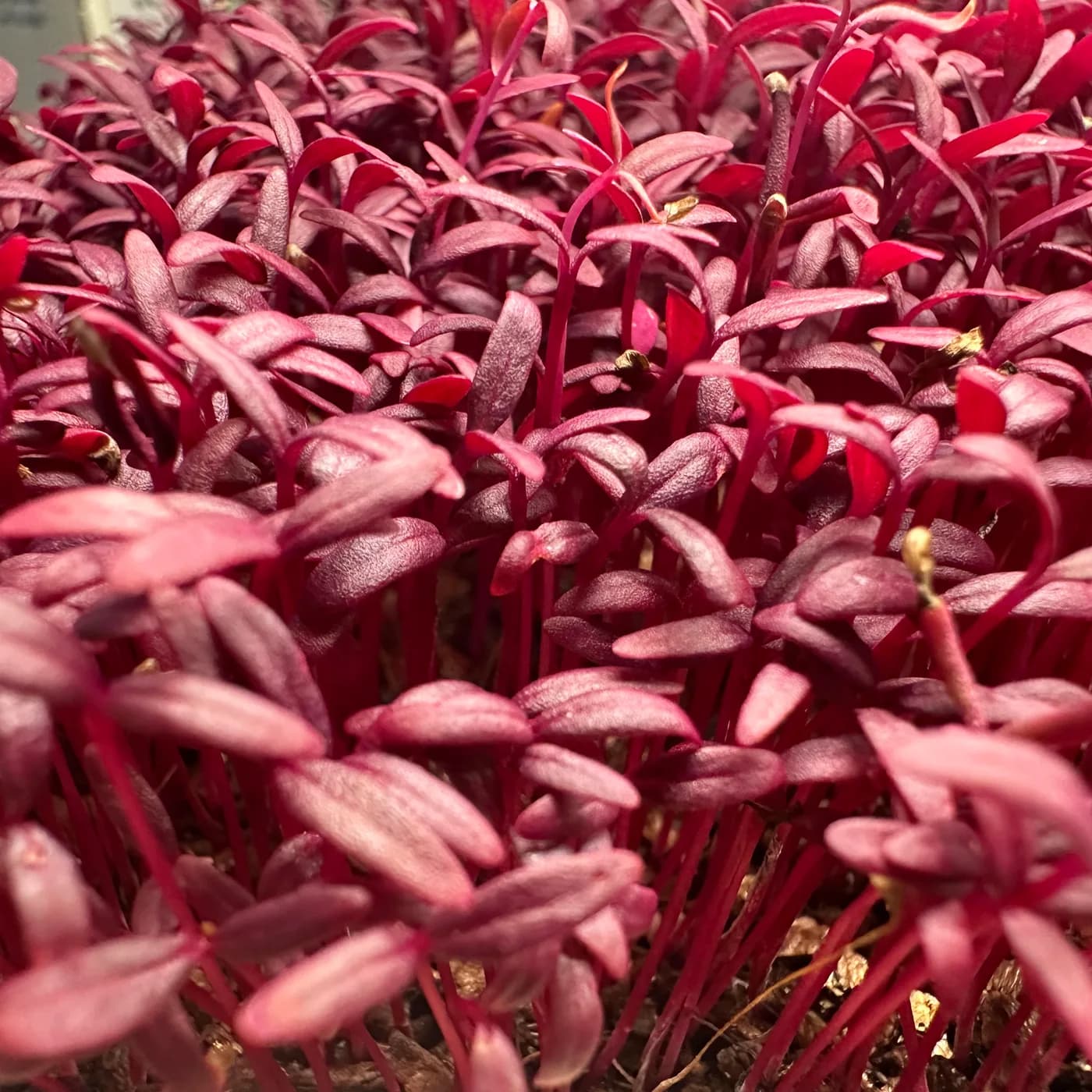
What can growing conditions change?
Our researchers study how light, water and growing conditions influence plants. Biological prediction and nutrition or taste adjustment are planned for Luya X1 Pro, not included in the X1 release.
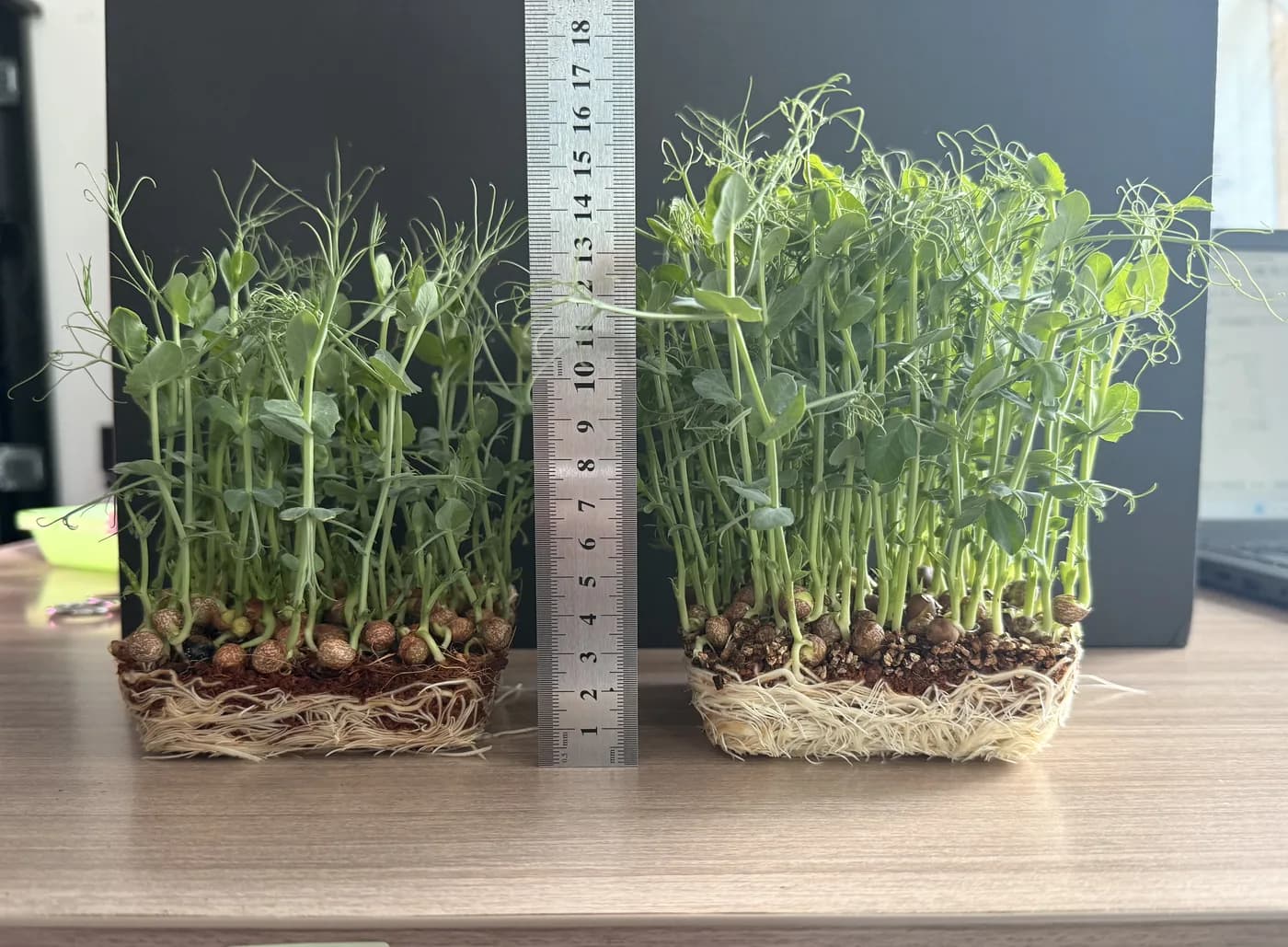
*Literature-based estimates derived from published studies and reference food-composition data. Comparisons refer only to the specified nutrient by mass, not overall nutritional or health equivalence. 150 g is an assumption, not a measured tray yield. These results do not establish the nutrient content of LUYA-grown crops.
Sources: USDA ARS; Xiao et al., Journal of Agricultural and Food Chemistry; Zhang et al., Food Chemistry; Kyriacou et al., Frontiers in Plant Science; published broccoli glucoraphanin studies.
What if your daily nutrition could grow in your kitchen?
One tray does the work of the bottle. Pick a crop and see what a single weekly LUYA tray delivers, measured against the pills people buy for the same thing.
The same broccoli, raw vs cooked: sulforaphane bioavailability fell ~11-fold with cooking. What form food is eaten in matters as much as what it contains.6
- 1.Broccoli microgreens contain ~13 µmol/g glucoraphanin (fresh weight), sulforaphane bioavailability study, Nutrients 2023.
- 2.Sulforaphane supplement doses (e.g. ~30 mg glucoraphanin per capsule; ~10 mg sulforaphane per tablet).
- 3.Vitamin & carotenoid levels across 25 microgreens. Xiao et al., J. Agric. Food Chem. 2012.
- 4.Typical eye-health lutein dose is ~10 mg per day.
- 5.Fresh broccoli sprouts vs a broccoli supplement, human cross-over (12 subjects, 40 g sprouts vs 6 pills): ~7× higher peak plasma sulforaphane, ~5× higher urinary excretion. Clarke et al., Pharmacological Research 2011;64(5):456-63.
- 6.Sulforaphane bioavailability in humans: ~37% from raw broccoli vs ~3.4% from cooked. Vermeulen et al., J. Agric. Food Chem. 2008;56(22).
- 7.Adult RDA for vitamin E (α-tocopherol) is 15 mg/day. NIH Office of Dietary Supplements.
Illustrative figures based on published data; nutrient content varies with crop, cultivar, light and harvest time, and glucoraphanin converts to sulforaphane only when the plant is chewed or cut. Not medical advice.
One tray, and what it equals.
Each row divides a published concentration for the crop by the USDA value for a food you already know. One tray is 150 g of fresh cut greens throughout. Nothing here is a measurement of LUYA-grown product, and four crops have nothing to show yet; those rows say so rather than disappearing.
| Crop | One tray equals | Source | Calculation |
|---|---|---|---|
Broccoli Waltham 29 | 34 heads of broccoli matched on glucoraphanin Compared against the mean of 31 supermarket broccoli heads. Field-grown genotypes average higher, which would put the figure nearer 12-15. | Crop value 1 Broccoli, raw 8FDC #170379 · one head of broccoli = 151 g | 576 mg/100 g × 150 g = 864 mg 16.6 mg/100 g × 151 g = 25.0 mg 864 ÷ 25.0 = 34.5 |
Kale Vates Blue Scotch Curled | Nothing to show yet Measured kale microgreens come in below mature kale on calcium and potassium, and the nutrient they do lead on, coenzyme Q10, has no comparator food in the USDA database. | — | Unlocked by: A carotenoid and vitamin C assay on our own Vates Blue Scotch Curled. |
Daikon Radish Daikon Minowase | 31 avocados matched on vitamin E The highest vitamin E of the 25 microgreens in that survey. | Crop value 2Measured on green daikon, not the Minowase we grow. Avocados, raw, all commercial varieties 8FDC #171705 · one avocado = 201 g | 87.4 mg/100 g × 150 g = 131 mg 2.07 mg/100 g × 201 g = 4.16 mg 131 ÷ 4.16 = 31.5 |
↳ also | 111 heads of broccoli matched on vitamin E | Crop value 2 Broccoli, raw 8FDC #170379 · one head of broccoli = 151 g | 87.4 mg/100 g × 150 g = 131 mg 0.78 mg/100 g × 151 g = 1.18 mg 131 ÷ 1.18 = 111.3 |
Purple Radish Rambo (Organic) | 125 blueberries matched on anthocyanins | Crop value 3Reported for red radish microgreens generally, not the Rambo cultivar. Blueberries, raw 8FDC #171711 · one blueberry = 1.36 g | 186 mg/100 g × 150 g = 279 mg 163 mg/100 g × 1.36 g = 2.22 mg 279 ÷ 2.22 = 125.9 |
Red Cabbage Red Acre | 82 carrots matched on lutein and zeaxanthin | Crop value 2 Carrots, raw 8FDC #170393 · one carrot = 61 g | 8.60 mg/100 g × 150 g = 12.9 mg 0.26 mg/100 g × 61 g = 0.16 mg 12.9 ÷ 0.16 = 82.6 |
↳ also | 31 heads of broccoli matched on beta-carotene | Crop value 2 Broccoli, raw 8FDC #170379 · one head of broccoli = 151 g | 11.5 mg/100 g × 150 g = 17.3 mg 0.36 mg/100 g × 151 g = 0.55 mg 17.3 ÷ 0.55 = 31.6 |
↳ also | 26 apples matched on vitamin C The highest vitamin C of the 25 microgreens in that survey. | Crop value 2 Apples, raw, with skin 8FDC #171688 · one apple = 182 g | 147 mg/100 g × 150 g = 221 mg 4.60 mg/100 g × 182 g = 8.37 mg 221 ÷ 8.37 = 26.3 |
Arugula Slow Bolt | 7.7 apples matched on vitamin C Taken at the low end of the study's untreated range of 43-61 mg/100 g; the high end would read 10. Mature arugula is higher still per gram, so this is not a claim against the grown leaf. | Crop value 4 Apples, raw, with skin 8FDC #171688 · one apple = 182 g | 43.0 mg/100 g × 150 g = 64.5 mg 4.60 mg/100 g × 182 g = 8.37 mg 64.5 ÷ 8.37 = 7.7 |
Mustard Wasabi (Organic) | 27 blueberries matched on anthocyanins The highest of five Brassicaceae microgreens measured. Anthocyanins only — the same study puts mustard lowest of the five in total phenolics. | Crop value 5 Blueberries, raw 8FDC #171711 · one blueberry = 1.36 g | 40.6 mg/100 g × 150 g = 60.8 mg 163 mg/100 g × 1.36 g = 2.22 mg 60.8 ÷ 2.22 = 27.4 |
Basil Genovese | 3.0 heads of broccoli matched on calcium Among the highest calcium of seventeen microgreens tested. Mature basil is higher per gram. | Crop value 6 · variety matches ours Broccoli, raw 8FDC #170379 · one head of broccoli = 151 g | 142 mg/100 g × 150 g = 213 mg 47.0 mg/100 g × 151 g = 71.0 mg 213 ÷ 71.0 = 3.0 |
Amaranth Red Garnet | 80 carrots matched on lutein and zeaxanthin | Crop value 2 · variety matches ours Carrots, raw 8FDC #170393 · one carrot = 61 g | 8.40 mg/100 g × 150 g = 12.6 mg 0.26 mg/100 g × 61 g = 0.16 mg 12.6 ÷ 0.16 = 80.7 |
Pea Shoots Speckled (Organic) | 17× the selenium of the mature pea Reported as a fold-change against the mature plant in the same study, with no absolute value to turn into a count. Molybdenum ran 12.2×. | Crop value 7Microgreen and mature plant compared in one study. | Reported directly as a fold-change;no absolute value to convert into a count. |
Basic Mix Kale · Kohlrabi · Broccoli · Red cabbage · Arugula | 31 heads of broccoli matched on beta-carotene, from the red cabbage in this mix | Crop value 2 Broccoli, raw 8FDC #170379 · one head of broccoli = 151 g | 11.5 mg/100 g × 150 g = 17.3 mg 0.36 mg/100 g × 151 g = 0.55 mg 17.3 ÷ 0.55 = 31.6 |
Spicy Mix Broccoli · Kale · Arugula · Kohlrabi · Red cabbage · Mustard | 27 blueberries matched on anthocyanins, from the mustard in this mix | Crop value 5 Blueberries, raw 8FDC #171711 · one blueberry = 1.36 g | 40.6 mg/100 g × 150 g = 60.8 mg 163 mg/100 g × 1.36 g = 2.22 mg 60.8 ÷ 2.22 = 27.4 |
- 1.Bouranis JA, Wong CP, Beaver LM, et al. Sulforaphane bioavailability in healthy subjects fed a single serving of fresh broccoli microgreens. Foods 2023;12(20):3784.
- 2.Xiao Z, Lester GE, Luo Y, Wang Q. Assessment of vitamin and carotenoid concentrations of emerging food products: edible microgreens. J Agric Food Chem 2012;60(31):7644-51.
- 3.Maisto M, Marzocchi A, Piccolo V, et al. Nutraceutical potential of radish (Raphanus sativus cv. Tango) microgreens. Food Chem X 2026;35:103816. — The 186 mg/100 g anthocyanin figure is attributed in this paper to Dhaka et al. 2023; we have not obtained the primary.
- 4.Kathi S, Laza H, Singh S, Thompson L, Li W, Simpson C. Increasing vitamin C through agronomic biofortification of arugula microgreens. Sci Rep 2022;12:13093. Untreated control, 43-61 mg total vitamin C per 100 g fresh weight.
- 5.Marchioni I, Martinelli M, Ascrizzi R, et al. Small functional foods: comparative phytochemical and nutritional analyses of five microgreens of the Brassicaceae family. Foods 2021;10(2):427. — Values reached us through the Zhang et al. 2021 review rather than the primary paper.
- 6.Di Gioia F, Hong JC, Pisani C, Petropoulos SA, Bai J, Rosskopf EN. Yield performance, mineral profile, and nitrate content in a selection of seventeen microgreens species. Front Plant Sci 2023;14:1220691.
- 7.Johnson SA, Prenni JE, Heuberger AL, et al. Comprehensive evaluation of metabolites and minerals in 6 microgreen species and the influence of maturity. Curr Dev Nutr 2021;5(1):nzaa180.
- 8.USDA FoodData Central. Foundation Foods and SR Legacy. Comparator nutrient values and household portion weights, retrieved 2026-09-01 via the official API.
Microgreen values are published figures for the crop type and not measurements of LUYA product; where the study used a different variety from the one we grow, the row says so. Comparator nutrient values and household portion weights are USDA FoodData Central, retrieved 2026-09-01. Each comparison covers one named nutrient by mass, not overall nutritional or health equivalence. Not medical or nutritional advice.
Nutrition is more than a number on a label.
In a human trial, fresh broccoli sprouts and six supplement pills were matched for glucoraphanin going in, about 220 µmol each. But over 24 hours, the body absorbed far more sulforaphane from the living plant.
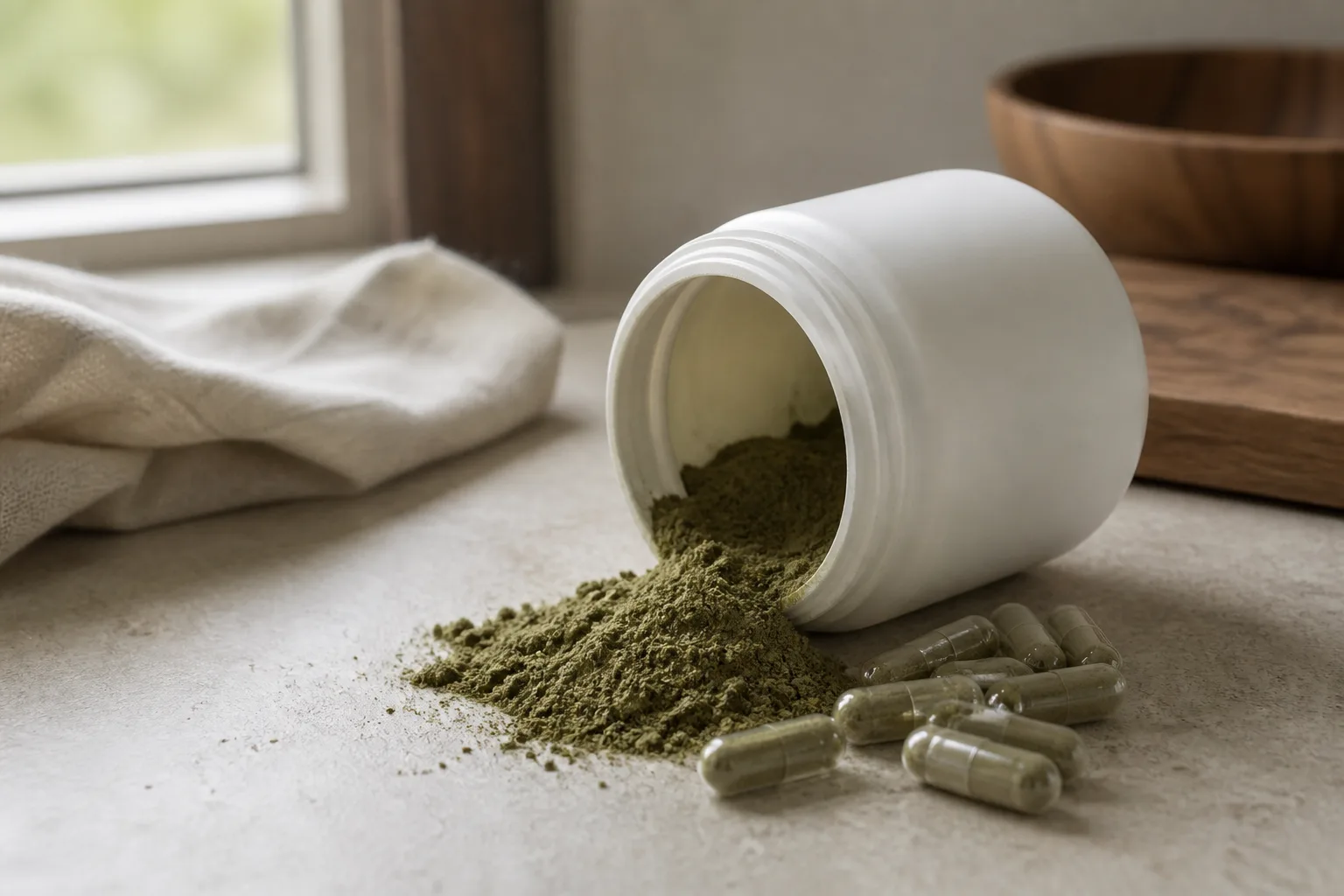
A human crossover trial: 12 subjects ate fresh broccoli sprouts, then, after a washout, took six broccoli supplement pills. Sulforaphane metabolites in urine ran about 5× higher on the sprouts, and peak plasma about 7× higher. Most pills lack active myrosinase, the enzyme the living plant brings with it. Clarke et al., Pharmacological Research 2011
Why drink powdered greens when you can eat them alive?
Educational summary of published research, not medical advice. Bioavailability depends on the supplement (some add myrosinase), preparation, and the individual.
Add them at the end, raw.
Most of what makes microgreens worth eating (texture, aroma, and heat-sensitive compounds) does not survive cooking. Treat them as a finishing ingredient: on eggs, folded into a salad, over a grain bowl, in a sandwich, or blended into a smoothie.
Rinse before eating. Cut what you need and leave the rest growing.
Sensible handling, and when not to eat them.
Fresh produce carries ordinary food-safety considerations: clean hands, clean tools, clean water, and rinsing before eating. Keep the growing area and any reusable parts clean between cycles.
Do not eat a tray that smells sour, is slimy, or shows fuzzy growth on the stems. Discard it and start again. If you are pregnant, immunocompromised, or feeding young children, follow standard fresh-produce guidance from your local food-safety authority. [5]
- [1] Xiao et al. (2012). Assessment of vitamin and carotenoid concentrations of emerging food products: edible microgreens. J. Agric. Food Chem.
- [3] Fahey et al. (1997). Broccoli sprouts: an exceptionally rich source of inducers of enzymes that protect against chemical carcinogens. PNAS.
- [5] U.S. FDA. Sprouts: What You Should Know (food-safety guidance distinguishing sprouts from other fresh produce).