
Good food starts with good questions.
What makes a crop grow well? How do light and time affect it? Explore the published research, our growing trials and academic collaboration, with the methods and limits beside each finding.
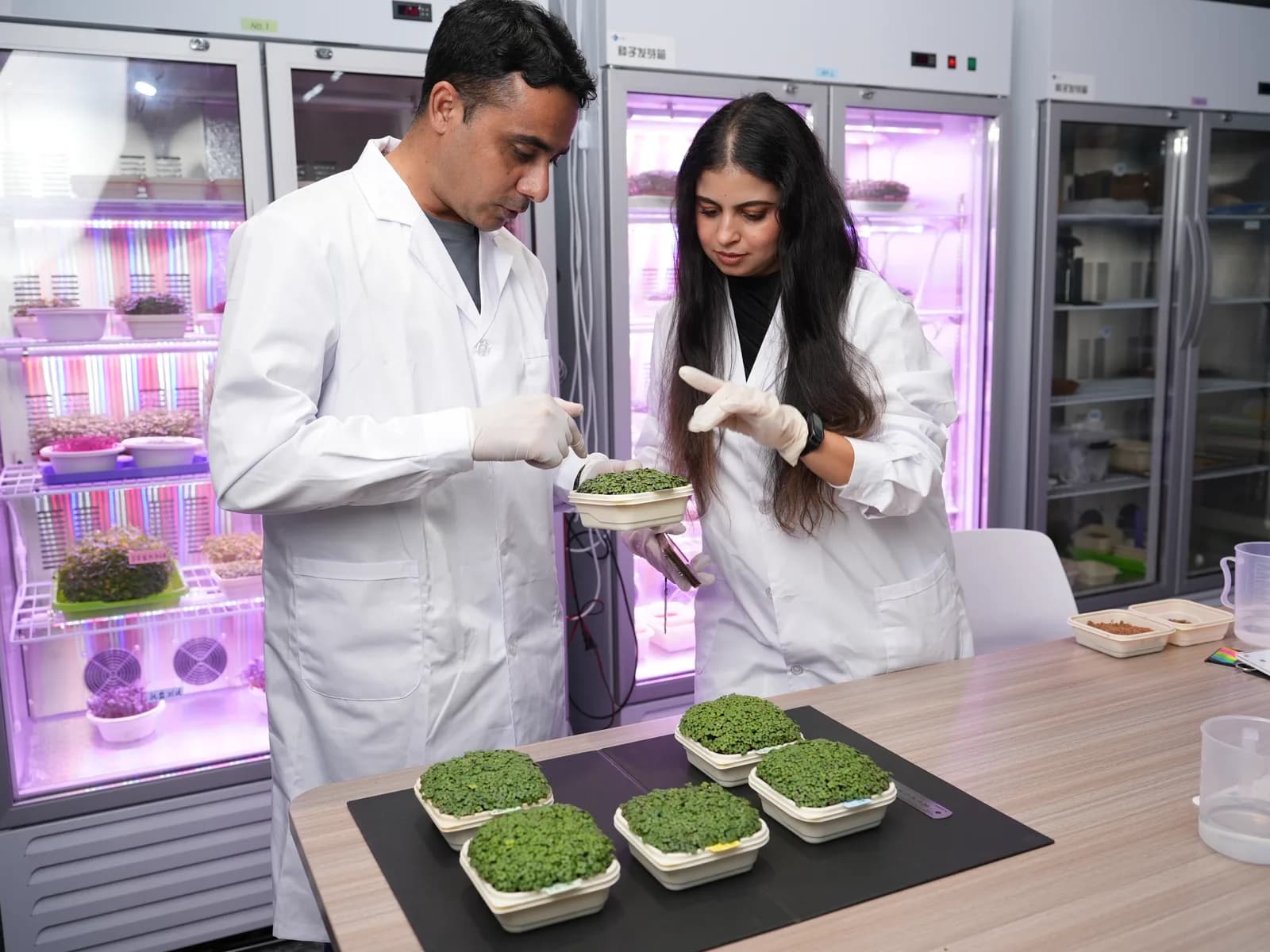
The growing conditions become part of the food’s story.
A seed carries possibilities. Light, the growing medium and harvest time help shape how the plant develops and which compounds accumulate. Published microgreen research finds differences between cultivars and growing conditions; there is no single nutrition multiplier for every crop.
- Light
- Light-grown and dark-grown pea shoots show different pigment and vitamin profiles. Kale research also explores responses to different LED conditions.
- Growing environment
- Broccoli studies show that mineral composition changes with the growing medium. A result from one setup is not automatically a result from another.
- Time
- Young and mature leaves can have different compound profiles. Younger does not mean higher in every nutrient.
Luya X1 automates light, watering and airflow. These studies explain why conditions matter; they do not measure the nutrient content of a Luya harvest. Predictive biology and nutrition or taste adjustment are planned for X1 Pro.
Explore the evidence and its limits →Different evidence answers different questions.
These layers are not interchangeable. A media article is not a study; a single household's success is not a success rate; a deployment in one environment does not describe every kitchen.
- Product & method
- How LUYA tests and decides. Explains our method and product version; it does not establish long-term health outcomes.
- Academic collaboration
- How outside experts participate. Describes their actual scope of work, never a blanket endorsement of the brand.
- Scenario validation
- How the product behaves in a specific environment. A case, not a general guarantee.
- Real households
- What families actually experienced. Individual evidence, not an overall success rate.
- Third-party observation
- What outsiders report or review. Coverage is not a scientific conclusion.
Where each layer stands today.
Our work includes internal trials, academic collaboration and learning from use in real kitchens. Each has a different role; here is the current record.
- Product & method: active
- Internal growing tests on current hardware, run by the LUYA growing-science team.
- Academic collaboration: agreement signed
- A formal research collaboration with the University of Connecticut is in place. Results will be published when available. This is a collaboration, not independent verification; LUYA’s Chief Agriculture Scientist is also a UConn faculty member.
- Scenario validation: in preparation
- Deployment trials in specialised environments are planned. Nothing is published until the project record and authorisations exist.
- Real households: recruiting
- Founder 100 Program is recruiting households. Selected applicants will be invited to purchase pre-production hardware and help shape the experience through real growing cycles.
- Third-party observation: limited
- We will link original coverage when it exists, rather than paraphrasing it into a claim.
What the wider literature does support.
LUYA did not discover that microgreens are nutrient-dense; published research did. Several crops have been measured with high vitamin and carotenoid concentrations by weight relative to their mature counterparts. [1] Broccoli has been studied specifically for glucoraphanin, the precursor of sulforaphane. [2]
It is also established that certain nutrients, vitamin C among them, decline during storage, at a rate that depends on crop, temperature and elapsed time. [3] And the growing environment itself, including light quality, is known to influence composition in this crop category. [4]
These are findings about microgreens as a category, from independent researchers. They are the reason LUYA works on this crop, not evidence about LUYA's own hardware or recipes.
How to read these findings.
- Food and health
- No LUYA product or content is intended to diagnose, treat, cure or prevent any disease.
- Human studies
- We have not run studies on health effects in people who use the system.
- Comparing foods
- We do not claim LUYA-grown food is more nutritious than any specific alternative.
- Growing variation
- Growing results vary by crop, tray and household conditions.
Luya Lab is the growing-science work behind the product: which questions we are trying to answer, how we test, and what stage each question is at.
How a factual statement gets onto this website: evidence levels, review, scope, expiry — and the rule that unapproved claims never reach a marketing page.
The scientists who develop LUYA's growing recipes and advise on microgreen nutrition, with their actual scope of involvement stated.
An explicit list of the things LUYA has not established: nutrient retention in our own system, health outcomes, long-term reliability, and more.
- [1] Xiao et al. (2012). Assessment of vitamin and carotenoid concentrations of emerging food products: edible microgreens. J. Agric. Food Chem.
- [2] Fahey et al. (1997). Broccoli sprouts: an exceptionally rich source of inducers of enzymes that protect against chemical carcinogens. PNAS.
- [3] Lee & Kader (2000). Preharvest and postharvest factors influencing vitamin C content of horticultural crops. Postharvest Biology and Technology.
- [4] Kyriacou et al. (2016). Micro-scale vegetable production and the rise of microgreens. Trends in Food Science & Technology.