LUYA
Luya Lab

Inside the growing lab.

In the lab, we grow trays side by side, change one condition and look closely at what happens. These tests help us develop growing recipes and decide which questions need further study.

Three microgreen trays side by side in a substrate comparison, labelled and dated
Mission

Make growing repeatable, then make it better.

The lab exists to serve two practical problems: can an ordinary household complete a cycle reliably, and can a controlled environment produce food that is better to eat than the same crop grown carelessly?

The team focuses on crop recipes, repeatability and the practical work of growing in a home appliance.

Open questions

What we are actively trying to answer.

What counts as a stable cycle?
Defining germination, canopy and harvest readiness precisely enough that software can judge them.
How should a recipe change by stage?
Which light, climate and irrigation changes actually improve the result, versus which are noise.
How consistent is crop-to-crop performance?
Repeatability across trays, devices and ambient conditions.
Does the environment change composition?
Whether controlled conditions measurably affect nutrition and flavour in our crops — the question that needs external validation before it can be claimed.
What makes households stop?
The failure modes that end a growing habit: cleaning burden, a bad cycle, tray supply.
How we test

Every result carries its conditions.

A test result without its conditions is not usable. Internal growing tests record the hardware version, the crop and seed lot, the recipe version, the ambient environment, the measurements taken, and the number of trays.

Results that only hold on one device, in one season, with one seed lot, are described that way.

The Growing Model

What shapes a plant’s growth, flavour and nutrition?

Our scientists compare crops and growing conditions to improve recipes. Luya X1 focuses on visual monitoring and automated growing. Biological predictions and nutrition or taste adjustment are planned for the future X1 Pro; this section describes the research behind that direction.

Twenty labelled microgreen trays photographed from above, each a different variety or treatment
A morning's labelled trays, the kind of record the Growing Model learns from.
01
Plant
A crop with known genetics and behavior.
02
Recipe
A defined environment: light, climate, water, nutrients.
03
Growth
A growing cycle, with timing that varies by crop.
04
Measurement
Vision and sensor data from every tray.
05
Test again
Compare the results and test a revised recipe before release.
Measure, compare, then test again
Bench results

What the bench work has settled so far.

These are internal growing trials run by our own team on our own hardware, the first evidence layer, not independent research. Each result below is a controlled comparison with the crop, the treatment and the measured outcome stated.

The research list is broader than the launch range of 10 single varieties and 2 mixes. Fourteen varieties have been through the bench so far: radish, red cabbage, kohlrabi, arugula, kale, basil, mustard, broccoli, wheatgrass, amaranth, pea, cilantro, beet and sunflower.

Dr. Oumayma Shaiek holding a steel rule upright in a tray of microgreens to measure canopy height, a colleague beside her writing the reading on a clipboard, growth chambers lit magenta behind them
Dr. Oumayma Shaiek measuring canopy height on a tray, the reading written down as it is taken. Every tray on the shelves behind is a variety, a treatment and a date, the work behind the numbers below.

Which growing substrate produces the best crop?

Red cabbage · 3 substrates
SubstrateHeight (cm)Fresh weight (g/tray)
Cocopeatchosen6.9437.51
Peat moss6.4531.09
Jute mat5.4924.98

Cocopeat won on both measures and became our substrate — it holds water, keeps airflow, is light enough for an indoor appliance, and carries few enough native nutrients that we can control EC precisely.

Organic or inorganic nutrient solution?

Arugula · equal EC
TreatmentHeight (cm)Fresh weight (g)
Control (water only)3.4915.12
Organic, EC 1.03.4312.56
Inorganic, EC 1.0chosen4.3521.22

At matched EC the inorganic solution produced taller stems and 69% more fresh weight than organic, and grew noticeably less fungal and bacterial contamination — which matters more in a sealed countertop appliance than in a field.

How do nutrient strength and seed density interact?

Seed density 0.6 vs 1.0
TreatmentHeight (cm)Fresh weight (g)
Control · SD 0.62.394.93
EC 1.0 · SD 0.65.4820.66
Control · SD 1.02.649.88
EC 1.0 · SD 1.0chosen6.0321.29

Nutrient strength moved the result far more than seed density did: without feeding, doubling the seed doubled yield; with feeding, both densities landed above 20 g. Sowing more seed is not a substitute for a correct recipe.

Water level at germination

Germination was compared at 100, 120 and 140 ml. 120-140 ml, with a light spray during germination, gave the best rate: the band the recipes now use.

Beet: a crop that fought back

Beet germinated poorly in cocopeat and grew twisted stems. Covering the seed with vermiculite fixed both — one of several crop-specific rules that only surface by running the crop.

Tray materials, still open

Plastic, sugarcane and corn-starch trays are under test, alongside composites with a PHA/PBS shell and a bamboo, sugarcane and wood-fibre core. No conclusion yet.

Next on the bench

Biofortification trials (calcium, iron, selenium, zinc, iodine and vitamin C), and whether mild pre-harvest stress raises antioxidant and anthocyanin levels without costing yield.

Twenty labelled trays photographed from above, each a different variety or treatment at a different stage of germination
One morning's trays. Every label is a variety, a density and a date.
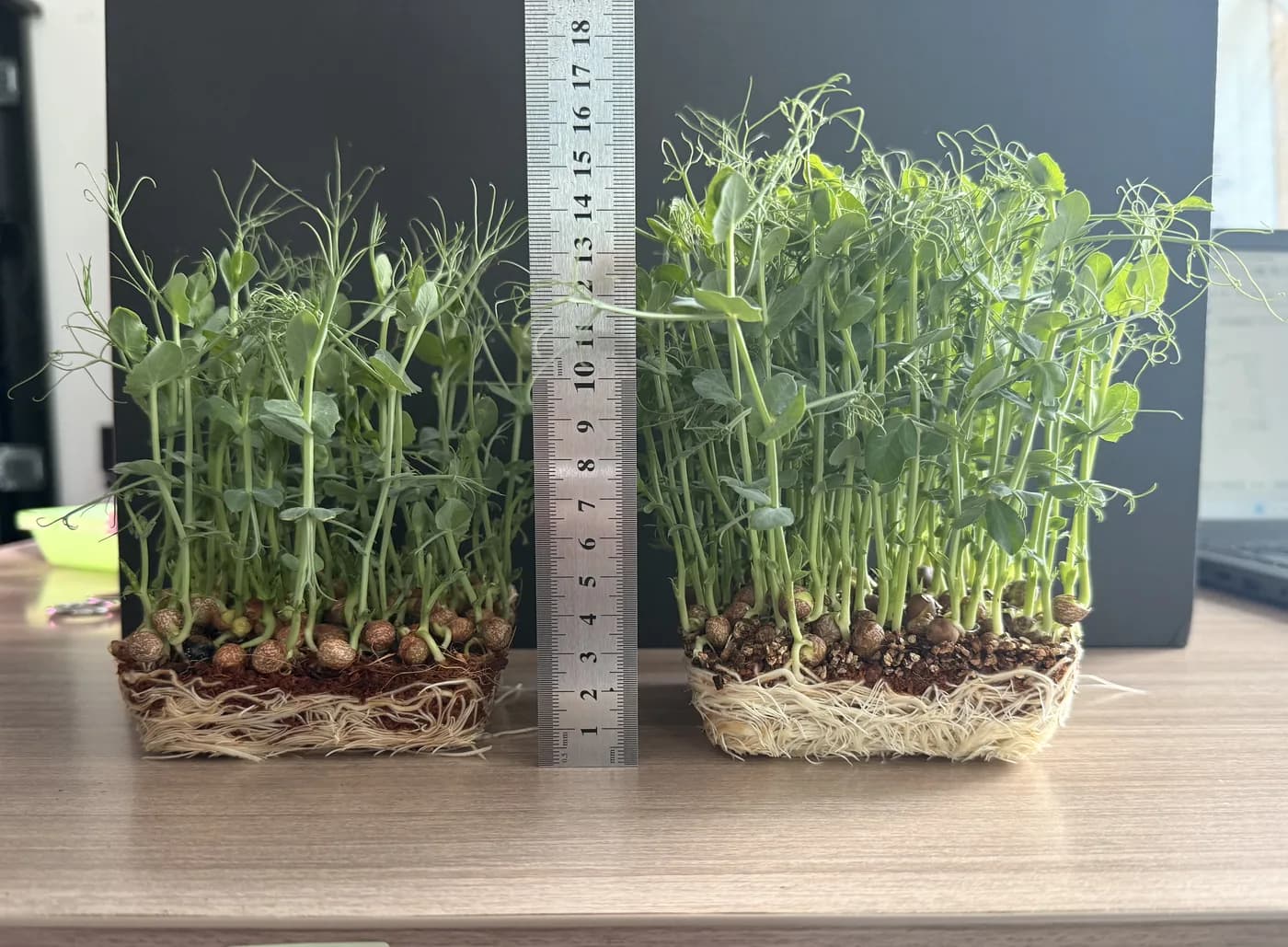
Two pea microgreen trays side by side against a steel rule, roots and seed coats visible, labelled by treatment
Three treatment trays photographed from above for comparison, each labelled
Individual seedlings laid out along a steel rule to measure stem length
Seed being weighed out on a bench balance before sowing
Gloved hands setting a tray of brown growing substrate onto a bench balance, a second tray held ready beside it, tweezers and a colour reference card on the bench
Substrate weighed into each tray before sowing, so density is a number rather than a habit.
Two researchers in lab coats at adjacent desks in the lab office, one working at a laptop in the foreground, monitors and a notebook on the desks
The other half of a trial, and the slower half: readings entered, checked and argued with before any of it becomes a claim.

Seed is weighed before sowing; seedlings are laid against a rule; trays are photographed and labelled with treatment and date, the record that turns an impression into a measurement.

These are internal trials, run by our own team on our own hardware, and they are presented as exactly that. They establish how we grow, not what the food does in a human body, which is a different kind of study we have not run.

Status

Where the work is today.

Luya X1 uses a visual model to observe the plants and automate growing. Biological growth prediction and nutrition or taste adjustment are planned for Luya X1 Pro, a later version; they are not included in this X1 release.

Current work is internal: repeatability testing on current hardware, recipe development across the validated crop library, and building the measurement pipeline that turns camera and sensor data into usable growth records.

Beyond the bench, a formal research collaboration agreement with the University of Connecticut is signed. Nothing from it is published yet — when there is a result, it appears here with its conditions, like everything else.

Research notes, published methods and any external validation will appear here as they are reviewed. Nothing is posted while a result is still a draft, and an internal test will never be presented as an independent study.

What's next

The bench can only take this so far.

Everything above was run by our own team, on our own hardware, under conditions we controlled. That is the first evidence layer and it has a ceiling: it cannot tell us what happens in a real kitchen, on a real schedule, in a household that did not design the machine. The second layer is Founder 100 Program, a first cohort running real cycles and reporting what actually happens, including the failures.