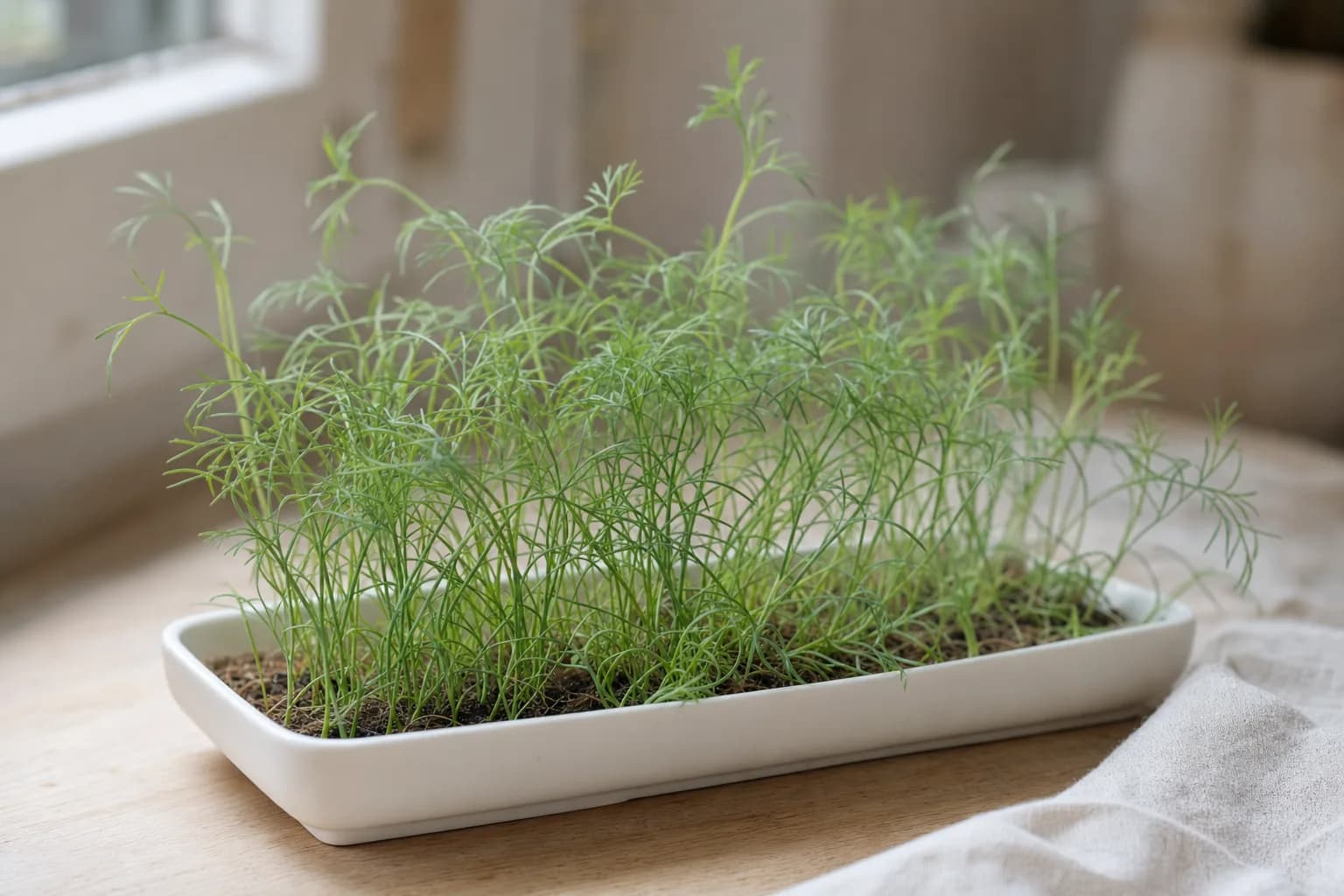
Some microgreens taste like a milder version of the mature plant. Dill is not one of them. Cut a tray and the room smells like dill immediately — the aroma compounds are all there, in feathery leaves a fraction of the size.
What it tastes like
Dill. There is no gentler way to put it, and that is the point. The flavour is fully formed at microgreen stage, which makes it useful in exactly the places the mature herb belongs: eggs, cucumber, potatoes, and fish — salmon above all.
Because it is fully formed, it is also easy to overuse. Dill is an accent, never a base.
The buying decision that matters most
Dill comes in several garden varieties — the tall traditional kind, the compact Dill Bouquet, and the neat dark-green Fernleaf. As microgreens, all three produce the same feathery leaves and the same aroma.
What differs enormously is seed price. Fernleaf dill seed can cost around twenty times what the other varieties cost, and at microgreen stage you are not growing the plant long enough to benefit from what makes Fernleaf special in a garden.
Buy the ordinary microgreen-grade dill seed. This is one of the few cases where the expensive option is straightforwardly the wrong one.
Growing it
- Sow thinly. Dill's feathery foliage is airy rather than dense, and a crowded tray traps moisture in a crop that has plenty of surface to hold it.
- Give it airflow. Same reason. Our piece on why microgreens keep molding covers the mechanics.
- Cut with scissors, low. The stems are fine and the leaves tangle; grabbing a handful gives you an uneven cut and bruised foliage.
How to use it
- On salmon — the pairing dill exists for, and microgreen dill delivers it without the woody stems.
- In egg dishes, added off the heat.
- With cucumber and yoghurt, where its job is aroma rather than bulk.
- On potatoes, hot, scattered at the table.
Like fennel, dill is a finishing herb with a strong personality — the two are worth keeping apart on the same plate rather than combining.
Timing and variety notes draw on Cooking With Microgreens by Sal Gilbertie and Larry Sheehan.