Mizuna belongs to the mustard family — Brassica juncea, the same species as the mustard greens that make people wince. Somewhere along the way this Japanese cultivar traded most of that heat for sweetness, and the result is one of the most useful crops in the catalogue.
What it tastes like
Fresh, sweet, and mustardy in a way that reads as brightness rather than burn. It adds zing to a salad without taking it over, which puts it in a different job from mustard proper or radish — those are accents you deploy carefully; mizuna can carry a larger share of the bowl.
It is sometimes sold as California peppergrass, which describes the flavour better than the name mizuna does.
What it looks like
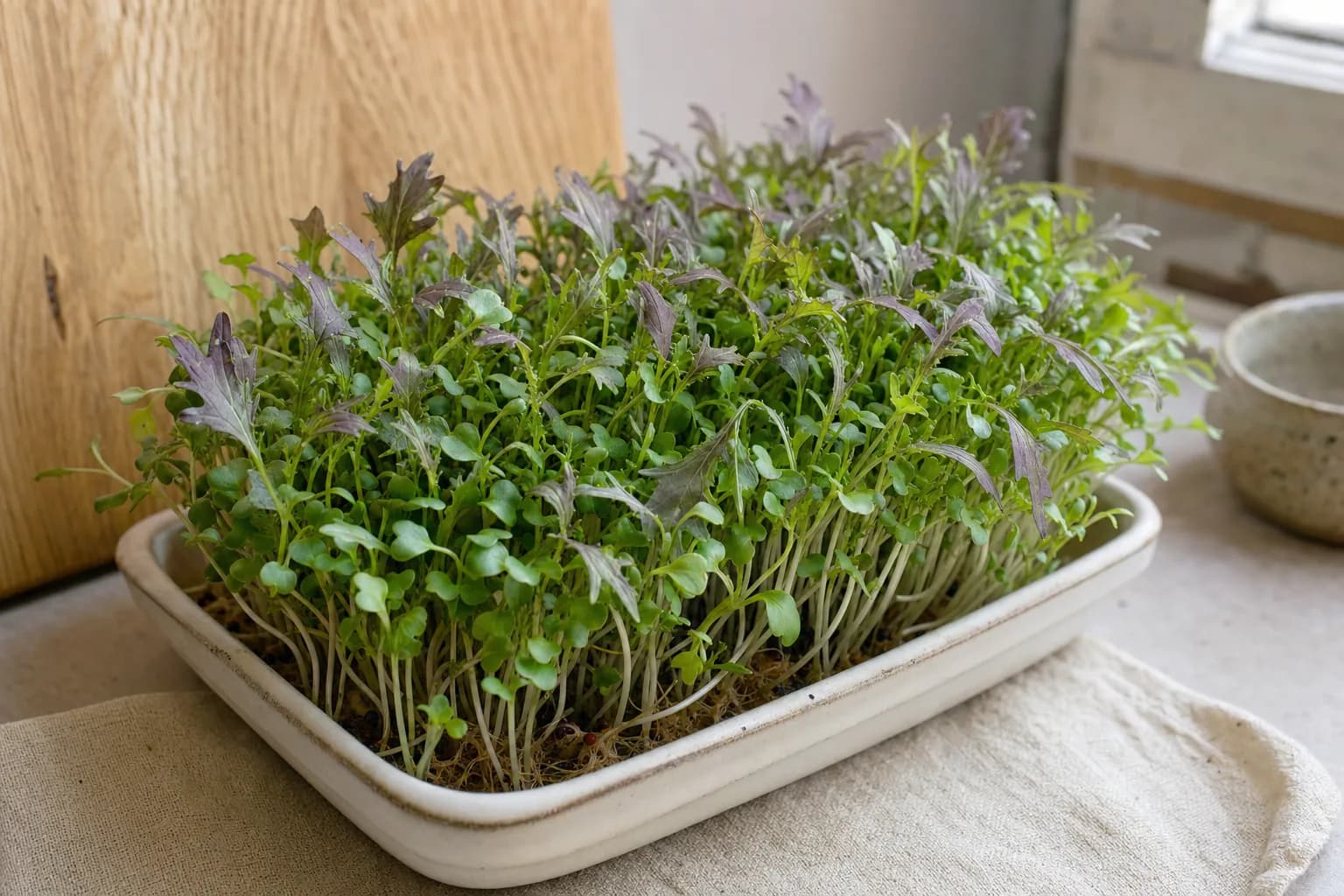
White stems, bright green cotyledons, and — as the true leaves come in — serrated edges with a blush of purple. The 'Red Coral' type is the one usually grown as a microgreen and it is genuinely attractive in a tray, which matters if you are the one looking at it every morning.
Growing it
Easy and fast, like most brassicas.
- Germination in 3 to 5 days, and highly productive per tray.
- Three usable harvest points, which is unusual: a micro crop at 3 to 5 days after germination, a petite green at around 14 days, and a baby leaf at about 21. You can decide late what you are growing.
- Grows alongside its relatives. Broccoli, kale and kohlrabi share close enough timing to run on the same schedule.
How to use it
- As a salad base, which most peppery crops cannot do.
- In an Asian-leaning blend, where its sweetness balances sharper leaves.
- On rice bowls and noodles, added at the end so the heat of the dish does not wilt it.
- In sandwiches, where it does the job lettuce does but with flavour.
How much of it survives digestion
Red mizuna is one of the few microgreens with a published measurement of what actually makes it through the gut. Researchers ran it through the standardised INFOGEST digestion model and found that 46.28% ± 1.35% of its antioxidant activity was bioaccessible by the total-phenolic-content assay. [1]
Slightly under half. That is worth sitting with, because the interesting number in nutrition is rarely what an assay finds in the leaf — it is what is still available after digestion. A crop can be genuinely rich in phenolics and glucosinolates and still deliver a fraction of them.
The same study encapsulated the microgreens in sodium alginate and got the bioaccessible figure up to 83.64% ± 9.02%. [1] That is a laboratory formulation, not a serving suggestion — nobody is proposing you eat your mizuna in capsules, and we mention it only because it demonstrates that the loss is a delivery problem rather than a limit of the plant.
What it means practically is modest and worth saying plainly: mizuna is a good source of these compounds, roughly half of that measured activity is available to you, and no preparation you can do at a kitchen counter has been shown to change that number.
References
- Enhanced bioaccessibility of encapsulated red mizuna microgreens: A phytochemical profiling and in vitro digestion study. Food Bioscience. 2025;71:106249. https://doi.org/10.1016/j.fbio.2025.106249
Timing and variety notes draw on Cooking With Microgreens by Sal Gilbertie and Larry Sheehan.