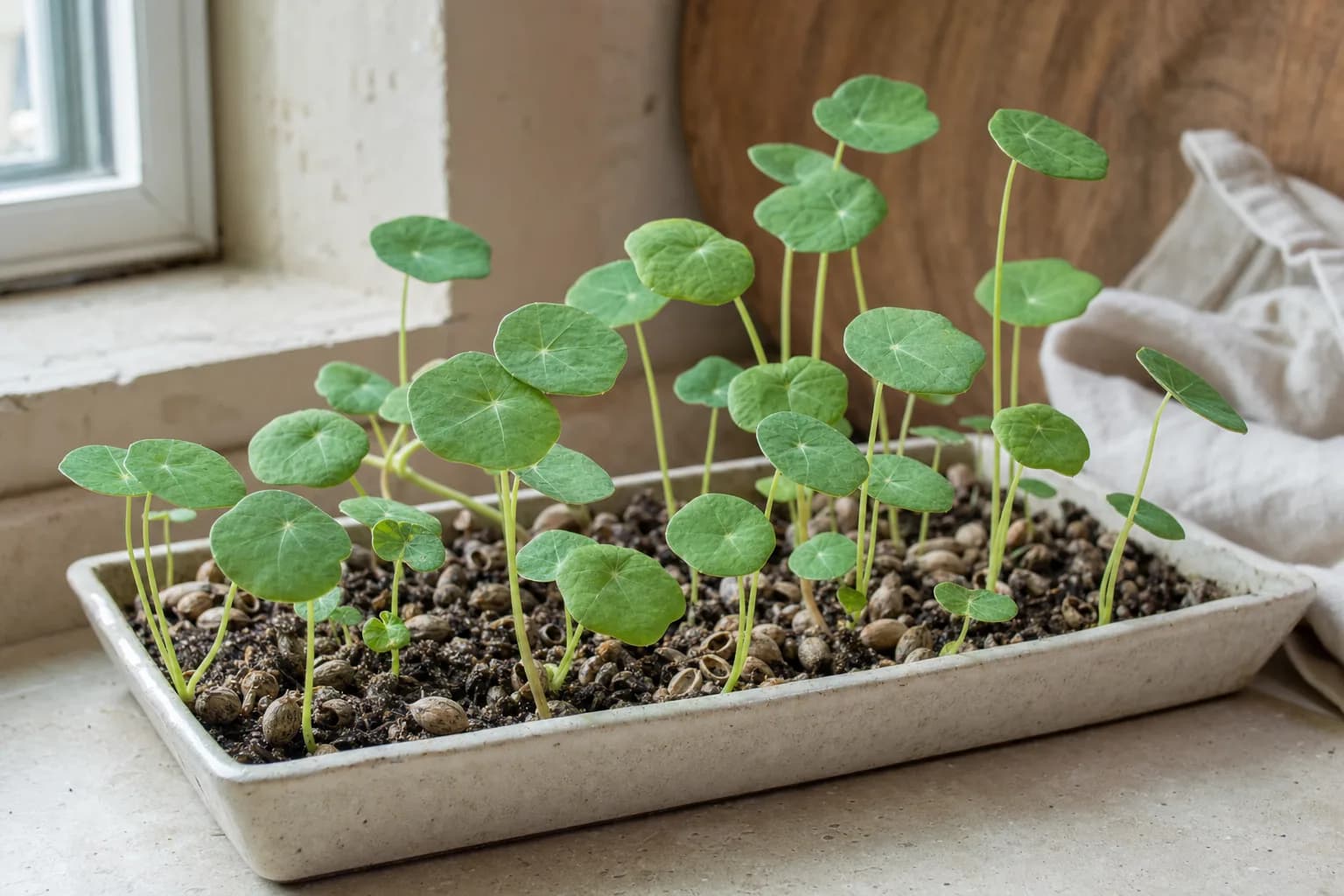
Most microgreen seed is a nuisance to distribute. Nasturtium is the opposite problem: the seeds are large, hard and easy to place individually — which makes this one of the few crops where you can sow deliberately rather than scatter and hope.
The leaves that come up are round, pale green, roughly the size of a coin, and they taste considerably more interesting than they look.
What it tastes like
Brisk and nutty at first, and then a peppery afterbite that arrives a moment later. It is not the immediate heat of radish or mustard — it builds, and it lingers. In a mixed salad it registers as freshness followed by a small sting.
That afterbite means nasturtium belongs in spicy blends rather than mild ones, alongside radish and mustard rather than pea shoots.
Growing it
Easy, with one detail that decides whether you get an even tray.
- Bury the seed properly — about ¾ inch. This is the rule that matters. Large seed left shallow germinates unevenly and over a spread of days; buried to depth, the tray comes up together, which is what you want when you intend to cut it all at once.
- No soaking needed. Large hard seed usually invites an overnight soak. Nasturtium does not require it and will germinate in four to seven days regardless.
- Rows or clusters both work. Unusually forgiving on sowing pattern, because the seed is big enough to place where you want it.
- Harvest at 15 to 20 days. Slower than a brassica, faster than fennel.
Note that you are growing this for leaves, not flowers. Nasturtium flowers need real summer sun and heat and will not appear on an indoor tray at this stage — they are a different crop grown a different way.
How to use it
- In sandwiches and wraps, where the round leaves keep their shape and the afterbite cuts through mayonnaise and cheese.
- In a spicy blend. It belongs with the peppery family — see the spicy microgreens guide for how that group behaves.
- On rich or fatty food, which is where the delayed heat does most work.
- Raw, always. The pungency is volatile and heat removes it.
If you grow them on
Nasturtium is one of the few crops where letting some plants mature has a separate payoff: grown to full size in summer sun they produce edible flowers, and the fresh seeds that follow have the same tangy character as the leaves. Pickled, they are a traditional caper substitute.
None of that is a microgreen job. It is just worth knowing that the packet in your hand can be two different crops.
Timing and variety notes in this article draw on Cooking With Microgreens by Sal Gilbertie and Larry Sheehan, cross-checked against our own trays.