This article is for general education and is not medical advice. Talk to your doctor before changing your diet for a health condition or if you take medication.
Researchers in West Bengal took one batch of radish seed, split it across soils collected from eight districts, and standardised everything else — same seeds, same watering, same harvest window. The microgreens heavy metals question they were chasing has a reassuring answer. The mineral answer is the surprising one: zinc in the finished crop ranged from 44.21 to 158.92 mg/kg depending only on which district's soil it grew in. Same seed. Three and a half times the zinc. [1]
That is the whole lesson of this study in one number. A microgreen is a seed's stored energy plus whatever the growing medium hands it, harvested before the plant has had time to do much else. It is an unusually honest reporter of its inputs.
What the study actually measured
Radish microgreens were grown in soils from eight districts, harvested at the normal 7 to 14 days, and analysed by flame atomic absorption spectroscopy for four minerals and three heavy metals. [1] The mineral spread was wide:
| Element | Range across eight soils |
|---|---|
| Calcium | 1091.43 – 1481.17 mg/kg |
| Zinc | 44.21 – 158.92 mg/kg |
| Manganese | 66.21 – 83.47 mg/kg |
| Selenium | 0.32 – 1.01 mg/kg |
Germination tracked the soil too. The alluvial soils were the fastest, with one district reaching 90% germination, while the most acidic soil ran visibly behind — half the tray still finishing at day 10. [1]
What the heavy metals in these microgreens measured
Lead and cadmium came in at 1.57 to 11.21 micrograms per kilogram — note the unit change, three orders of magnitude below the minerals above. Chromium sat below toxic limits. The authors calculated a Hazard Index for each district, combining the target hazard quotients for chromium, cadmium and lead, and every district came out below 1. [1]
Below 1 is the threshold at which non-carcinogenic risk from a dietary exposure is considered unlikely. Eight soils, eight results under the line.
So: no, these microgreens were not concentrating dangerous amounts of heavy metals, and there is no reason to treat a tray of radish shoots as a contamination risk. If you came here because something you read implied otherwise, that is the answer.
The more useful finding is the one about inputs
The heavy metals were all low, but they were not identical, and they moved together — the authors found a positive correlation between them, which points to a shared source and a shared uptake route. Combined with the 3.6-fold zinc spread, the picture is consistent: the plant is drawing from the medium, and what the medium contains is what shows up.
That cuts both ways. It is why the same crop can be a good selenium source in one place and a poor one 200 kilometres away. It is also why the sensible question about a microgreen is never "is this crop safe" in the abstract — it is "what is it growing in, and what is it being watered with."
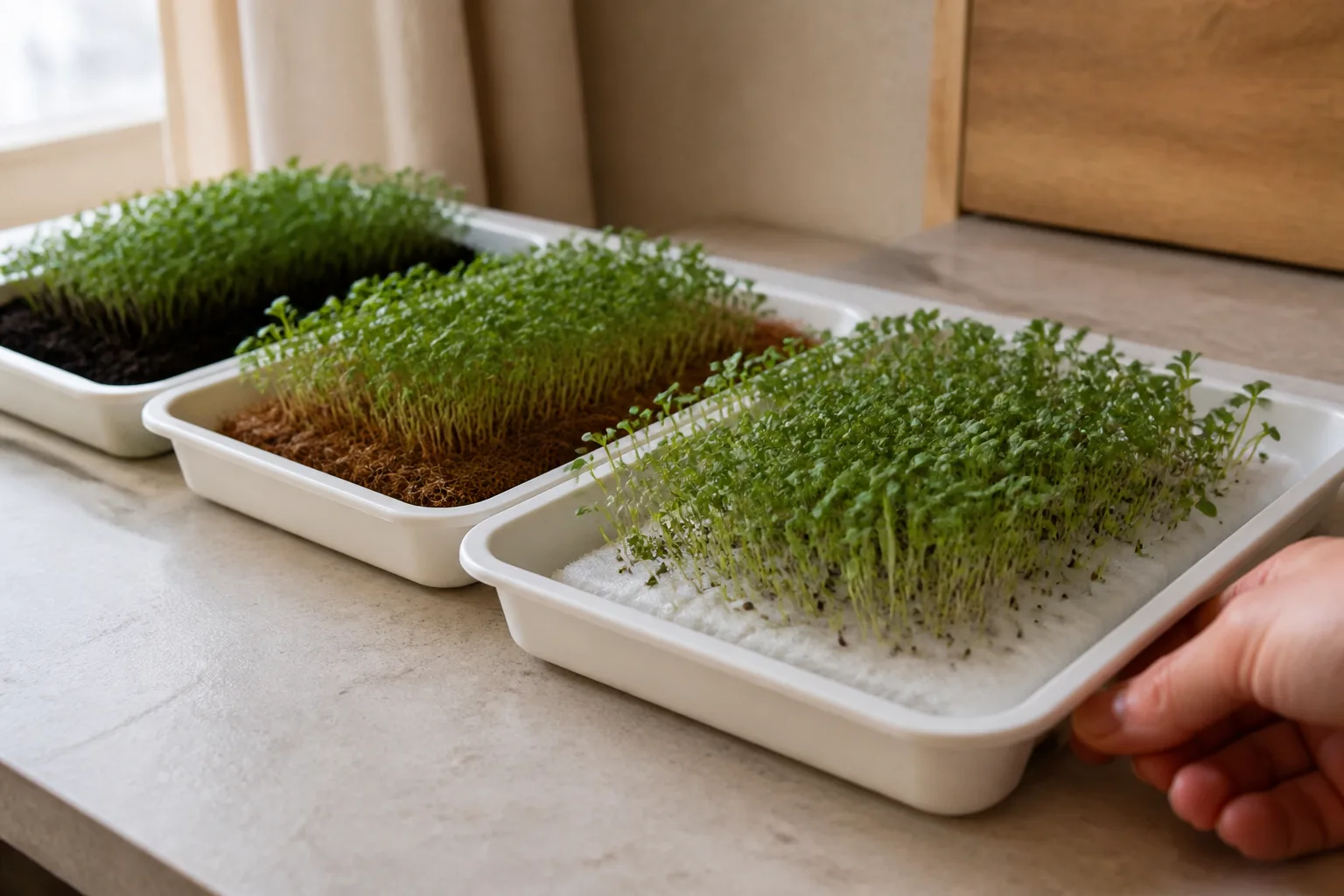
For anyone growing at home, that reframes the decision. The choice of growing medium is not only about water-holding and root anchorage; it is the single largest determinant of the mineral profile of what you harvest. A soilless medium with a known composition and clean water gives you something a bag of unspecified garden soil cannot: a known input.
What this study does not tell you
One crop — radish. One region. Field soils, not the soilless media most indoor growers use. Bioavailability was not measured, so "1481 mg/kg calcium in the tissue" is not the same claim as "1481 mg/kg calcium your body can use"; the authors say so themselves and flag in vivo bioavailability as the next thing that needs doing. [1]
We have not run this measurement on our own crops. When we do, the numbers will go on the record whatever they say.
The practical version
- Heavy metal risk in microgreens is low, and one careful multi-soil study found it below the hazard threshold everywhere it looked. [1]
- Mineral content is not a property of the crop. It is a property of the crop plus the medium, and the medium can move it several-fold.
- Know your inputs. Medium and water are the two variables that decide what ends up in the tray.
- Seed is a separate question from medium, and it is the one with the better-documented risk — see seed safety.
References
- Hazra S, Chakraborty A, Giri S, Sarkar A, Adhikari T. Agroclimatic variation in mineral and heavy metal levels of Raphanus sativus L. microgreens grown in West Bengal. Journal of Trace Elements and Minerals. 2026;15:100278. https://doi.org/10.1016/j.jtemin.2026.100278