Reviewed by Dr. Shaiek, Plant & Growing Scientist at Luya. Educational content, not medical advice.
The standard advice for raw greens is to wash them thoroughly. For microgreens that advice is not wrong, but it is aimed at the wrong target — and the reason is a word most people never encounter: internalization.
During germination, bacteria present on or around the seed can be taken up into plant tissue rather than remaining on the surface [1]. Once inside, they are past the reach of rinsing, of a salad spinner, and of the produce washes sold for the purpose. Germination conditions — warm, wet, nutrient-rich, days long — actively favour this happening [1].
So the question stops being "how do I clean these?" and becomes "what went into the tray?"
The seed is the control point
Across the documented contamination record for sprouts and microgreens, most cases are associated with seed contamination [1]. Pathogens enter the agricultural chain primarily via animal faeces, and then reach growing systems through water, soil, compost and — most consequentially — seed [1].
There is also no comfortable threshold. When researchers contaminated growing systems deliberately, how much pathogen reached the edible plant depended on the pathogen and the crop, not on how heavily the source was contaminated [2]. A lightly contaminated lot is not proportionally safer.
This is why seed sourcing outranks every kitchen habit you could adopt afterwards.
What to ask of a seed supplier
- Is this seed intended for sprouting or microgreen production? Garden seed is grown, stored and sometimes treated for a different purpose, and is not handled to the same microbiological standard.
- Is it lot-tested, and can you see the result? Testing seed lots for pathogens is the industry's main control, and a supplier who does it will say so.
- Is there a lot number? Traceability is not a formality — it is what makes a problem stoppable instead of mysterious.
None of this is exotic. It is the same reasoning behind buying pasteurised juice for a pregnant person: control the input, because you cannot fix it downstream.
What the growing cycle does to what is already there
Some of it dies. Researchers irrigating microgreens with contaminated water followed the pathogens across a 14-day cycle and saw populations fall, with the lowest counts on harvest day — but the pathogens persisted throughout, and how much depended on the water source [3]. The behaviour is variable enough that a 2026 paper built a quantitative model for Salmonella Enteritidis in a controlled growing system rather than relying on a rule of thumb [4].
The practical reading: growing conditions are not a decontamination step. They are a period during which whatever arrived is doing something, usually declining, sometimes not.
What is still worth doing in your kitchen
Rinsing remains sensible for surface contamination, dust and substrate. Beyond that, the things that help are unglamorous:
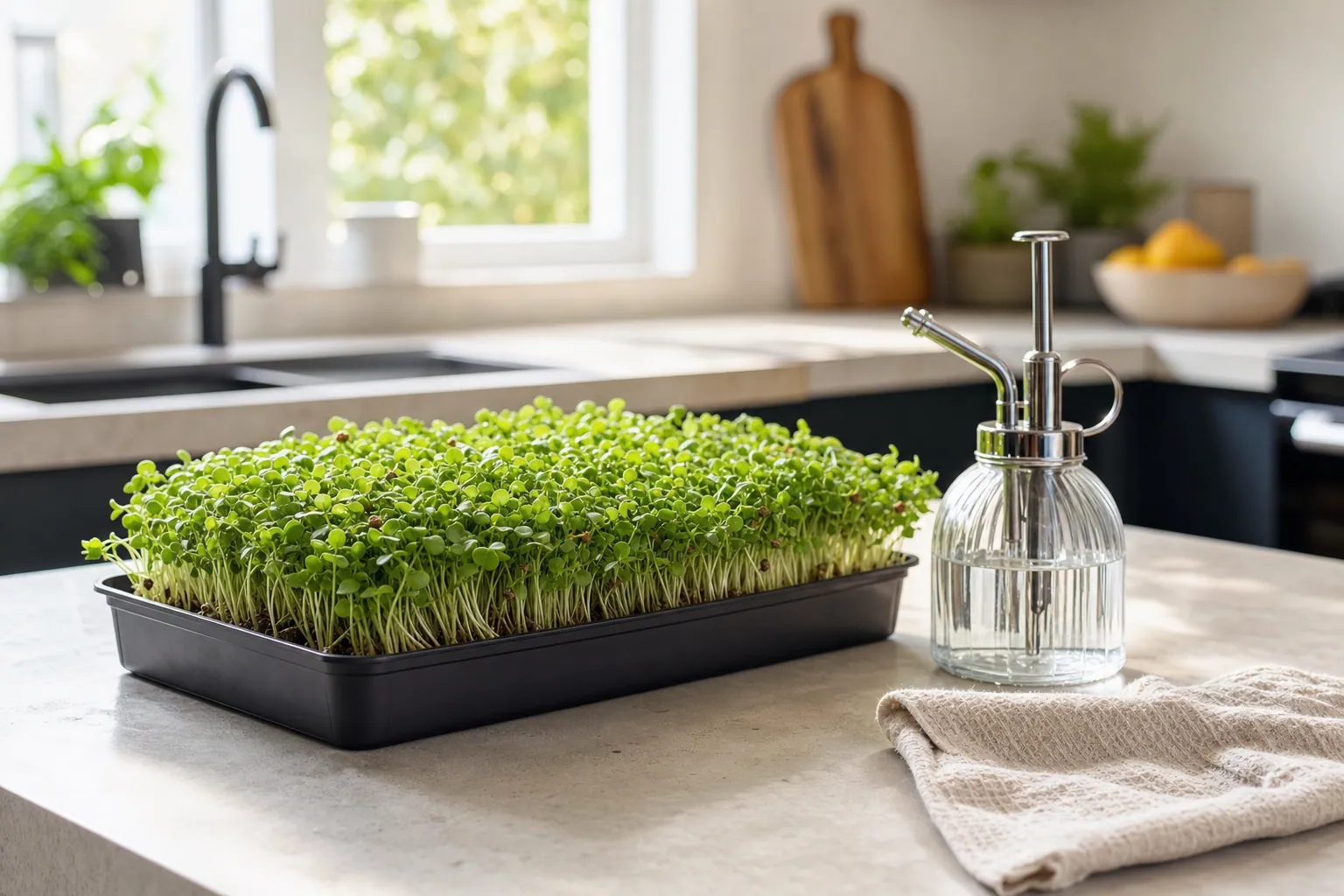
- Clean trays and reservoirs between every cycle. Residue is a place for populations to carry over.
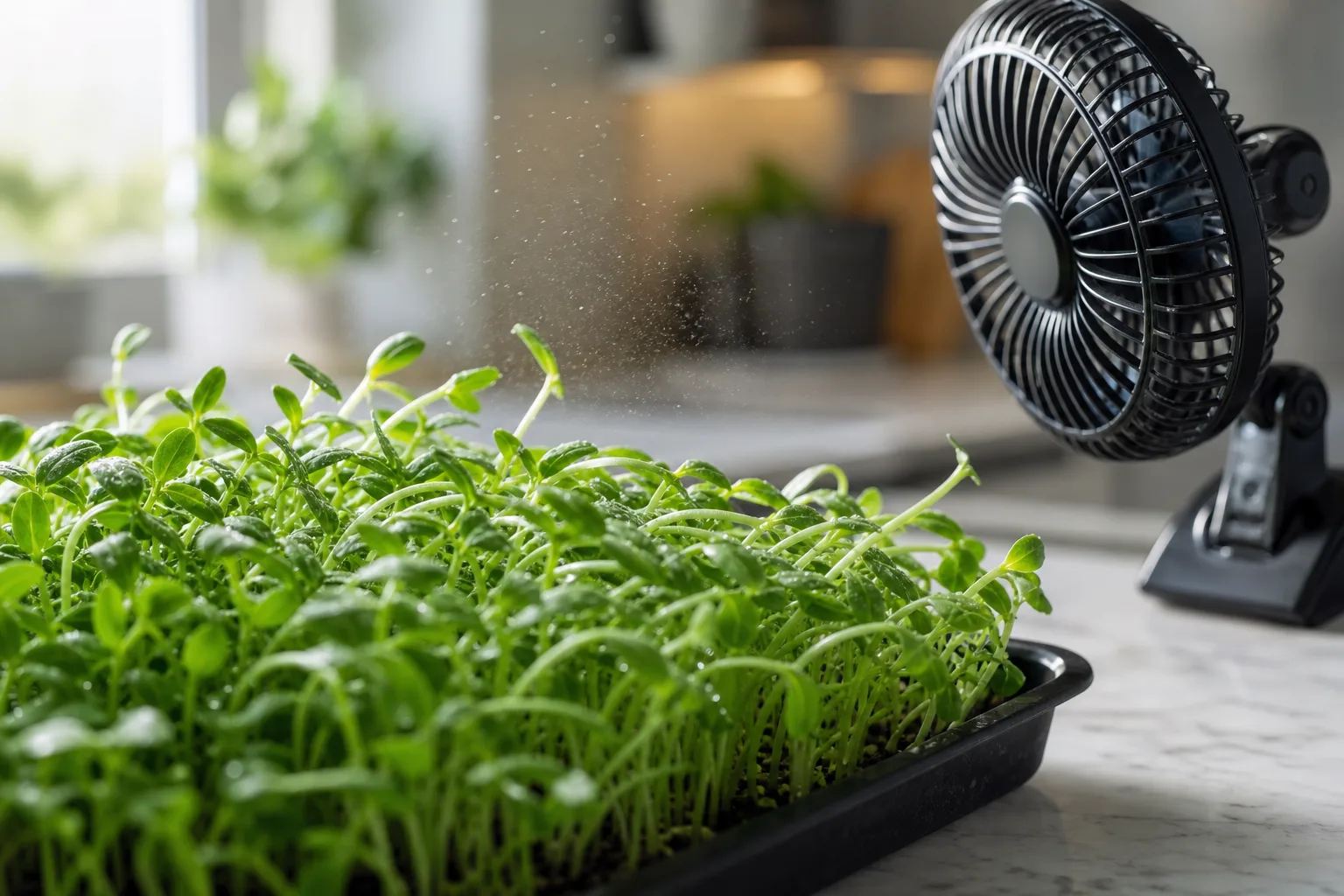
- Do not overwater, and keep air moving. The same conditions that produce mould suit bacteria.
- Harvest with clean tools, into a clean container, and eat them soon. Time at room temperature is growth time.
- Refrigerate promptly if you are not eating immediately — see harvest and storage.
The honest limit of any home system, including ours
A home growing system shortens the chain: no commercial irrigation shared with other operations, no distribution, no days between cutting and eating. Those are real reductions in exposure.
It does not touch the seed. We are not going to tell you a machine makes raw food sterile, because it does not, and because a company that oversells safety is the last company you should trust on it. What a closed system can do is control the water, the substrate and the equipment, and make the seed lot a known quantity rather than an anonymous one. The rest is the same biology it has always been.
For the outbreak and recall record behind all of this, see are microgreens safe?
Sources
- Xavier IB, et al. Understanding food safety on sprouts and microgreens: contamination routes, outbreaks and challenges. Food Research International 2025;214:116589. https://doi.org/10.1016/j.foodres.2025.116589
- Transfer of Salmonella, Escherichia coli O157:H7 and Listeria monocytogenes from contaminated sources to microgreens. International Journal of Food Microbiology 2024;414:110612. https://doi.org/10.1016/j.ijfoodmicro.2024.110612
- Persistence of foodborne bacterial pathogens on microgreens and soil irrigated with contaminated water. Journal of Food Protection 2025;88:100594. https://doi.org/10.1016/j.jfp.2025.100594
- Salmonella in microgreens: quantitative modeling of Salmonella Enteritidis in a controlled growing system. Food Research International 2026;235:119209. https://doi.org/10.1016/j.foodres.2026.119209