Radish is ready in a week. Celery takes about four. That ratio is the single most important thing to know before you commit a tray, and it is also the reason almost nobody grows it.
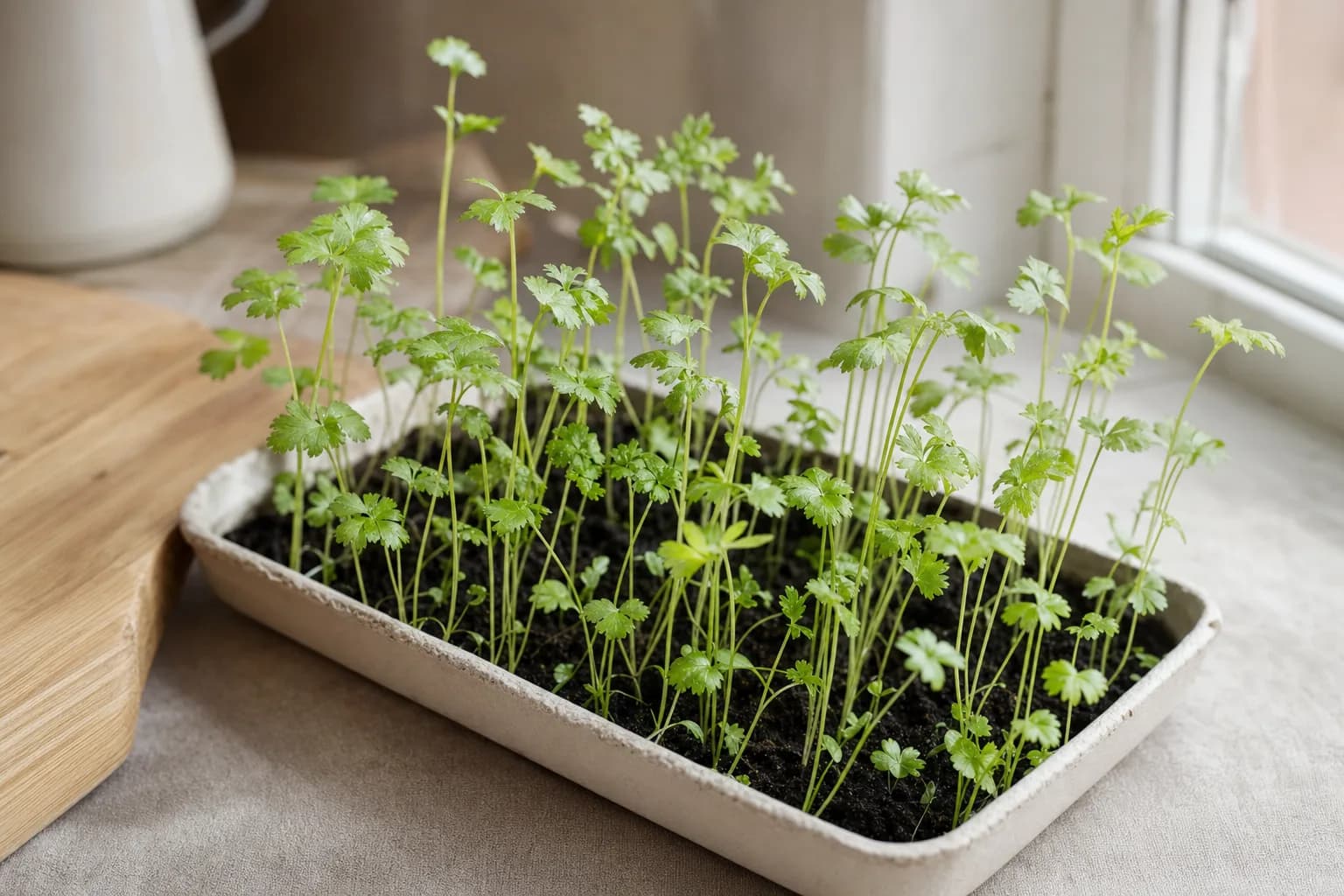
Grow it anyway, if you cook. Cutting celery — the name the trade uses for celery grown this way — produces slender stems and small pale-green leaves that carry the full, concentrated flavour of the mature vegetable. There is no substitute for it in the microgreen catalogue.
What it tastes like
Celery, unmistakably, and more intensely than the stalks in your fridge. The leaf is where most of celery's aromatic character lives; the crunchy ribs most people think of as celery are largely water and texture.
Which means a small handful of celery microgreens does something a whole stalk cannot: it adds the flavour without adding the volume or the stringiness. In a soup, in a stock, in a potato salad, that is a genuinely different tool.
Growing it
This is a patient crop and it behaves differently from the fast brassicas most guides are written around.
- Germination takes 10 to 12 days. Radish sown the same morning will be finished before celery has properly started. Do not conclude the seed is dead at day six.
- Sow in rows, not scattered. Celery grows slowly and spreads as it goes; scattered sowing produces a tangle that is awkward to cut cleanly.
- Harvest at about four weeks, once it has reached its true-leaf stage and roughly 3 to 4 inches. Left to five or six weeks it becomes a petite green rather than a microgreen — still good, just a different product.
- Sow thinly. A month under humid conditions is a long time for a dense mat to stay healthy, and the failure mode is mould. Our seed density guide covers the general rule; celery sits well below the average.
Celery seed is also small enough that even distribution is a real problem — the techniques in sowing tiny seeds evenly apply directly.
How to use it
Raw, and late. Heat drives off exactly the volatile aromatics you grew it for.
- Finish a soup with it. This is the best use. Stir it in off the heat and the bowl tastes as if it had a fresher base than it did.
- In egg dishes and potato salad, where celery belongs but the texture of chopped stalk does not.
- On seafood. Celery and shellfish is an old pairing for good reason.
- In a blend, as the accent. It is too assertive for a base and too interesting for an edge — see how to blend microgreens.
Is it worth four weeks?
If you grow one tray at a time and want maximum output, no — grow pea shoots. If you have capacity for a slow crop running alongside the fast ones, celery is the one that changes what you can cook rather than just adding more green to the plate.
Young celery looks a lot like a delicate coriander at this stage, which is worth knowing if you grow both and label carelessly.
Timing and variety notes in this article draw on Cooking With Microgreens by Sal Gilbertie and Larry Sheehan, cross-checked against our own trays.