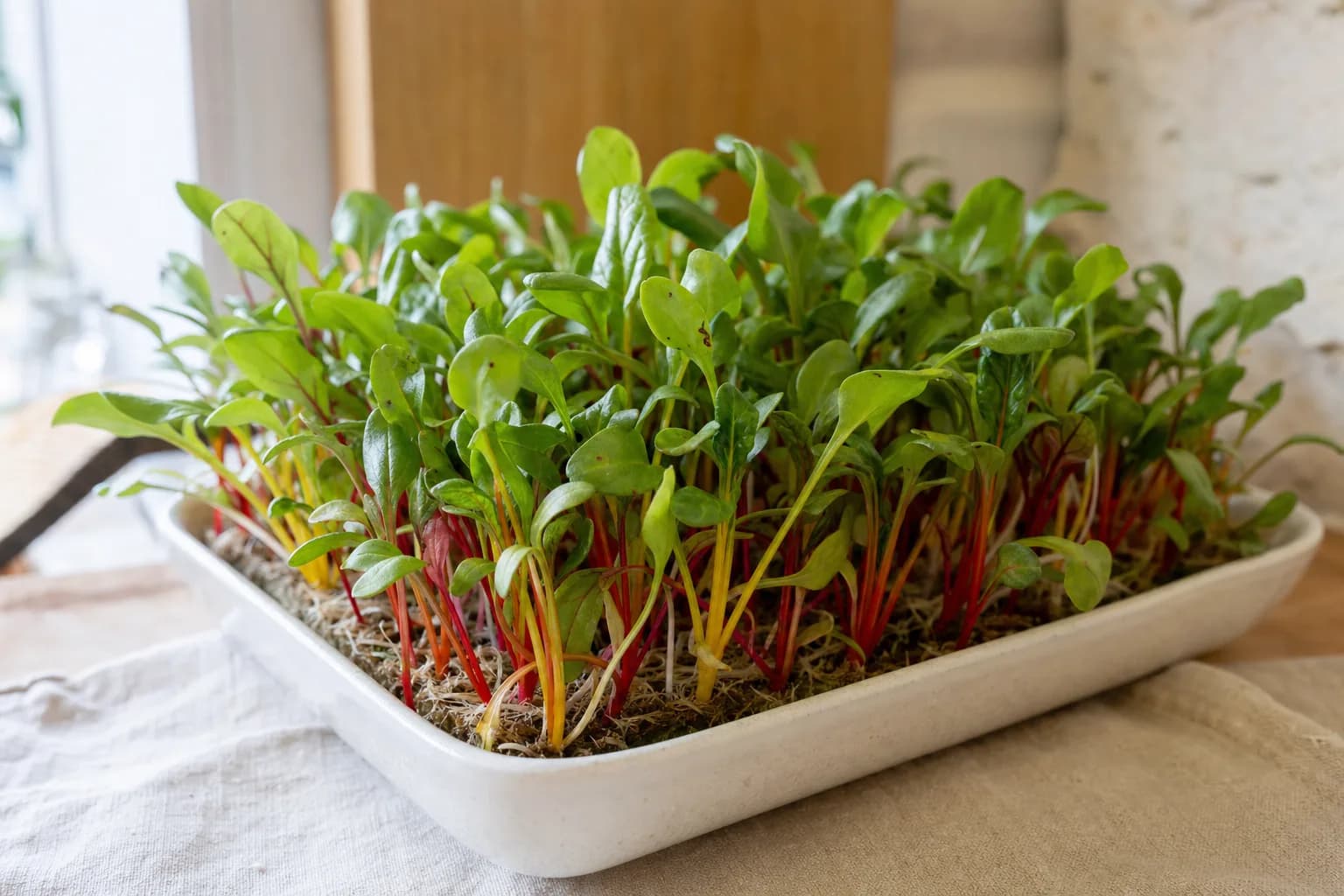
Most microgreens are green with green stems. Chard is the exception that costs you nothing: the same crop, grown the same way, arrives with stems in red, yellow, orange, pink and white depending on the variety you sow.
If you have ever wanted a salad to look like something without buying edible flowers, this is the cheapest route to it.
What it tastes like
Sweet, mild, somewhere between beet and spinach — unsurprising, since chard and beet are the same species. It has the faint earthiness beet greens have, without the intensity, and enough sweetness to be pleasant eaten on its own.
That mildness makes it a base or a mid-weight component rather than an accent. It will not fight anything, which is exactly the point when the reason you grew it is colour.
Growing it
Straightforward, with one rule that is not optional.
- Cover the seed properly. Chard seed is large and knobby — the same awkward shape as beet seed, because it is essentially the same seed. Leave it sitting on the surface and germination is patchy. Make sure it is fully covered by substrate before you water.
- Germination in about 6 days, harvest at roughly 12 for a microgreen. Wait 14 to 20 days if you want a petite green with more developed stem colour.
- Colour develops with time. Cut on the early side and you get green with a hint of stem; a few extra days and the stems reach their full saturation. This is one of the few crops where waiting visibly improves the product.
- Sow a rainbow mix rather than a single colour unless you have a reason not to. The seed costs the same and the tray is more useful.
How to use it
Chard's job is usually visual, so treat it that way: put it where it will be seen, and add it last.
- On top of a finished plate, not stirred through it. Buried under dressing, the colour is wasted.
- In a blend at 5 to 10 percent, purely for colour. Our piece on blending microgreens treats colour as its own job, separate from flavour.
- With anything beet-adjacent — goat cheese, walnut, orange, dark leaves.
- Raw. The stem colour is water-soluble pigment and heat takes it straight out.
If you like the flavour and want it stronger, beet microgreens are the same family with more intensity and a deeper red.
A note on labelling
Chard and beet seed look nearly identical, and so do the seedlings for the first several days. Label the trays when you sow them, not later. Our texture guide is more use than your eyes for telling apart crops at that stage.
Timing and variety notes in this article draw on Cooking With Microgreens by Sal Gilbertie and Larry Sheehan, cross-checked against our own trays.