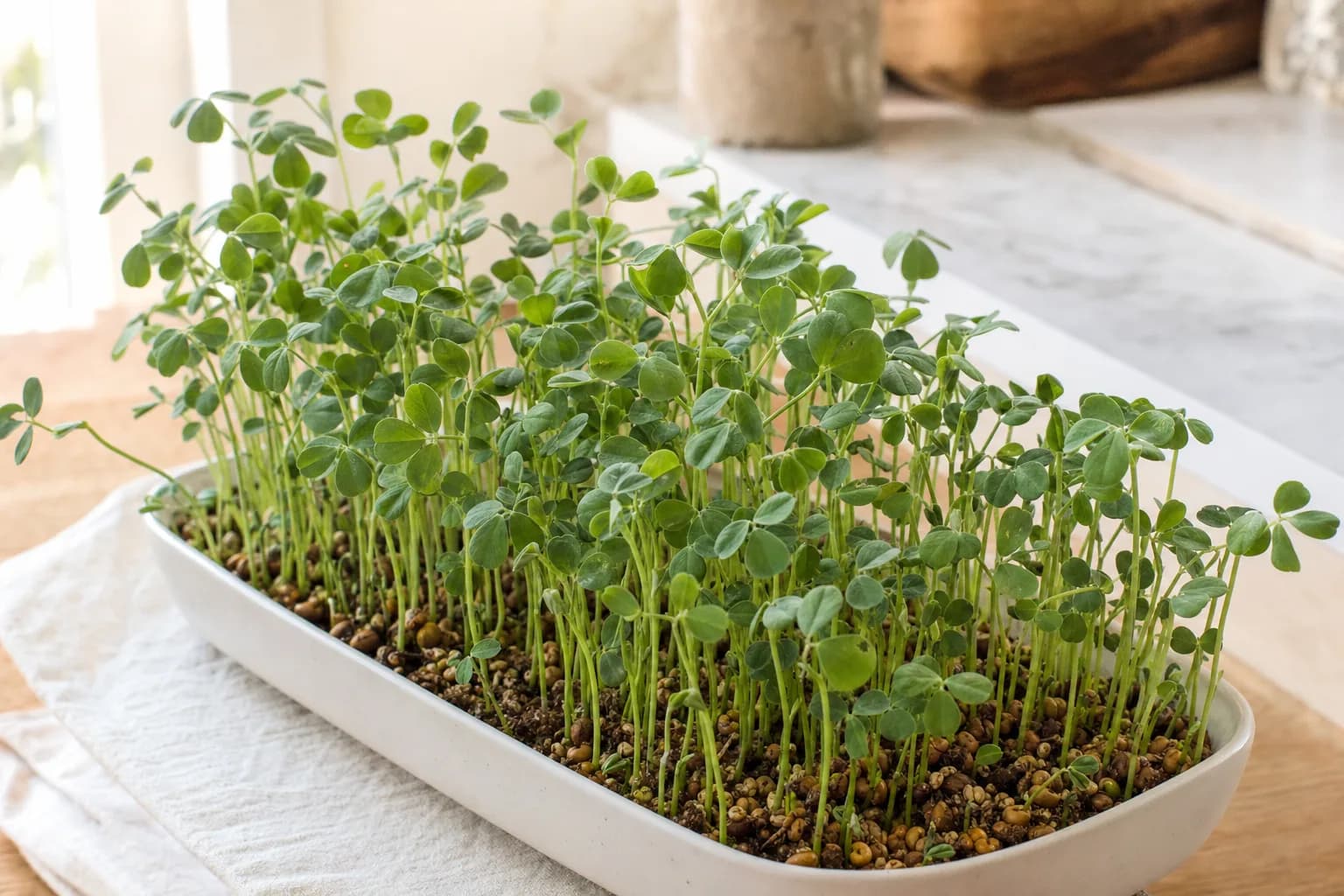
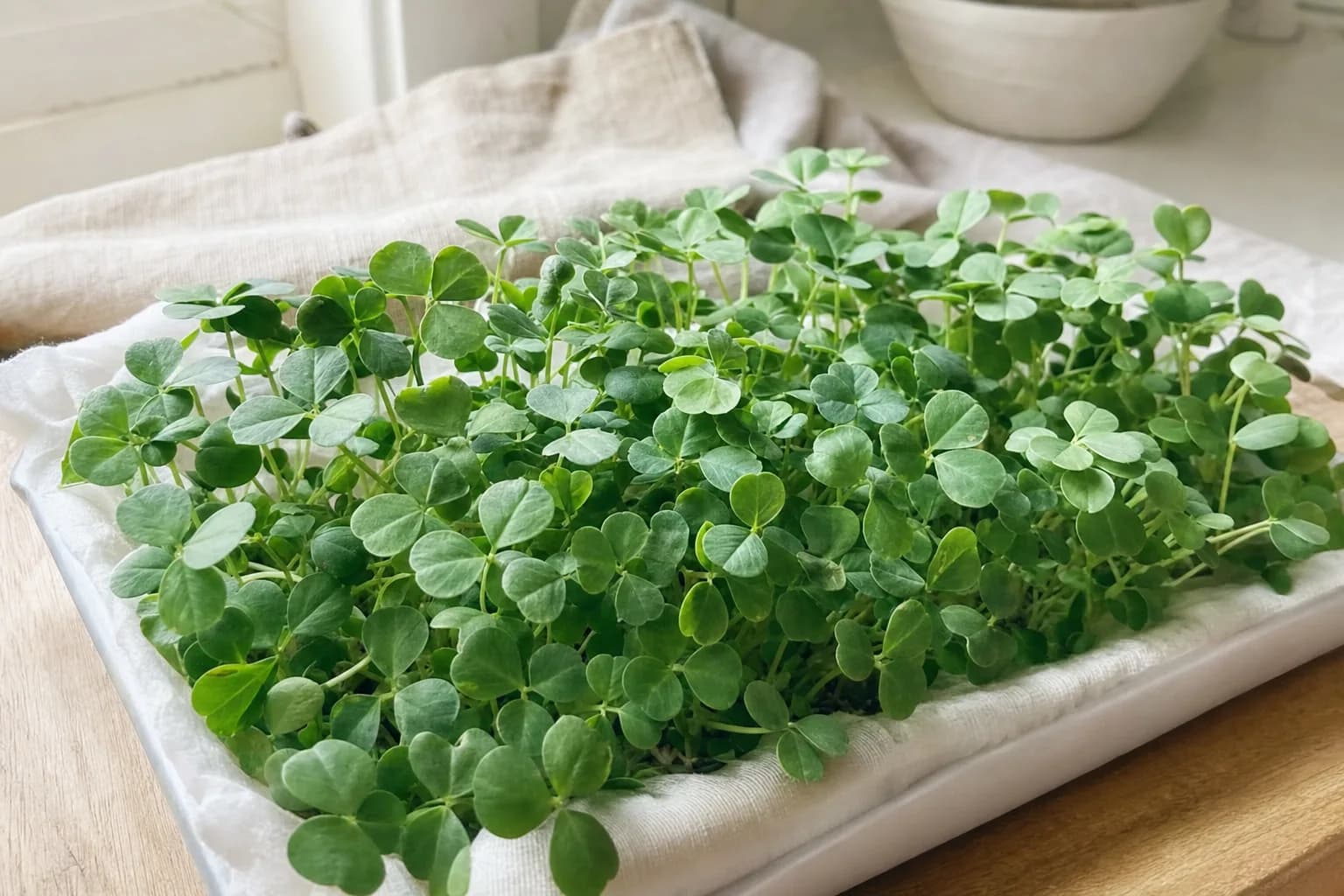
Clover is the crop most people know as something growing at the side of a road, or as a cover crop farmers plant to put nitrogen back in a field. As a microgreen it is a legume like pea shoots, and it shares the family's crisp texture and mild nuttiness.
What surprises people is the timeline.
Slower than the number suggests
Clover germinates in 7 to 10 days — already slow — and then needs considerably longer before it is worth cutting: 20 to 28 days for a microgreen, and 36 to 40 for a petite green.
That is three to four weeks of tray occupancy against seven days for radish. If you run a single tray at a time, clover is an expensive choice in the only currency that matters, which is time under your lights.
What it tastes like
Mild and nutty, with a crunch that holds up better than most soft microgreens. The flavour is not the reason to grow it; the texture is. In a sandwich, clover survives being pressed under other ingredients in a way that delicate leaves do not.
Growing it
- Red clover (Trifolium pratense) is the usual choice for microgreens, though white clover is widely grown too.
- Plan around the occupancy. Sow it alongside fast crops rather than instead of them, so a month of tray time is not a month of no harvests.
- Long cycles need airflow. Four weeks under humid conditions is a long exposure — the same principle that applies to sorrel and other slow crops.
How to use it
Clover is a structural green. Use it where crunch is the job:
- In sandwiches and wraps, layered rather than scattered.
- Mixed into salads as bulk with texture — it works as a base in the sense our blending guide uses the term.
- As a topping on soups, added at the table so it stays crisp.
One small pleasure: clover normally produces three leaves per stem, and occasionally a four-leaf one turns up in the tray.
Timing and variety notes draw on Cooking With Microgreens by Sal Gilbertie and Larry Sheehan.