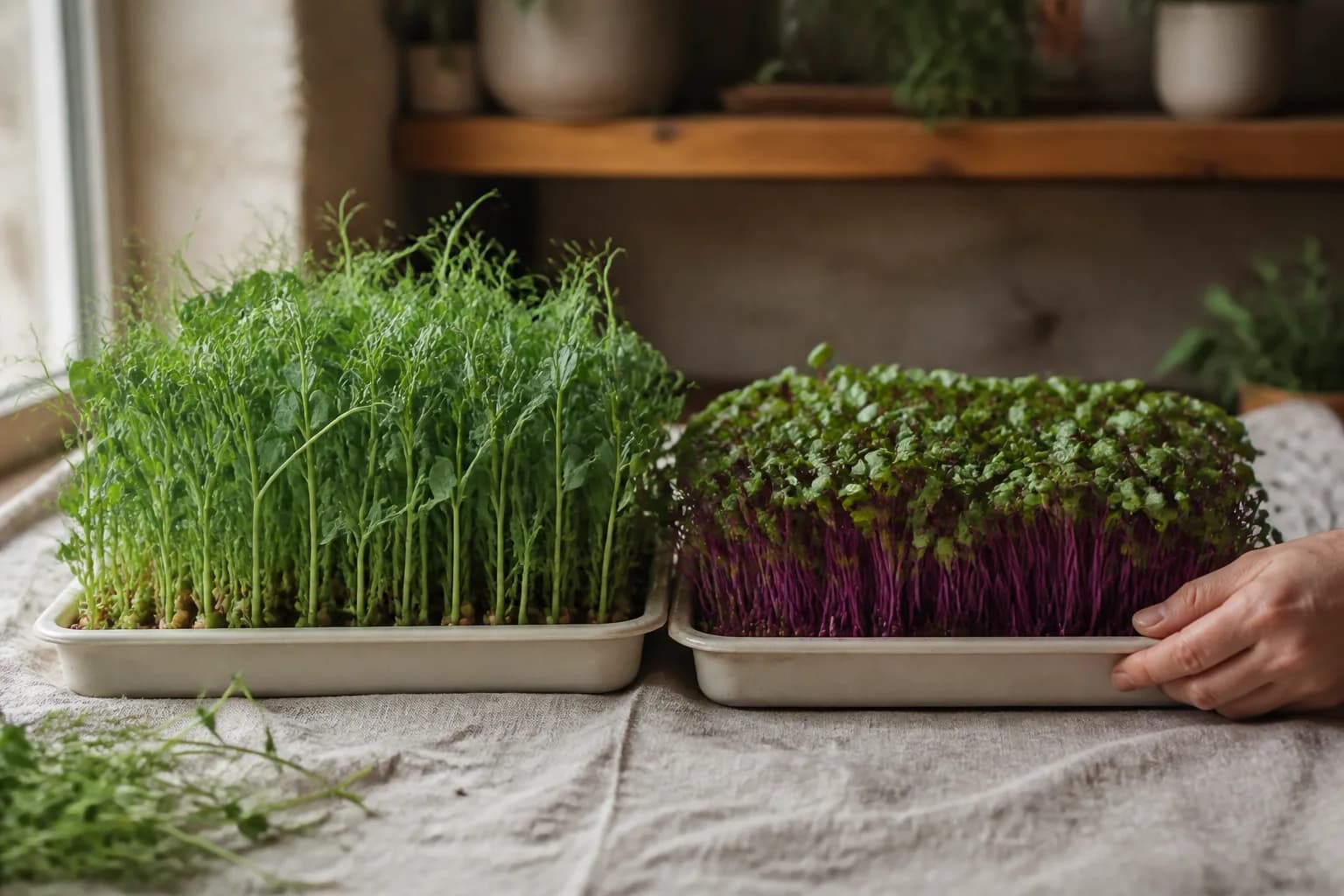
Almost all nutrition advice is about choosing: eat this vegetable rather than that one, this oil rather than that one. Biofortification asks a different question. Instead of choosing between plants, could you change what is inside the plant while it is still growing?
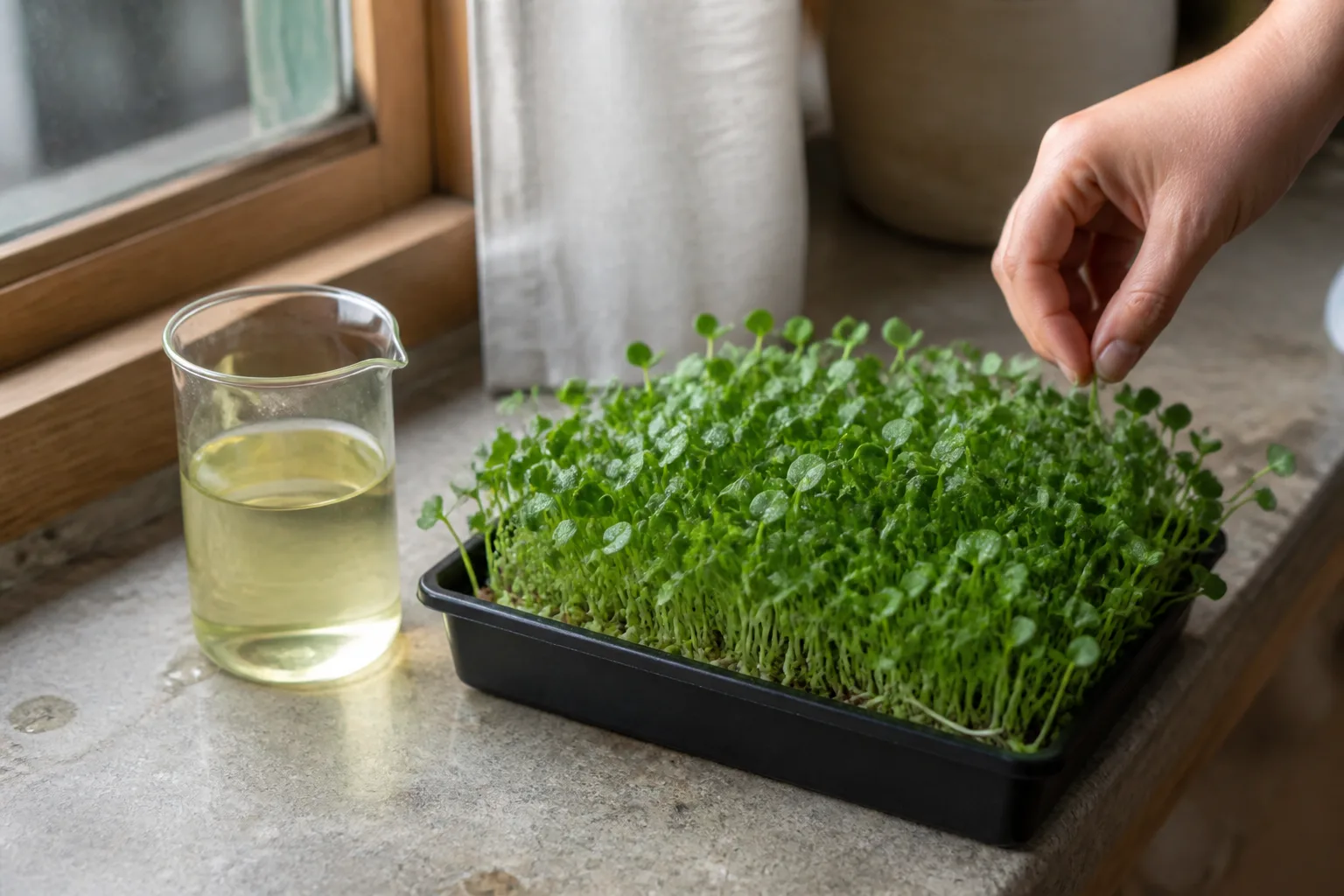
For microgreens the answer is measurably yes, and it is not new or exotic. Add a mineral salt to the nutrient solution, and the plant takes it up and holds it in its tissue. Researchers have done this with selenium, iodine, zinc and iron, published what came out, and — more usefully — published what it cost elsewhere. This article is the map of that literature: what works, what it trades away, and where the honest edges are.
The problem it is aimed at
The World Health Organization identifies iodine deficiency alone as affecting more than a third of the world's population, and roughly 60% of people are estimated to experience some form of what researchers call hidden hunger — deficiencies with vague, non-specific effects that appear regardless of income or country [3]. Zinc deficiency puts over 17% of the global population at risk [4]. These are not exotic conditions. They are widespread, quiet, and largely invisible until measured.
The twentieth-century answer was fortification after the fact: iodine into salt, folate into flour. Agronomic biofortification asks whether the plant can do the work instead, so the nutrient arrives inside food rather than added to it.
Why microgreens are unusually suited to this
Three properties stack up in their favour, and they are worth separating because each does different work.
The cycle is short. Seven to fourteen days from seed to harvest means the mineral has a brief, controlled journey from solution to plate. There is little time for the losses and variability that accumulate across a mature crop's season.
The system is closed. These are soilless setups where the solution is exactly what you put in it. A field has soil chemistry with its own history and opinions — pH, existing mineral load, microbial activity — all of which modify what the plant actually receives. Remove the soil and you remove the largest uncontrolled variable.
Phytic acid is low. This one matters more than it sounds. Phytic acid, abundant in mature grains and seeds, binds minerals and blocks their absorption in the gut. Microgreens are harvested long before it accumulates. So a mineral that goes into a microgreen is more likely to survive digestion than the same mineral in a mature grain [4].
That last point deserves emphasis because it separates two things people routinely conflate. A concentration on a lab report is not nutrition. What matters is bioaccessibility — how much survives digestion and is available for absorption. Some biofortification studies measure only the first. The better ones measure both, and the gap between them can be large.
What has actually been measured
| Mineral | Headline finding | Where the detail is |
|---|---|---|
| Selenium | Up to 893.3 µg/kg DW in kale, with no yield penalty — and delivery method mattered ~37× | Selenium in microgreens |
| Iodine | Tissue concentration up an average 226.52%, with dry matter, colour and nitrate all unchanged | Iodine in microgreens |
| Zinc | Bioaccessible zinc up 4× in pea, 17× in radish — same treatment, same facility | Zinc and iron |
| Iron | Achievable, but antagonistic with zinc — enriching one suppresses the other | Zinc and iron |
Three trade-offs the headlines skip
1. Minerals compete with each other. This is the finding most likely to disappoint anyone hoping for a single enriched super-crop. In pea and radish microgreens, raising zinc reduced iron content [4]. Iron and zinc are known to interact antagonistically, which is precisely why a Penn State team fed both together across a factorial design — because almost nothing had been published on enriching them simultaneously [6]. You are not adding nutrients to a list. You are shifting a balance, and the balance pushes back.
2. Every study reports an optimum, not a maximum. The selenium work tested 0, 10, 20 and 40 µM and landed on 20 µM as best for fresh consumption — not the highest dose the plant tolerated [1]. This is the opposite of how supplements are marketed, and it is the single most important habit of mind to carry into this topic. More is a different outcome, not a better one.
3. Species differ enough to invalidate cross-reading. The same selenium treatment produced 133 µg/g in kale and 28 µg/g in wheat [2]. The same zinc treatment produced a 4-fold rise in pea and a 17-fold rise in radish [4]. Taking a number obtained in one crop and assuming it holds for yours is the most common way to be confidently wrong about this whole subject.
Two levers, and they are more independent than you would guess
Here is the finding I keep coming back to, because it changes what you optimise. Across the zinc experiments, light intensity did not affect zinc accumulation at all — but it substantially raised phytochemical content [4]. A companion metabolomics study went further: across zinc-enriched pea microgreens grown at four light intensities, light intensity was the dominant factor shaping the metabolome, more so than the zinc application itself [5].
So the nutrient solution governs the mineral content, and the light governs the phytochemical profile, and the two can be tuned largely separately. That is a convenient piece of biology — it means improving one does not force you to give up the other. The light side of this is covered in light and microgreen nutrition.
What biofortification does not do
It changes mineral content. It does not turn a plant into a supplement, it does not treat a deficiency, and it does not improve everything at once. The zinc work is the cleanest illustration: enrichment lowered iron, and also lowered nitrate [4] — an unwanted compound in fast-grown leafy greens. Good and bad in the same sentence, from a single change.
It is also worth saying plainly that every result described here came from a research setting: controlled solutions, measured doses, laboratory analysis afterwards. That last step is the one that does not travel. A grower can replicate a concentration; verifying what the plant actually accumulated requires equipment that does not sit on a countertop.
What this is, and what it is not. LUYA grows food, not medicine. Nothing here is medical advice, and enriched microgreens are not a treatment for any deficiency. If you think you are short of a nutrient, that is a conversation with a clinician and a blood test — not a growing tray.
Where we stand on it
We treat biofortification as a direction we are studying, not a feature we are selling. The reason is dosing: reproducing these results at home requires precision, and more importantly a reason to trust the dose, given that the useful range for something like selenium is genuinely narrow. Publishing the research honestly seems more useful than shipping a claim ahead of the capability.
If you want the groundwork, do microgreens need nutrients explains how anything reaches the plant in the first place, and microgreens nutrition covers what is in them before you change anything.
Sources
Every figure in this article comes from one of the papers below, each read in full before being cited. Where a study measured one species under one set of conditions, we say so rather than generalising it to every crop. Follow the DOI to check any number yourself.
- Selenium biofortification of kale microgreens in a soilless cultivation system. Scientia Horticulturae 323 (2024) 112522. doi.org/10.1016/j.scienta.2023.112522
- Selenium biofortification of kale, kohlrabi and wheat microgreens. Plant Physiology and Biochemistry 206 (2024) 108283. doi.org/10.1016/j.plaphy.2023.108283
- Ciriello et al. — Iodine biofortification of four microgreens species and its implications for mineral composition. Scientia Horticulturae 320 (2023) 112229. doi.org/10.1016/j.scienta.2023.112229
- Zinc biofortification and light intensity independently modulate zinc accumulation and bioaccessibility. Future Foods 12 (2025) 100809. doi.org/10.1016/j.fufo.2025.100809
- Light intensity and zinc biofortification differentially impact the metabolome of pea microgreens. Food Chemistry 490 (2025) 145146. doi.org/10.1016/j.foodchem.2025.145146
- Ravichandran, Poudel & Di Gioia — Fertigation-driven dual enrichment of iron and zinc in radish, sunflower and pea microgreens (Penn State). Food Bioscience 79 (2026) 108693. doi.org/10.1016/j.fbio.2026.108693