Over 17% of the world's population is at risk of zinc deficiency [1]. Iron deficiency is more common still, and between them they account for a large share of what nutritionists call hidden hunger. Both are minerals that microgreens can be enriched with — and if you try to do both at once, you meet a problem that is chemical rather than agricultural.
Zinc: measuring what survives digestion
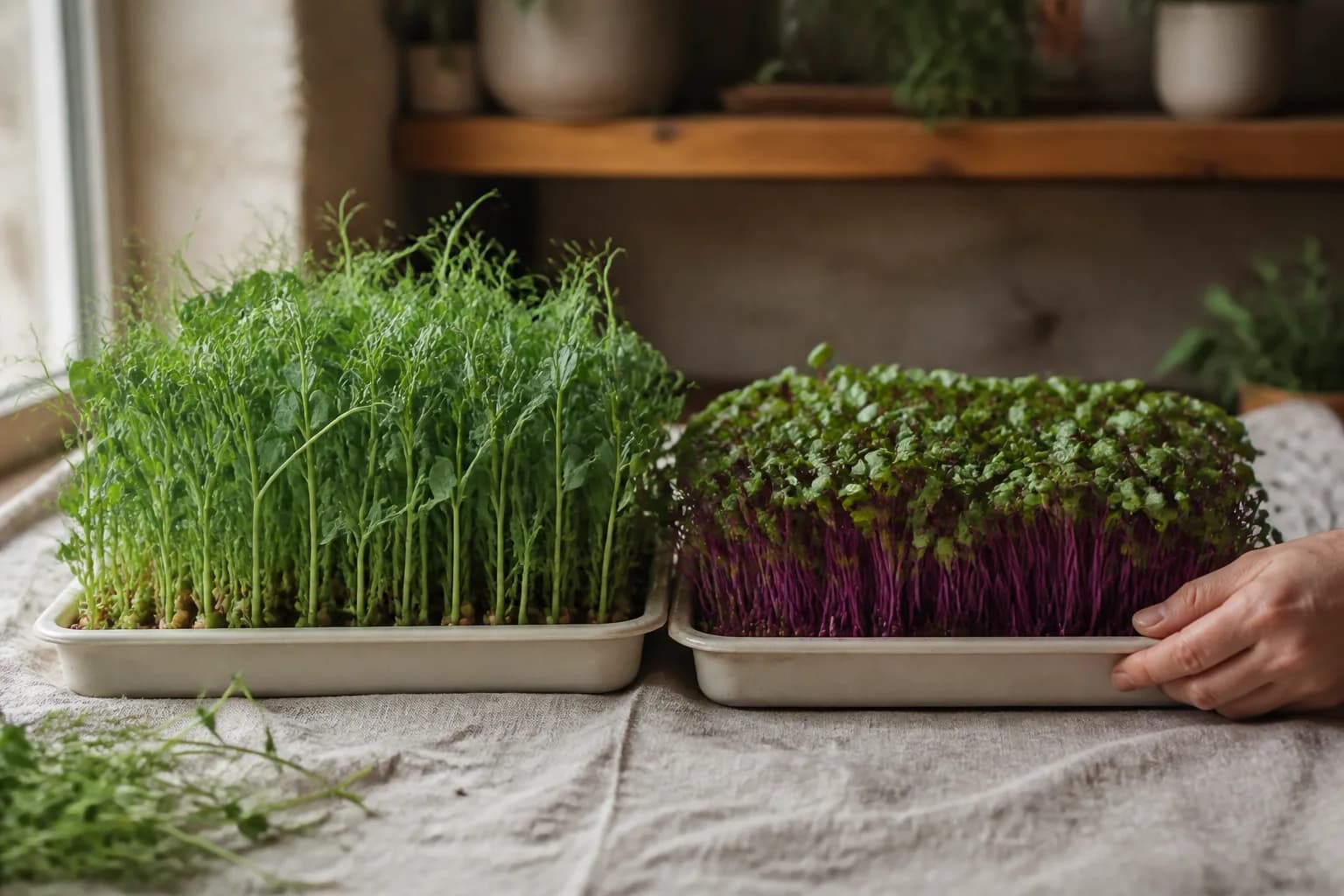
Researchers grew pea and radish microgreens across a full grid: four zinc levels (0, 5, 10, 15 mg/L) crossed with four light intensities (100, 200, 300 and 400 µmol/m²/s photosynthetic photon flux density). Then, instead of stopping at tissue concentration, they ran in-vitro digestion to measure bioaccessible zinc — the fraction actually released and available for absorption [1].
That extra step is what makes this study worth more than most. Tissue concentration tells you what the plant holds. Bioaccessibility tells you what you get.
At 15 mg/L zinc:
- Pea microgreens — 4-fold increase in bioaccessible zinc
- Radish microgreens — 17-fold increase
Biomass was barely affected. Same treatment, same facility, same week — and a four-fold difference in outcome between two crops. If you need one fact to inoculate yourself against over-generalised biofortification claims, this is it.
Part of why microgreens do well on the bioaccessibility measure is what they lack: phytic acid, the mineral-binding compound that accumulates as seeds mature, is low in a seven-day-old seedling. The mineral is not locked up before it reaches you.
The catch: enriching zinc lowered iron
Zinc enrichment reduced the content of other essential nutrients, iron among them [1]. This is not a quirk of one experiment — iron and zinc are known to interact antagonistically, competing for shared uptake and transport routes.
Which is exactly why a Penn State team fed both deliberately, crossing iron sulphate (0, 20, 40 mg/L Fe) with zinc sulphate (0, 10, 20 mg/L Zn) through fertigation in radish, sunflower and pea microgreens [2]. Their motivation was stated plainly: the antagonism is documented, simultaneous enrichment is what a real product would require, and almost nothing had been published on doing both at once.
The practical reading is unglamorous but clear. This is a balance to be tuned, not a dial to be turned up. "Maximum zinc" and "maximum iron" are not simultaneously available in the same tray, and any product claiming both should be asked, politely, how.
One genuinely good side effect
Zinc enrichment also decreased nitrate [1]. Nitrate accumulation is a standing concern in fast-grown leafy greens — it is one of the few compositional criticisms of the category that has substance. A treatment that raises a wanted mineral while lowering an unwanted compound is a rare two-for-one, and worth noting precisely because most interventions in this area trade one thing for another.
Light is a separate lever — and the stronger one
This is the finding I find most useful, because it changes what you optimise rather than merely adding to what you know.
Across the same grid of experiments, light intensity did not affect zinc accumulation. It did, however, raise phytochemical content [1]. A companion targeted-metabolomics study on zinc-enriched pea microgreens found that elevated light intensity increased flavonoid and phenolic acid biosynthesis — likely driven by oxidative stress and photoinhibition, the plant's own defensive response to more light than it strictly needs — while zinc enrichment enhanced sulphur-containing amino acids and oxalic acid, which may play a role in handling the metal [3].
The authors' overall conclusion is the part to carry away: light intensity was the dominant factor influencing metabolic shifts across compound classes, more so than the zinc application [3].
A caution on how to read that, since it is easy to overstate. These studies establish that light intensity and zinc dose act on largely separate outputs under the conditions tested — two crops, one facility, one set of intensities. They do not establish that the two never interact, and they do not license a general claim that "light controls phytochemicals" in every crop and every range. What they support is narrower and still useful: in these experiments, you could change the mineral without disturbing the phytochemistry, and change the phytochemistry without disturbing the mineral.
If that holds more broadly, it is convenient engineering — two knobs that do not fight each other. The spectrum side of the same question is in light and microgreen nutrition and blue light and microgreens.
What this is, and what it is not. LUYA grows food, not medicine. Nothing here is medical advice, and enriched microgreens are not a treatment for any deficiency. If you think you are short of a nutrient, that is a conversation with a clinician and a blood test — not a growing tray.
Background in the biofortification overview; if iron specifically is your interest, microgreens for iron covers the dietary side, and radish microgreens covers the crop that performed best here.
Sources
Every figure in this article comes from one of the papers below, each read in full before being cited. Where a study measured one species under one set of conditions, we say so rather than generalising it to every crop. Follow the DOI to check any number yourself.
- Zinc biofortification and light intensity independently modulate zinc accumulation and bioaccessibility. Future Foods 12 (2025) 100809. doi.org/10.1016/j.fufo.2025.100809
- Ravichandran, Poudel & Di Gioia — Fertigation-driven dual enrichment of iron and zinc in radish, sunflower and pea microgreens (Penn State). Food Bioscience 79 (2026) 108693. doi.org/10.1016/j.fbio.2026.108693
- Light intensity and zinc biofortification differentially impact the metabolome of pea microgreens. Food Chemistry 490 (2025) 145146. doi.org/10.1016/j.foodchem.2025.145146