This article is for general education and is not medical advice. Talk to your doctor before changing your diet for a health condition or if you take medication.
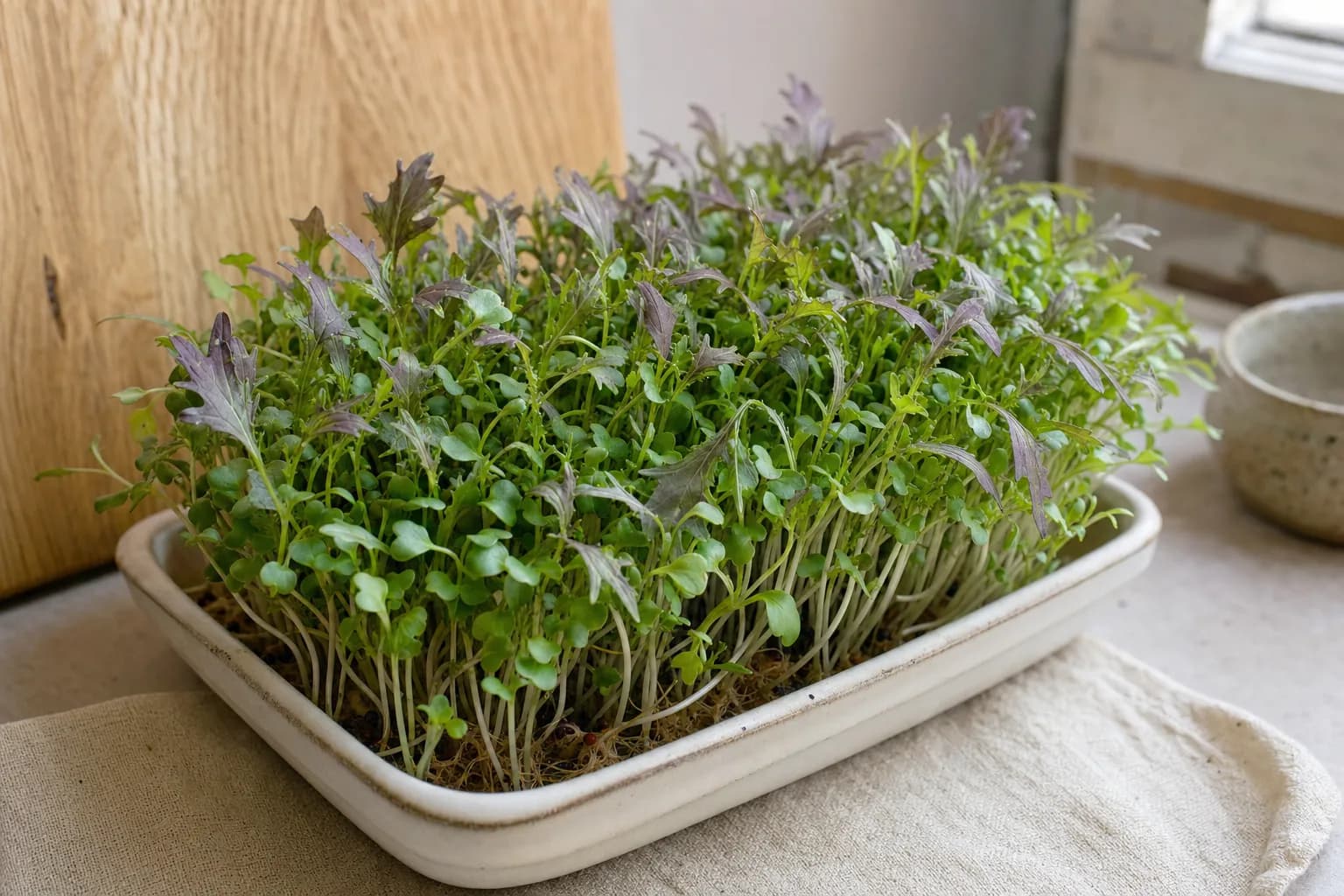
Bite into a pinch of mustard microgreens and you will feel it within a second or two: a clean, wasabi-like heat that climbs up the back of your nose and then fades. That sensation is not a gimmick. It is a chemical defense system the plant built for itself, and it happens to be one of the most useful flavors a home grower can keep on hand. A few weeks ago I would have called these greens underrated. After watching how reliably they grow and how much they wake up an otherwise plain plate, I think they deserve a spot in almost everyone's rotation.
This guide covers where that signature pungency comes from, what mustard microgreens actually deliver nutritionally, and how to grow a clean, even tray at home. If you are brand new to the whole category, the what are microgreens primer is a good companion read.
Where the heat comes from
Mustard is a member of the Brassica family, the same group that includes broccoli, cabbage, kale and radish. What unites these plants is a class of compounds called glucosinolates. On their own, glucosinolates are stable and flavorless. They sit quietly inside the leaf tissue, kept separate from an enzyme called myrosinase.
The fireworks start the moment you chew, chop or crush the leaf. That damage breaks the cellular walls and lets myrosinase reach the glucosinolates. The enzyme cleaves them into new compounds called isothiocyanates, and those are what your taste buds and nasal passages register as heat. In mustard specifically, the dominant product is allyl isothiocyanate, the same molecule responsible for the kick in prepared mustard, horseradish and wasabi.
This is why mustard microgreens taste sharper raw than cooked, and why they bite harder when finely chopped than when left whole. It is also why the flavor mellows if you let cut greens sit for a while. If you are curious about how this same machinery plays out across other peppery crops, the spicy microgreens guide and why do microgreens taste bitter both go deeper on the chemistry of pungency and bitterness.
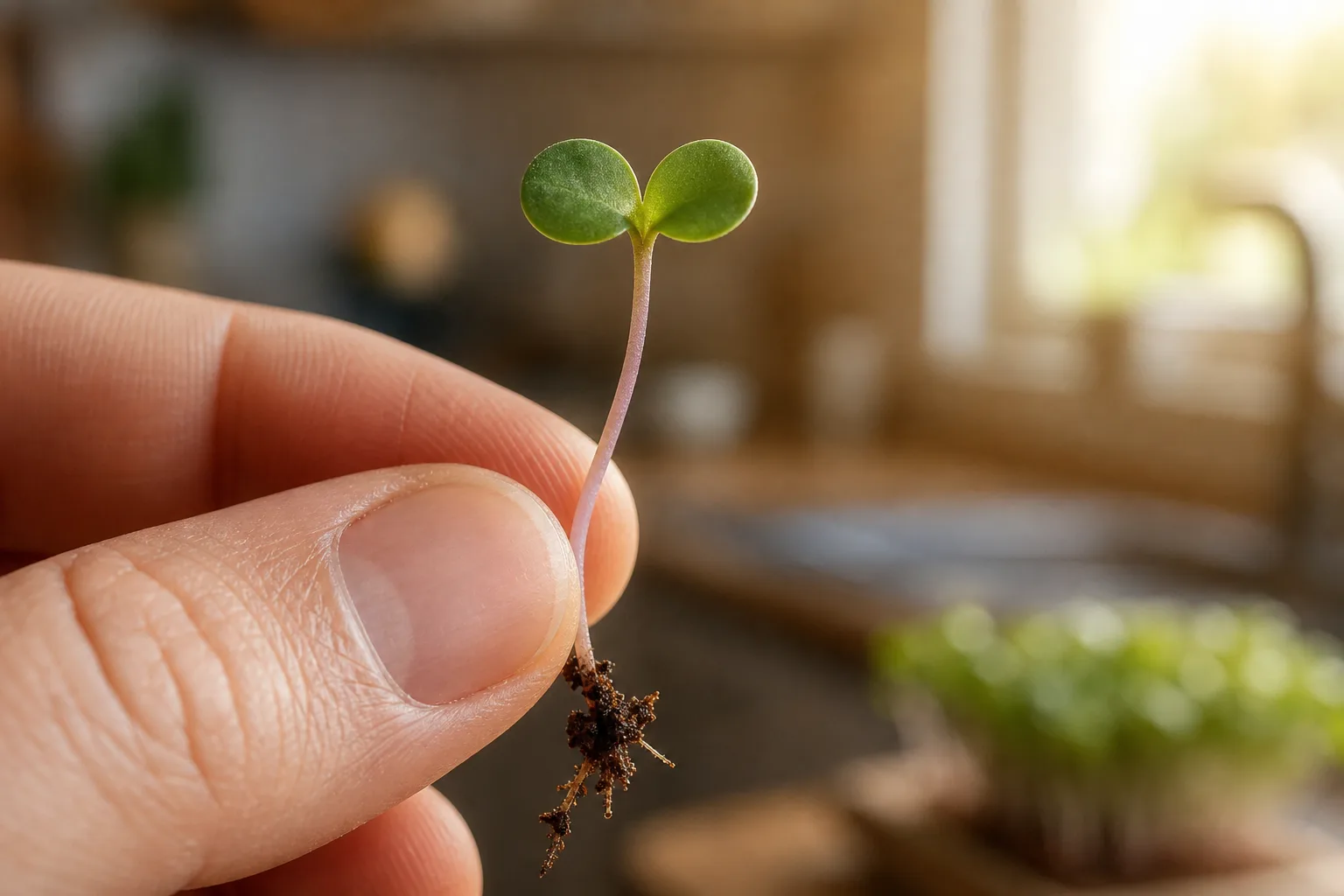
One practical note from the consumer-preference research: sharp brassicas like mustard and radish tend to be the least popular greens in blind taste tests, while sweet, colorful ones like beet and amaranth win the crowd. That is not a knock on mustard. It simply means a little goes a long way. Treat it as a seasoning green rather than a salad base and it earns its keep.
Nutrition in a small package
The appeal of microgreens in general is density. Because you are eating the seedling at its most concentrated stage, you get a lot of nutrition relative to the volume on your fork. Studies that measured 25 commercial microgreen varieties found vitamin and antioxidant levels that ran far higher, gram for gram, than the mature versions of the same plants. Mustard fits that pattern well as a brassica seedling rich in vitamins C, K and the carotenoids your body uses for vitamin A.
There is also the glucosinolate story again, this time on the health side rather than the flavor side. Isothiocyanates are the same family of compounds studied for the body's natural antioxidant and detoxification pathways. Broccoli's version, sulforaphane, gets the most attention; if that interests you, what is sulforaphane is the article to read. Mustard's allyl isothiocyanate is a different compound, but it belongs to the same protective toolkit.
Here is a rough comparison to set expectations. These are reasonable estimates per 25-gram serving, which is a generous garnish:
| Nutrient | Mustard microgreens (per ~25 g) | What it supports |
|---|---|---|
| Vitamin C | 15–22 mg | Immune function, collagen |
| Vitamin K | 50–90 mcg | Blood clotting, bone health |
| Vitamin A (as carotenoids) | 200–400 IU | Vision, skin |
| Glucosinolates | Present, variety-dependent | Source of isothiocyanates |
| Calories | About 6–9 | — |
For the broader picture of how seedlings stack up against grown vegetables, microgreens nutrition and are microgreens good for you lay out the research more fully.
A note on growing conditions and flavor
Here is something many growers miss: the light a plant receives does more than make it grow. It shapes the plant's chemistry. Light is one of the main environmental signals that controls how plants build their secondary metabolites, the defensive compounds that include both glucosinolates and the pigments behind color.
The research on this is striking. In one study on a brassica relative, ultraviolet-A light measurably increased glucosinolate production by switching on the genes that build them. The same body of work shows that blue light tends to boost flavonoids and overall antioxidant capacity, while specific wavelengths can deepen the purple anthocyanin pigments that some mustard varieties display. In plain terms: the spectrum and intensity of your light is a dial you can turn to influence both how spicy and how colorful your mustard turns out.
This is exactly the kind of fine control that purpose-built systems are designed for. Inside a Luya countertop grower, the lighting is part of the recipe rather than an afterthought, which makes it easier to get consistent flavor tray after tray. If the light science fascinates you, light and microgreen nutrition is a deeper dive on the topic.
How to grow mustard microgreens at home
The good news for beginners is that mustard is genuinely easy. It germinates fast, grows evenly, and forgives small mistakes. It is one of the crops experienced growers recommend when you are still learning the rhythm of the process. Here is the short version.
Seeding. Mustard seeds are small, so you do not need to soak them. Soaking small seeds actually makes them clump and hard to spread, because many develop a sticky gel coat when wet. Sprinkle them evenly and fairly densely across moist growing medium. About 1 to 2 teaspoons of seed will cover a small tray. A misting bottle is all you need to settle them in.
Germination (blackout). Cover the tray to block light and hold in moisture for the first few days. This blackout period is short, usually under four or five days, but it matters. Mist once in the morning and once at night, and keep the cover on. If the inside of the cover is beaded with moisture, you are doing it right.
Light and growth. Once you see stems lifting, uncover the tray and give the seedlings light. From here, water from the bottom rather than spraying the leaves. Wet foliage in a dense canopy is the single most common cause of mold. If you run into that issue, why microgreens keep molding has a full troubleshooting walkthrough.
Harvest. Mustard is typically ready in a tidy window. Snip the stems just above the soil line with clean, sharp scissors when the cotyledons are open and the first hint of true leaves appears. Below is a quick reference grounded in how mustard behaves relative to other common crops.
| Stage | Timing | What to do |
|---|---|---|
| Soaking | Not needed | Seeds are small; sow dry |
| Blackout germination | 2–4 days | Cover, mist twice daily |
| Uncovered growth | Day 4 onward | Bottom-water, give light |
| Harvest window | 8–12 days | Cut at cotyledon to early true-leaf stage |
For a fuller end-to-end method, how to grow microgreens at home covers the universal steps, and easiest microgreens to grow explains why mustard belongs on the beginner list.
How to actually use them
Because mustard brings real heat, it works best where you would otherwise reach for something sharp. A few combinations I keep coming back to:
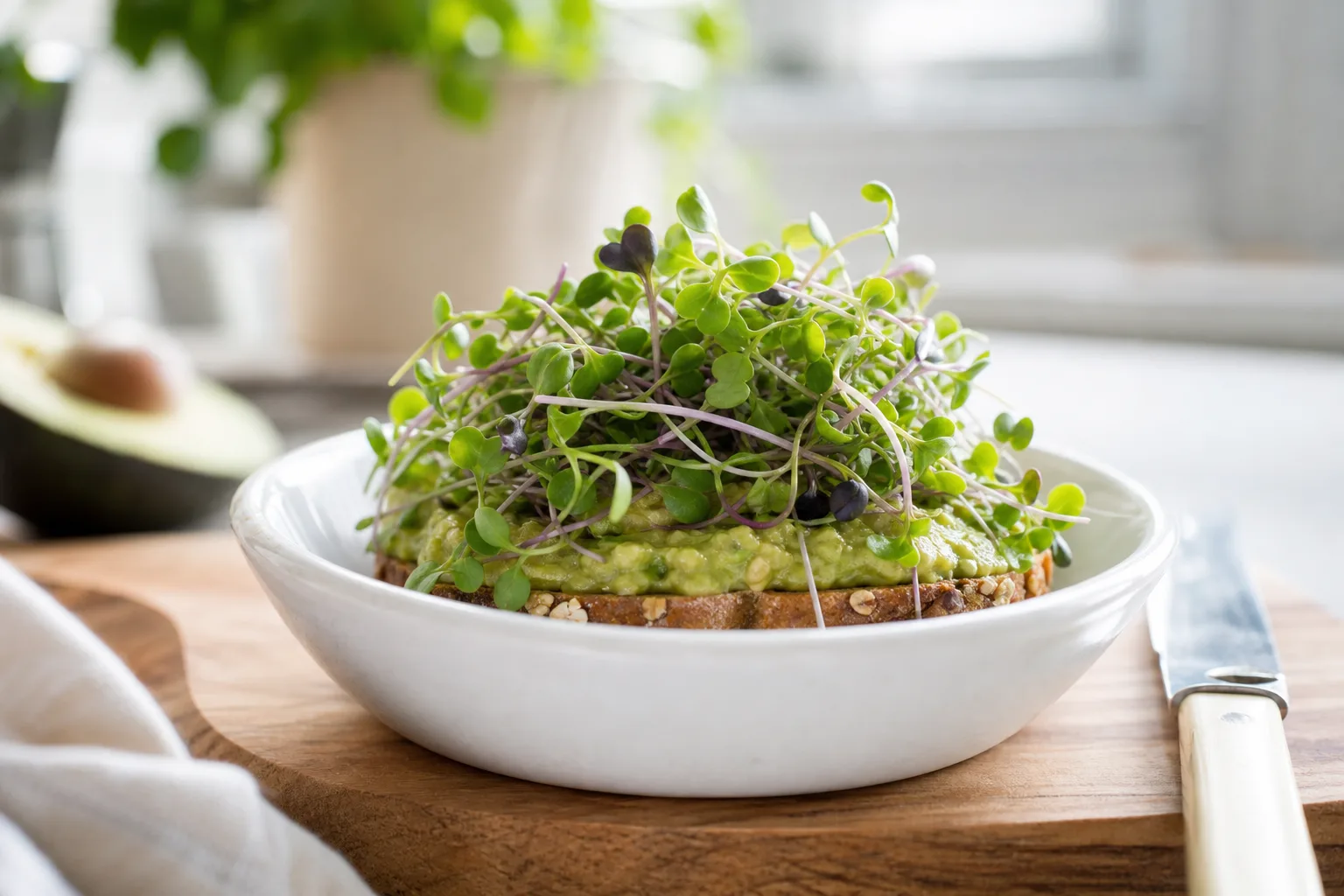
- On rich foods. A pinch on avocado toast, a soft-boiled egg, or a creamy soup cuts through the fat and adds brightness. Add them at the very end so the heat stays alive.
- In sandwiches and wraps. Mustard greens essentially function as a built-in condiment. Layer them in instead of, or alongside, mustard from a jar.
- As a finishing garnish. Scattered over grilled fish, roasted vegetables or noodles right before serving, they read as both decoration and seasoning.
- In small amounts in salads. Mixed with sweeter, milder greens so the heat balances rather than dominates. Microgreens salad ideas has more on building balanced combinations.
One rule worth repeating: heat fades with cooking. If you stir mustard microgreens into a hot dish, do it off the heat at the last moment, or you will lose most of the bite that made them worth growing. For the general principles, how to eat microgreens is a useful reference.
The bottom line
Mustard microgreens are a small crop with an outsized personality. The same glucosinolate chemistry that gives them their wasabi-like punch ties them to the broader brassica family and its well-studied protective compounds. They grow fast, forgive beginners, and respond in interesting ways to the light you give them. Keep a tray going, use them as a seasoning rather than a salad filler, and add them at the end of cooking so the heat survives. For a tiny amount of effort, you get a fresh, sharp finish that very few store-bought ingredients can match.