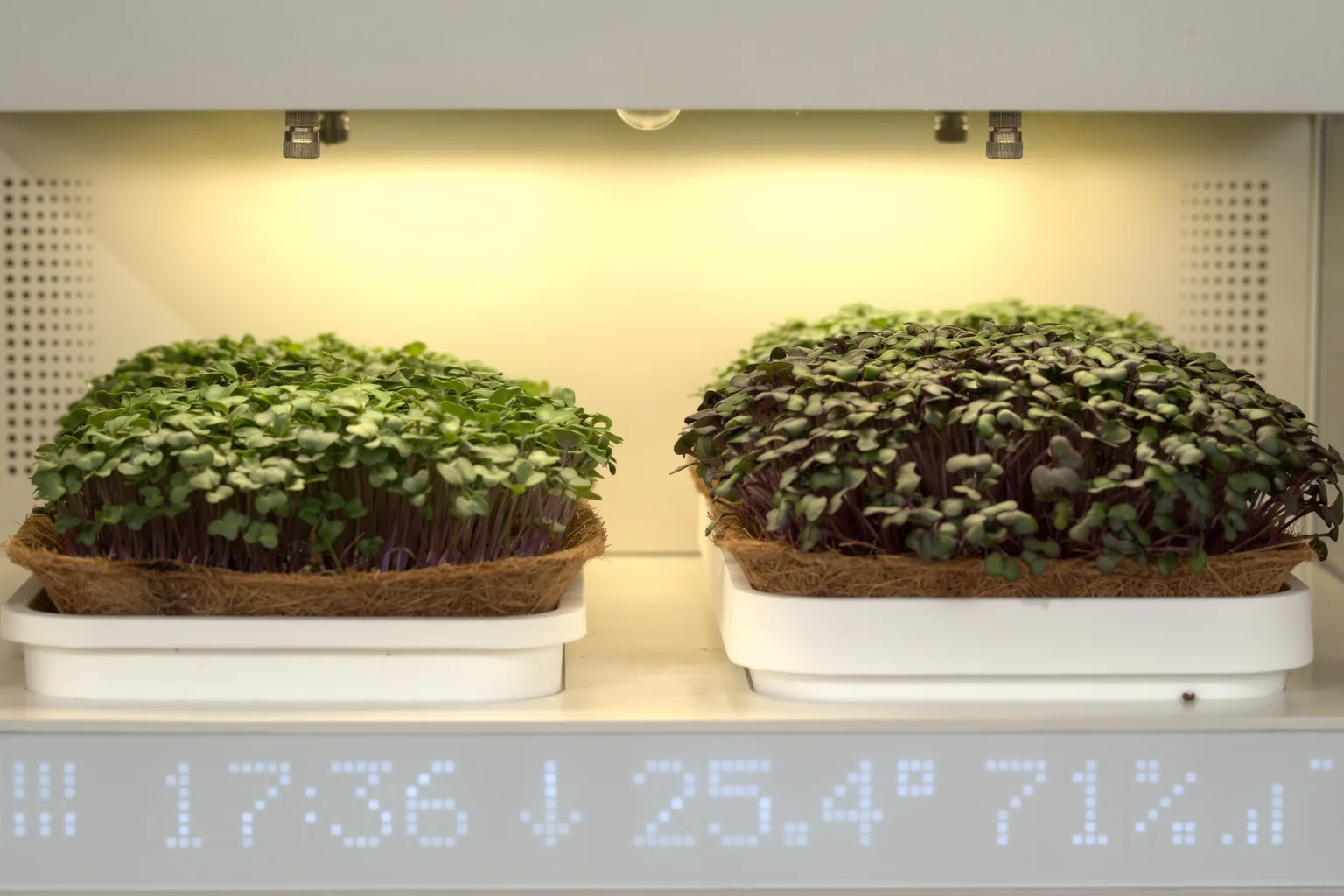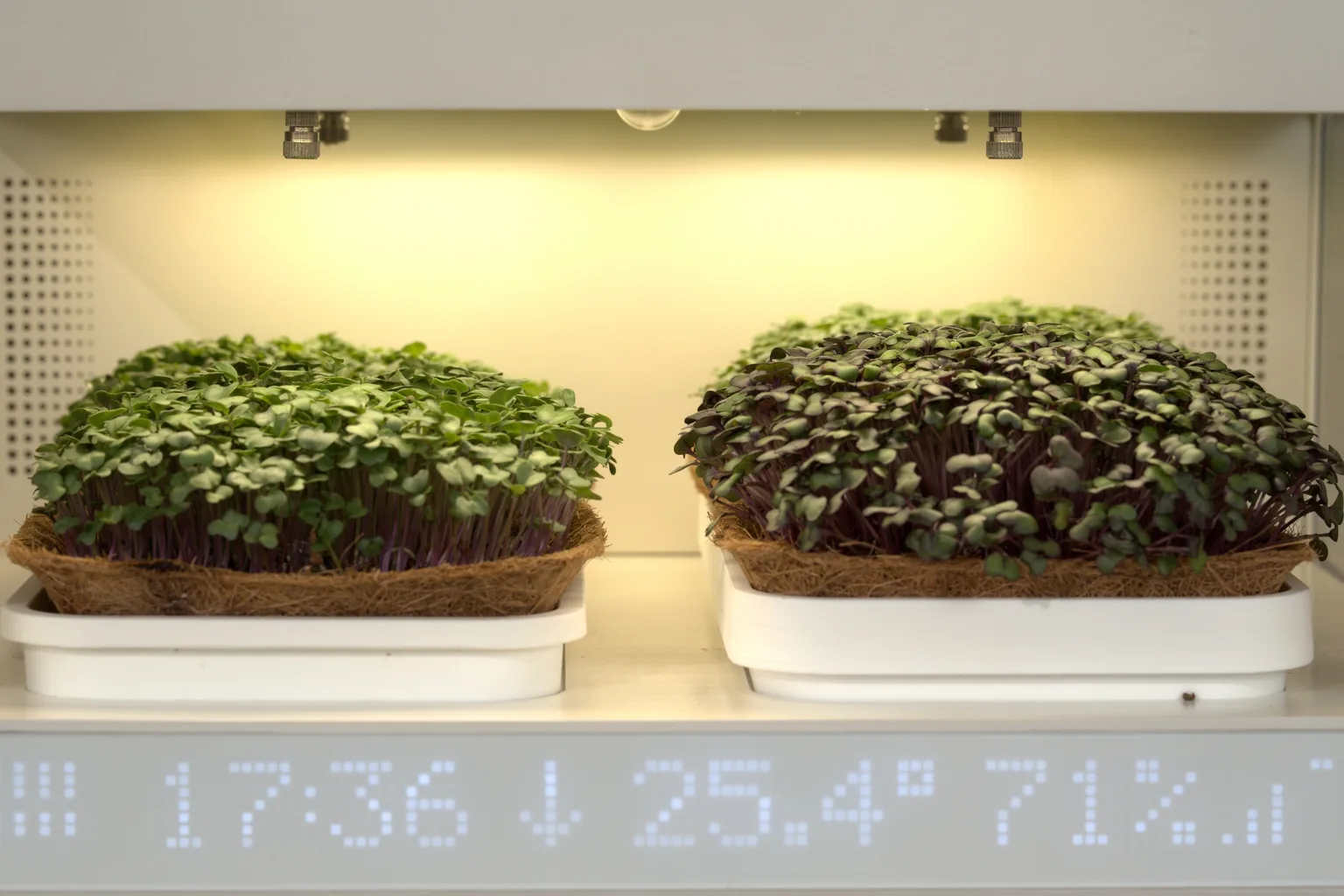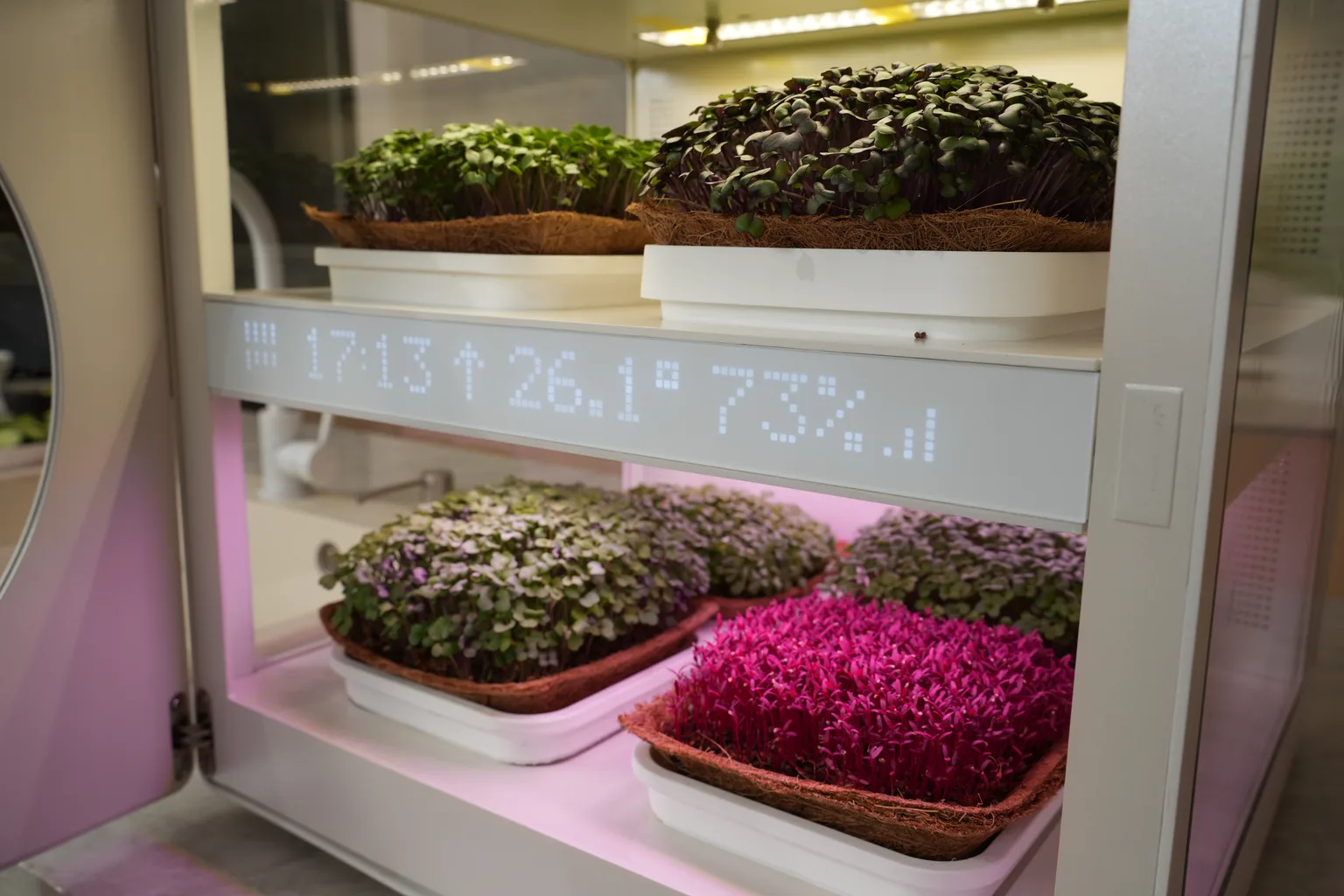

The same indoor farm, growing the same crop, in the same container, came out at 74 kg CO2-eq per kg of fresh produce on a fossil-based electricity mix — and 3.9 kg on renewable electricity with waste-heat cooling. Nineteen-fold, from one variable. [1] If you want the short answer on the microgreens carbon footprint of growing indoors, it is that the question "is indoor growing greener?" is almost entirely a question about your electricity.
One thing to be straight about before going further: that study grew chili pepper, not microgreens. No equivalent experimental life-cycle assessment exists for microgreens that we have been able to find. The number is not transferable and we are not transferring it. What transfers is the structure of the result.
Why the carbon footprint follows the energy source
The researchers ran chili pepper at two light intensities in a vertical farming container and modelled three energy supply scenarios. Doubling the photon flux raised annual dry yield by 57%, but light-use efficiency fell 27% — and system-level energy use barely moved, staying around 922 kWh per kg of dry matter. Adjusting light intensity or rearranging the growing area inside the container changed the climate impact only marginally. Switching the electricity changed it by a factor of nineteen. [1]
Their conclusion is worth quoting in shape if not in words: the environmental performance of these systems is set by the energy source, not by how cleverly you run the crop.
This is the opposite of the intuition most people bring to indoor farming, which is that the sustainability story is about food miles — lettuce not being trucked across a continent. Transport is real but it is small next to lighting and cooling. An indoor farm on coal power is not saved by being close to its customers.
Where microgreens sit, and why we cannot give you a number
A chili pepper is close to the worst case for a vertical farm. It has to be carried through a long vegetative phase, then flower, then set and ripen fruit — months of lighting and cooling before the first harvest, with most of the light going into structure you do not eat.
Microgreens are close to the opposite. The life cycle is 10 to 14 days, there is no flowering or fruiting phase at all, the crop needs little land and little labour, and you eat essentially the whole plant. [2] A published review of Brassicaceae microgreens lists exactly those properties — short cycle, low land requirement, reduced carbon footprint — as the reason the crop suits urban and vertical production in the first place. [2]
That is a directional argument, and a strong one. It is not a measurement. We are not going to convert it into a kilogram figure, because doing that honestly would require the experiment nobody has published yet. This one sits on our list of things the field has not settled.
What actually changes the answer
- Your electricity. Nineteen-fold, in the one system that has been measured end to end. [1] Nothing else on this list is close.
- What you do with the heat. In the low-impact scenario, cooling came from industrial waste heat rather than a conventional heat pump. Cooling is not a footnote in a sealed growing system; it is a large share of the load. [1]
- Crop choice. Days to harvest and the fraction of the plant you actually eat are the two levers that decide how much light gets wasted on inedible structure.
- Waste. The greens you throw away carry their full footprint with them. This is the lever that most favours growing at home, and it is the one hardest to quantify — see growing versus buying.
The honest position
Growing greens indoors is not automatically greener than buying them, and anyone telling you otherwise is skipping the electricity question. On a dirty grid, a vertical farm growing a fruiting crop can be several times worse than a good greenhouse. On clean power with the heat handled, the same system lands in the range reported for high-tech greenhouse tomatoes. [1]
Microgreens have real structural advantages inside that picture — the short cycle and the absence of a fruiting phase are not marketing, they are the two things that make light cheap per gram eaten. But until somebody publishes the life-cycle assessment, that is a well-founded expectation and not a measured fact, and we would rather say so than round it up.
References
- Wittmann S, Wittmann I, Wanielik F, Herrmann C, Asseng S, Mempel H. Experimental life cycle assessment of container-based vertical farming of chili pepper under two light intensities and three energy supply scenarios. Resources, Environment and Sustainability. 2026;25:100342. https://doi.org/10.1016/j.resenv.2026.100342
- Kumar A, Panwar A, Kumar S, Kumar V, Dhiman A, Sharma V, Sharma S. Brassicaceae microgreens: Pioneering sustainable solutions for functional benefits in modern diets and food security. South African Journal of Botany. 2025;182:93–111. https://doi.org/10.1016/j.sajb.2025.04.045