Ask an experienced gardener why this week's tray turned out better than last week's, and you'll often get a shrug and a sentence that starts with "I think." That instinct is real and valuable. But it's also hard to repeat. If you can't say exactly what was different, you can't reliably make it happen again.
This is where data-driven growing changes the game. Instead of leaning on memory and gut feel, you let numbers tell the story: how warm the air was, how humid, how much light the leaves actually received, how fast the crop gained weight. Once those numbers are written down, every harvest becomes a lesson instead of a one-off. The same shift that transformed commercial greenhouses is now small enough to sit on your kitchen counter.
What "data-driven" actually means for a tiny garden
At its core, data-driven growing is a loop with three parts: sensing, logging, and feedback. You measure what's happening, you record it, and then you adjust based on what the record tells you.
Modern research greenhouses do this at a scale that's almost hard to picture. In one autonomous tomato greenhouse study, scientists tracked 22 different observation variables at once, building up a snapshot of the environment with hundreds of dimensions, all feeding into decisions about heating, lighting, ventilation, CO2, and watering. A countertop grower doesn't need anything close to that complexity. But the principle scales down beautifully. Even four or five well-chosen measurements turn a black box into something you can understand and steer.
The reason this matters is that growing is full of invisible variables. A tray that molds, a crop that grows leggy and pale, a harvest that tastes bitter instead of sweet: each of these has a cause, and the cause almost always shows up in the numbers before it shows up in the plant. (If mold is your recurring headache, the numbers usually point straight at it, as we cover in why microgreens keep molding.)
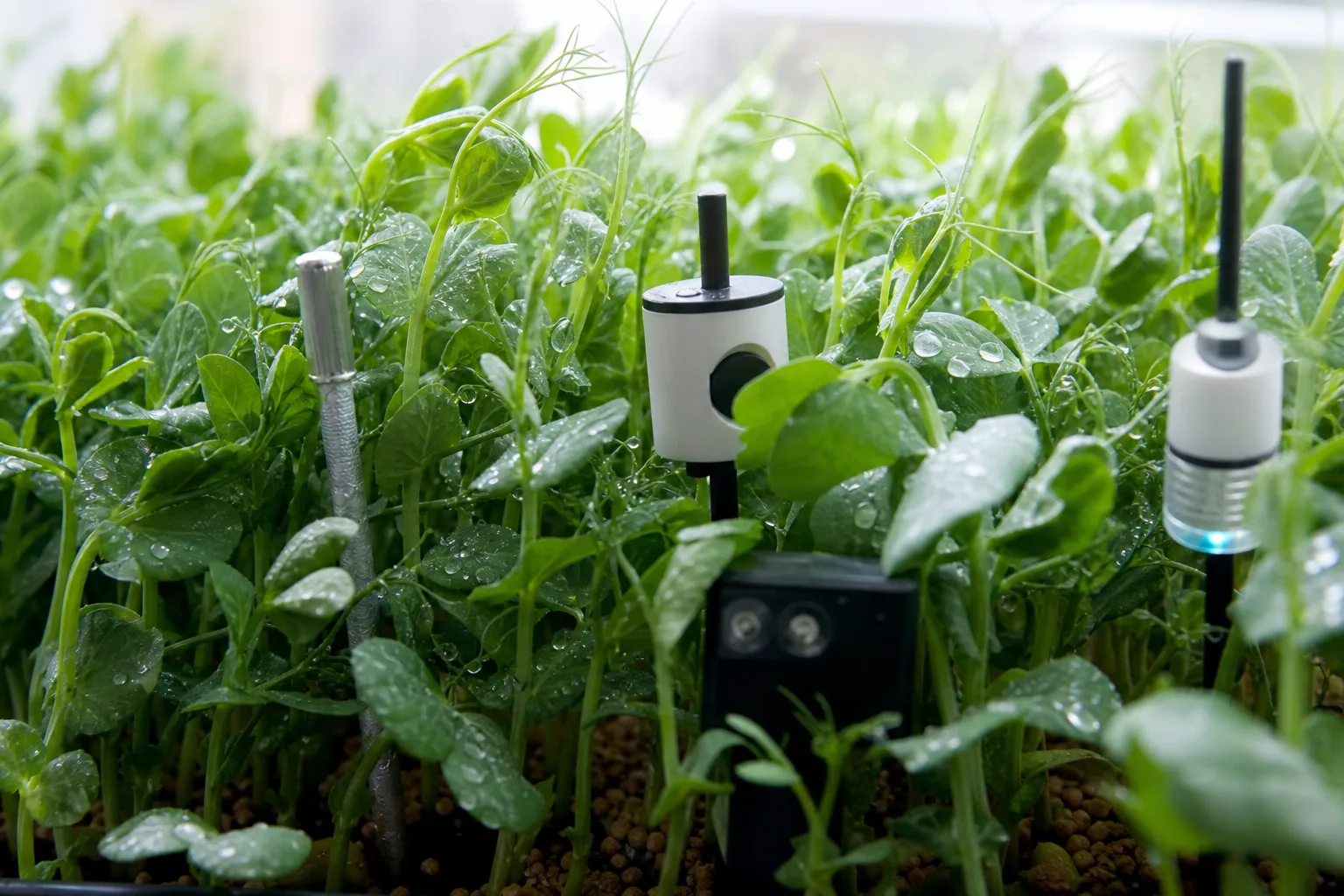
What a smart grower tracks
You don't need a lab to grow well, but a handful of measurements do most of the heavy lifting. Here are the signals that matter most for microgreens, what they influence, and the rough range to aim for.
| Metric | Why it matters | Typical target for microgreens |
|---|---|---|
| Air temperature | Drives germination speed and growth rate; too high invites mold | 18–24 °C (64–75 °F) |
| Relative humidity | High humidity sprouts seeds but feeds fungus once leaves open | 50–65% after germination |
| Light (PAR / DLI) | Determines color, sturdiness, and flavor compounds | 12–17 hrs/day of bright light |
| Water amount & timing | Too much drowns roots; too little stresses the crop | Even moisture, never waterlogged |
| Days since sowing | Anchors every other reading to a growth stage | Tracked from day 0 |
That last row is quietly important. In the tomato greenhouse research, "planting days" was tracked as its own variable alongside temperature and humidity, because the same reading means different things at different stages. A burst of humidity is exactly what you want during the blackout germination phase, but the same number a week later is a mold warning. Numbers only make sense in context, and time is the context. We dig into the germination phase specifically in microgreens germination blackout.
The feedback loop: where data turns into better harvests
Sensing and logging are only useful if they close the loop and change what you do next. This is the "feedback" part, and it's the engine behind every gain in yield and quality.
The pattern is simple. A sensor reads a value. That value gets compared to a target, what control engineers call a setpoint. If the reading drifts past the setpoint, something acts to pull it back. In a greenhouse, this is concrete: when the air gets warmer than the temperature setpoint, vents crack open by a percentage that scales with how far off the reading is. When CO2 drops too low, a supply system tops it up. The greenhouse is constantly nudging itself back toward the conditions you asked for.
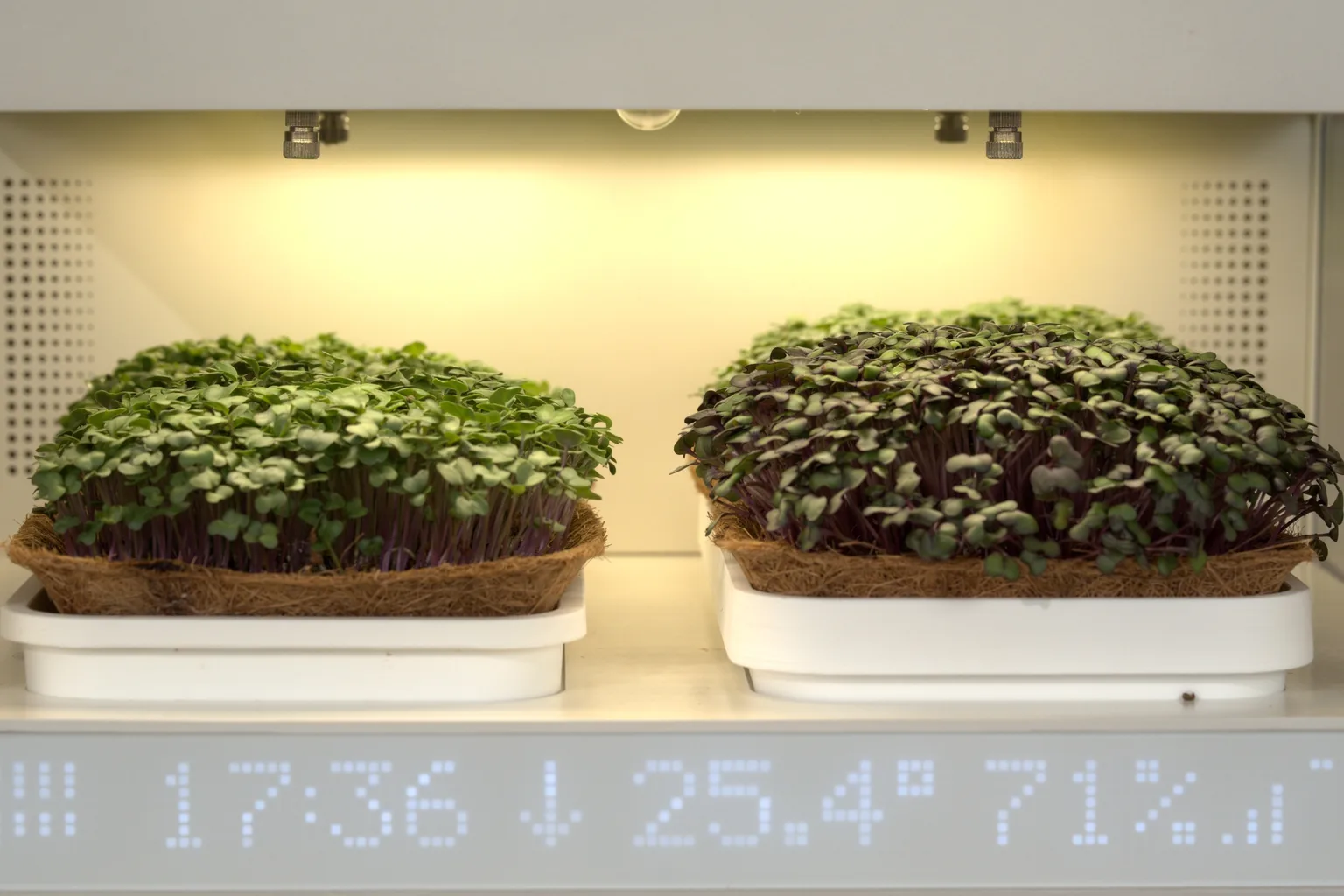
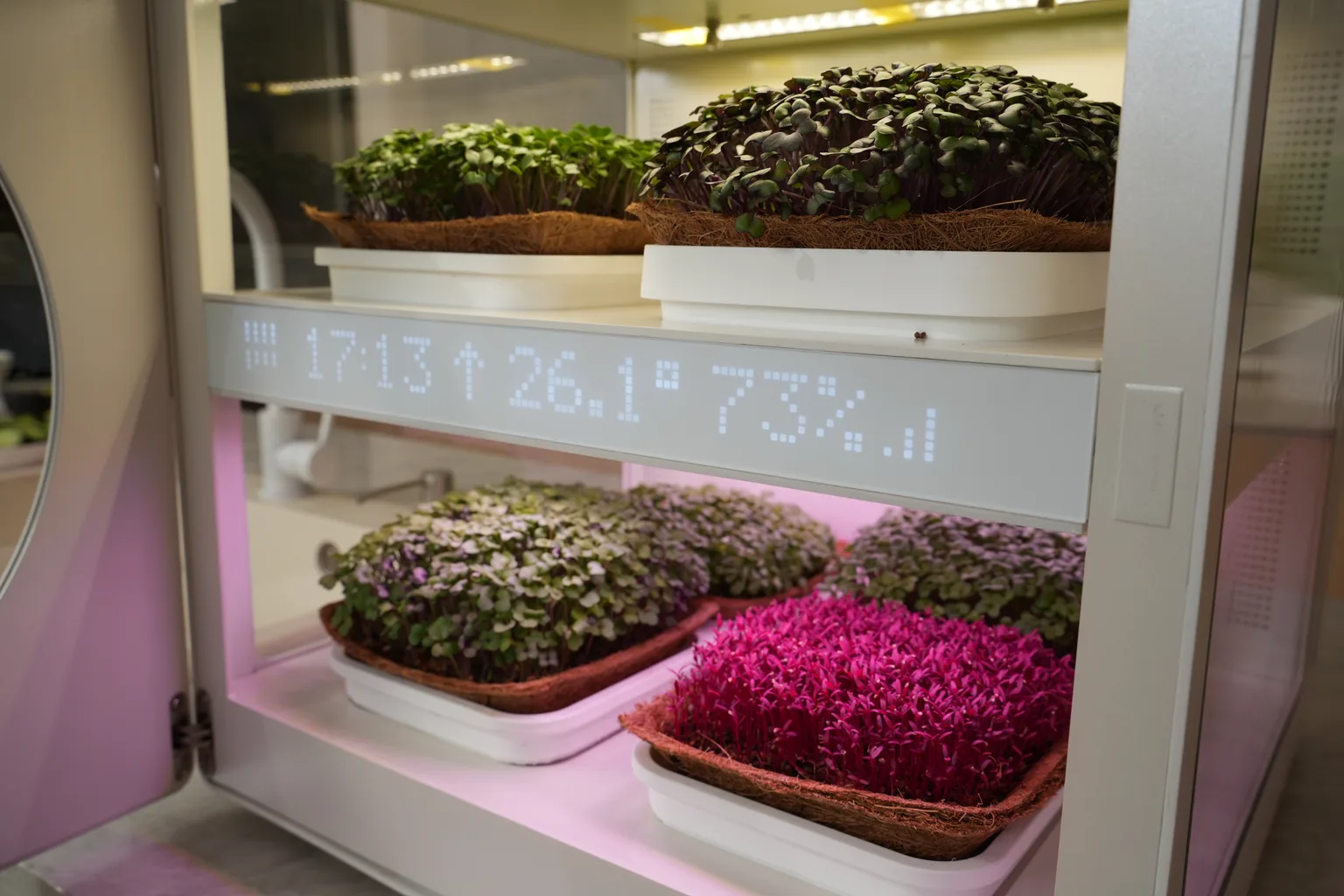
This closed-loop control is precisely what lets a device hold steady conditions while you're at work or asleep. It's the difference between checking on a tray and a tray that quietly manages itself. Our Luya countertop grower runs on exactly this principle, and you can see how the whole loop fits together in how Luya works.
Why steady numbers beat heroic effort
Here's a counterintuitive lesson from the research: chasing the single best outcome can actually make results worse. The autonomous greenhouse team found that an AI controller trained purely to maximize its average reward learned risky habits. It would do brilliantly in ideal conditions and then stumble badly when the environment got perturbed.
Their fix was to deliberately teach the system to care about its worst days, not just its best ones. By focusing training on the tougher, lower-reward situations, the controller became far more robust. The numbers back this up. When they stress-tested both versions under abnormal conditions, the robustness-focused approach held up dramatically better.
| Stress condition | Crop fresh weight (baseline) | Crop fresh weight (robust) | Survival rate (baseline → robust) |
|---|---|---|---|
| Excessive heat (35–40 °C) | 38.5 | 45.2 | 80% → 85% |
| Cold snap (−2 to 10 °C) | 30.3 | 38.5 | 63% → 73% |
| Very high humidity (90%) | 32.7 | 39.3 | 68% → 74% |
| No sunlight | 36.8 | 43.7 | 77% → 82% |
The takeaway for any grower, human or machine: consistency wins. A tray kept reliably in its comfortable range, day after day, will out-yield one that swings between great and terrible. This is the quiet advantage of controlled-environment agriculture, and it's why a home device that simply holds the line tends to beat sporadic hands-on fussing.
Looking ahead instead of just reacting
The most advanced systems do more than react to the current reading. They predict. A technique called model predictive control looks a few steps into the future, simulating how the crop and climate will respond to different choices, then picks the action that pays off best over time, not just this minute.
In one lettuce greenhouse study, researchers measured profitability with an economic indicator that subtracted heating and CO2 costs from the value of the harvest. A purely reactive controller struggled to plan that far ahead. But when they paired a learned policy with forward-looking optimization, the combined system squeezed out better economic results even with a short planning window. In plain terms: it grew a more valuable crop while wasting less energy.
You don't run optimization math by hand at home, of course. But you can borrow the mindset. Instead of reacting to a leggy, stretched-out tray after the fact, you learn that low light early on causes it, and you fix the cause before it happens. (We walk through that specific rescue in how to fix leggy microgreens.) Prediction is really just experience, written down and reused.
Starting your own data habit
You can begin with almost nothing. A cheap thermometer-hygrometer and a notebook will take you surprisingly far. The habit matters more than the gear.
A simple starting routine:
- Pick three numbers. Temperature, humidity, and a daily note on how the tray looks. That's enough to spot patterns.
- Log at the same time each day. Consistency in measuring is what makes the data comparable.
- Write down outcomes, too. Final harvest weight and a one-word taste note close the loop between conditions and results.
- Change one thing at a time. If you adjust light and watering together, you won't know which one helped.
Within a few cycles, you'll start seeing the connections yourself: this humidity level, that mold problem; this light schedule, those vibrant green leaves. That's the same insight an AI controller learns, just on a human timescale. If you want a fuller picture of how home growing is heading in this direction, the future of home farming is a good next read, and the basics in how to grow microgreens at home pair well with a fresh logging habit.
The bottom line
Data-driven growing isn't about turning your kitchen into a control room. It's about replacing "I think" with "I know." When you measure the right handful of variables, write them down, and let those numbers guide your next move, every tray teaches you something, and the lessons stack up. Whether the loop is closed by a smart device or by you and a notebook, the result is the same: steadier conditions, fewer failures, and a harvest that gets a little better every single time.