Imagine driving with your eyes closed, steering only by a route you memorized the night before. You might stay on the road for a while. But the moment a truck merges or the lane shifts, you are in trouble, because you are following a plan instead of reacting to the road. A surprising amount of indoor growing equipment works exactly like that closed-eyes driver. It runs a fixed schedule: lights on at 6 a.m., a burst of misting at noon, a heater that clicks on by the clock. It never actually looks at the plants.
Closed-loop climate control is the opposite. It keeps its eyes open. Sensors read what is really happening inside the growing space, a controller decides what to do about it, and actuators make the change, over and over, every few seconds or minutes. This article walks through how that loop works, why it consistently beats a fixed schedule, and how we put the same idea to work inside a countertop grower.
What "closed-loop" actually means
A control loop has four moving parts, and the word "closed" describes how they connect.
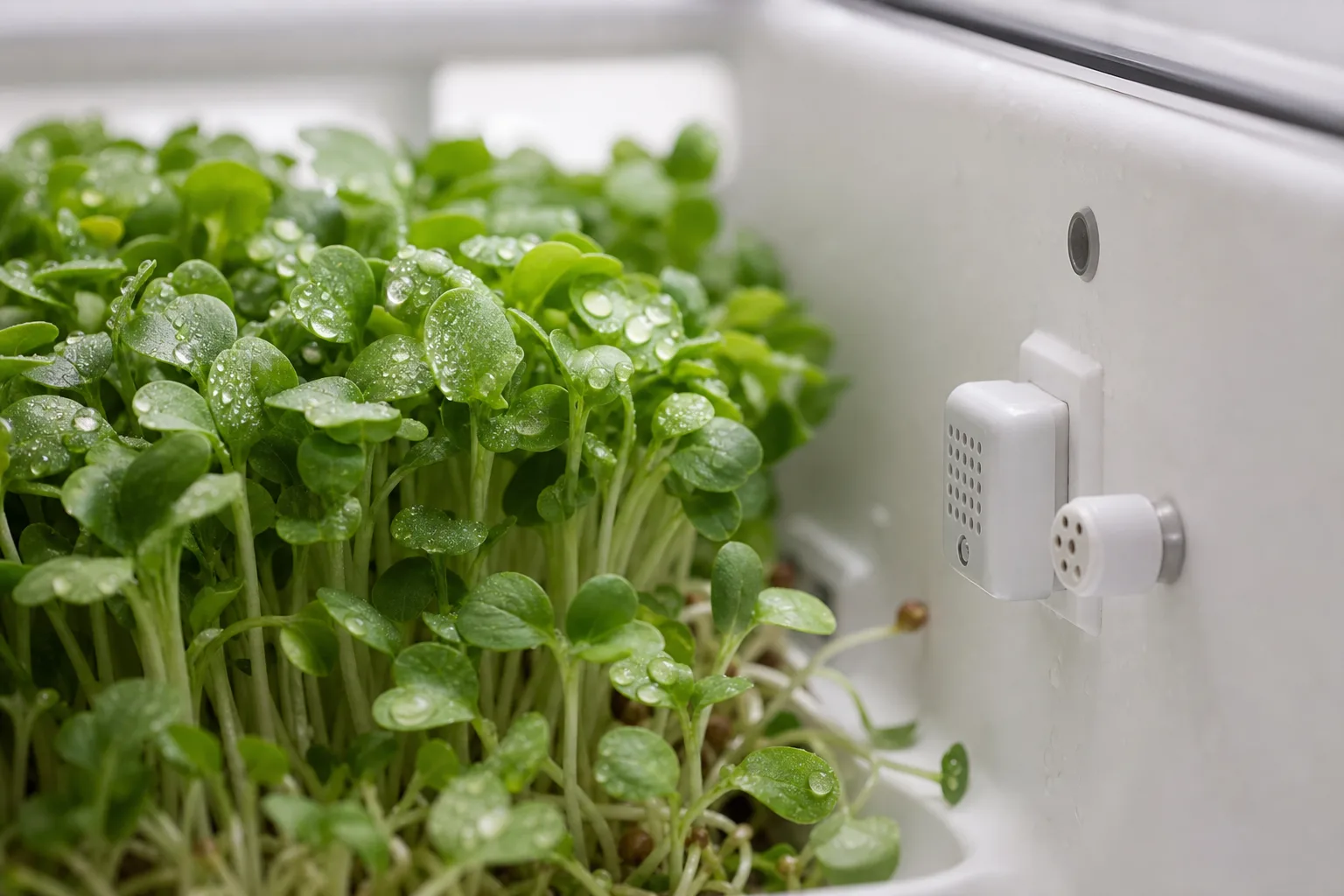
First, sensors measure the current state: air temperature, humidity, sometimes carbon dioxide or how much light is landing on the leaves. Second, a controller compares those readings against a target, like "keep the air between 22 and 25 degrees Celsius." Third, actuators act on the decision by adding heat, drawing it away, nudging a fan, or dimming a light. Fourth, and this is the part that makes it a loop, the sensors read again to see whether the action worked, and the cycle repeats.
In an open-loop system, that fourth step is missing. The controller sends commands and simply trusts that the world responded as expected. It never checks. A closed loop closes that gap by feeding the result back into the next decision. That single connection, output looping back to input, is why these systems handle surprises so gracefully.
Greenhouses are a good place to see why this matters. Researchers at Cornell University who modeled a semi-closed greenhouse in Brooklyn noted that indoor temperature is constantly shoved around by things you cannot schedule: outdoor air, wind, snow, a cloud passing over the sun. Their word for it was "stochastic," which is a polite way of saying the weather refuses to follow your plan. A fixed schedule has no answer for that. A feedback loop does.
Why fixed schedules quietly fail
A timer-based setup looks fine on paper. You decide the plants need a certain temperature and humidity, you program it, and you walk away. The trouble is that the timer is steering by a map drawn yesterday, in a room that keeps changing today.
Say your heater is set to run for ten minutes every hour. On a mild afternoon, ten minutes might overshoot and cook the seedlings. On a cold night, ten minutes might not be nearly enough, and the tray drifts cold for hours before the next cycle. The schedule cannot tell the difference because it never measures the result. Over a full season, those small misses pile up into uneven growth, leggy stretched seedlings, and the damp, stagnant conditions that invite mold.
There is also a cost angle. A blunt schedule tends to over-correct, running heating or cooling harder than the plants need. The Cornell team measured this directly: a smart, feedback-driven controller cut energy use by 61 percent over a six-month evaluation while keeping the plants in range. Same goal, far less wasted power, simply because the system stopped acting blind.
| Approach | Reacts to conditions? | Energy efficiency | Result for the plants |
|---|---|---|---|
| Open-loop timer | No, follows the clock | Low, tends to over-correct | Uneven, drifts off target |
| Basic thermostat | Yes, one variable | Moderate | Steadier temperature only |
| Closed-loop multi-sensor | Yes, several variables together | High | Consistent, tuned to the crop |
From sensor reading to decision
The interesting part of any control loop is the middle: how a stream of numbers becomes a good action. There is a whole ladder of sophistication here.
The simplest controller is a thermostat. Temperature drops below target, heat turns on; it rises above, heat turns off. Useful, but crude, and it only watches one thing. A step up is model predictive control, which uses a forecast of where conditions are heading to plan a few moves ahead, the way a chess player thinks past the current turn. It works well, but it leans on an accurate model of the space, and as the greenhouse researchers pointed out, real environments involve messy phenomena like heat flow and crop growth that first-principles models struggle to capture exactly.
That is where AI-driven approaches come in. Instead of being handed a perfect model, a reinforcement learning controller learns a strategy by trying actions and seeing what they earn. The Cornell framework used a neural network to estimate the value of each possible move from the current state, then nudged its choice toward the best available action. Crucially, it could choose from a smooth, continuous range of heating and cooling power rather than a handful of fixed steps, which let it apply exactly the right amount of energy instead of the nearest rough setting.
What all three share is the loop. Measure, decide, act, measure again. The smarter the controller, the better that decision in the middle gets, but the structure never changes.
The feedback loop in plain terms
Strip away the math and a closed loop is just disciplined attentiveness, the same thing a careful gardener does by hand.
You touch the soil. Too dry, so you water. An hour later you check again to see whether the water reached the roots or ran off the top. That second check is the feedback. It separates "I did something" from "I got the result I wanted." A good controller does this hundreds of times a day, without getting tired or optimistic.
The payoff is stability. Because the loop is always correcting, conditions hold steady in a tight band instead of swinging high and low. For microgreens, that steadiness is most of the game. These are fast crops, harvested in a week or two, and they reward consistency far more than occasional perfect moments. Steady warmth and steady airflow give you even germination, sturdy stems, and clean trays, which is the whole promise behind growing at home instead of buying tired store-bought packs.
Picking the right target
A loop is only as good as the number it is chasing. Aim at the wrong target and you will hit it perfectly, to no benefit. So part of designing closed-loop control is knowing what each crop actually wants.
The greenhouse study set a clear band for its tomato scenario, holding indoor air between 22 and 25 degrees Celsius for healthy growth and penalizing the controller whenever conditions strayed outside it. Microgreens have their own comfortable ranges, and they shift across the short life of the crop. Here are reasonable countertop targets to give you a feel for the variables a loop juggles at once.
| Stage | Air temperature | Humidity | Airflow |
|---|---|---|---|
| Germination (blackout) | 20-24 degC | 90-95% | Minimal |
| Early greening | 18-22 degC | 60-70% | Gentle, steady |
| Pre-harvest | 18-21 degC | 50-60% | Moderate |
Notice that humidity needs to fall sharply as the crop matures. A fixed schedule cannot make that transition cleanly, but a feedback loop watching the real numbers can ease humidity down exactly when airflow and moisture need to change, which is one of the best defenses against mold late in the cycle.
How Luya runs the loop on your counter
Everything above usually lives in an industrial greenhouse with rooftop vents and big climate machinery. The quiet shift of the last few years is that the same logic now fits in an appliance on your kitchen counter.
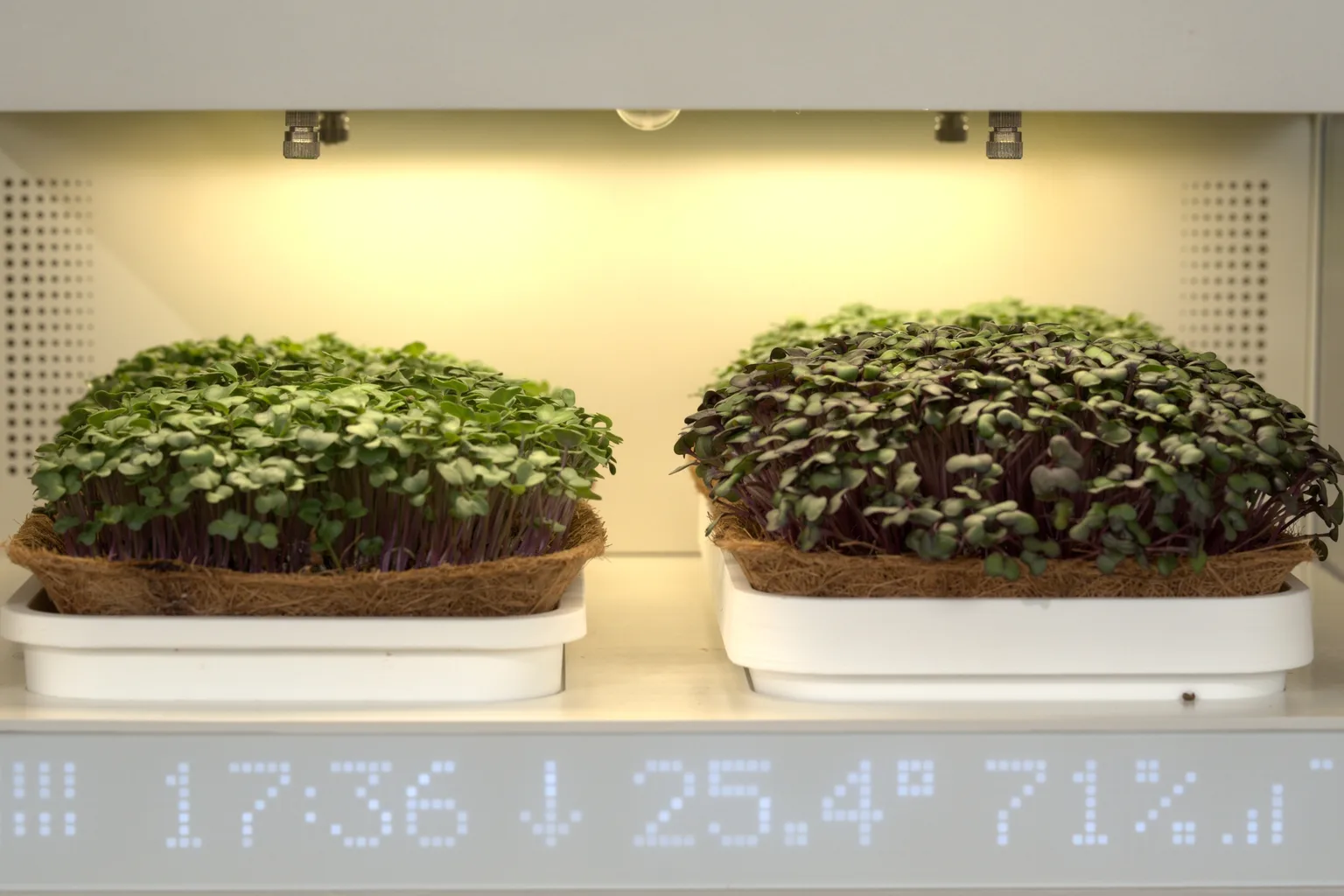
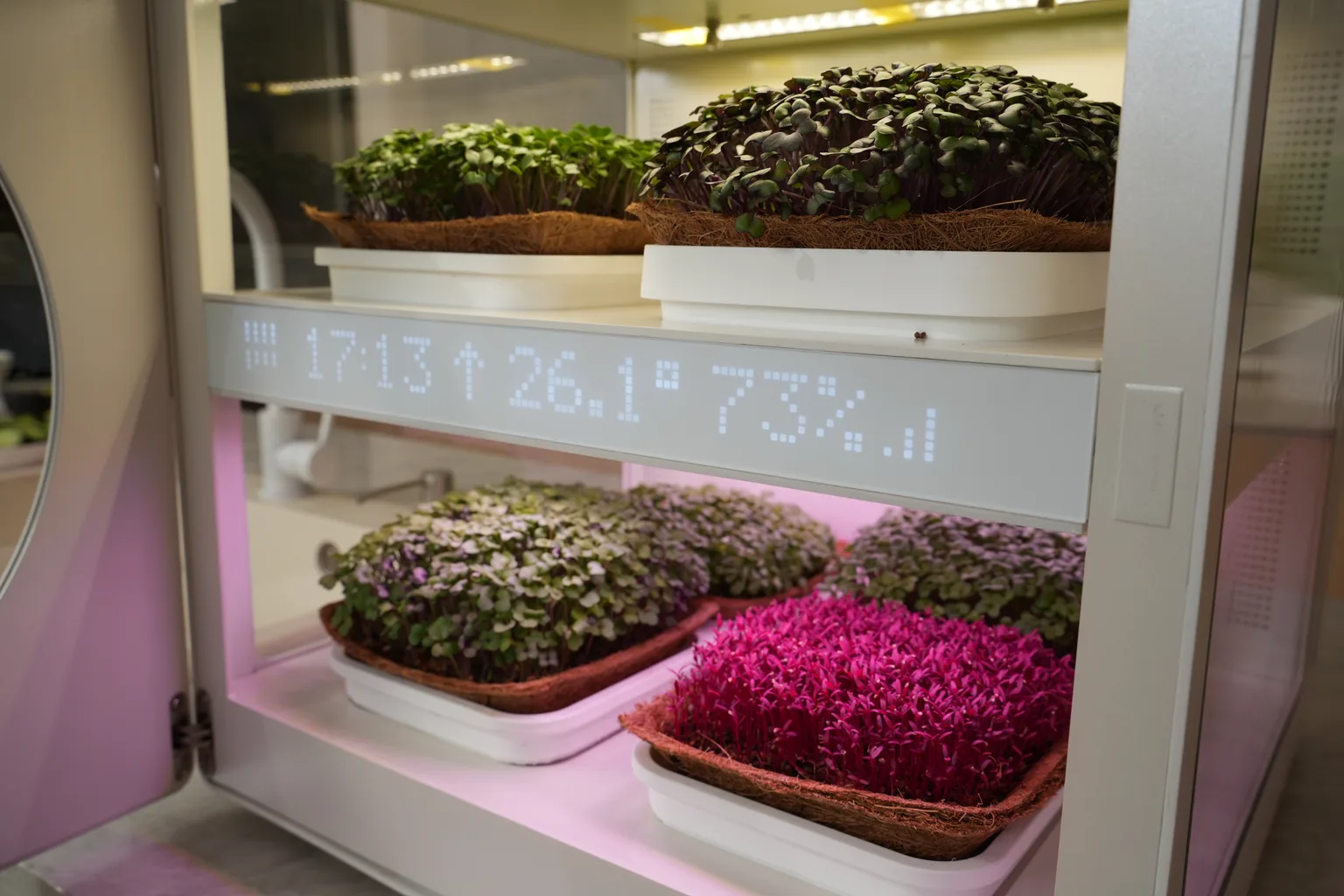
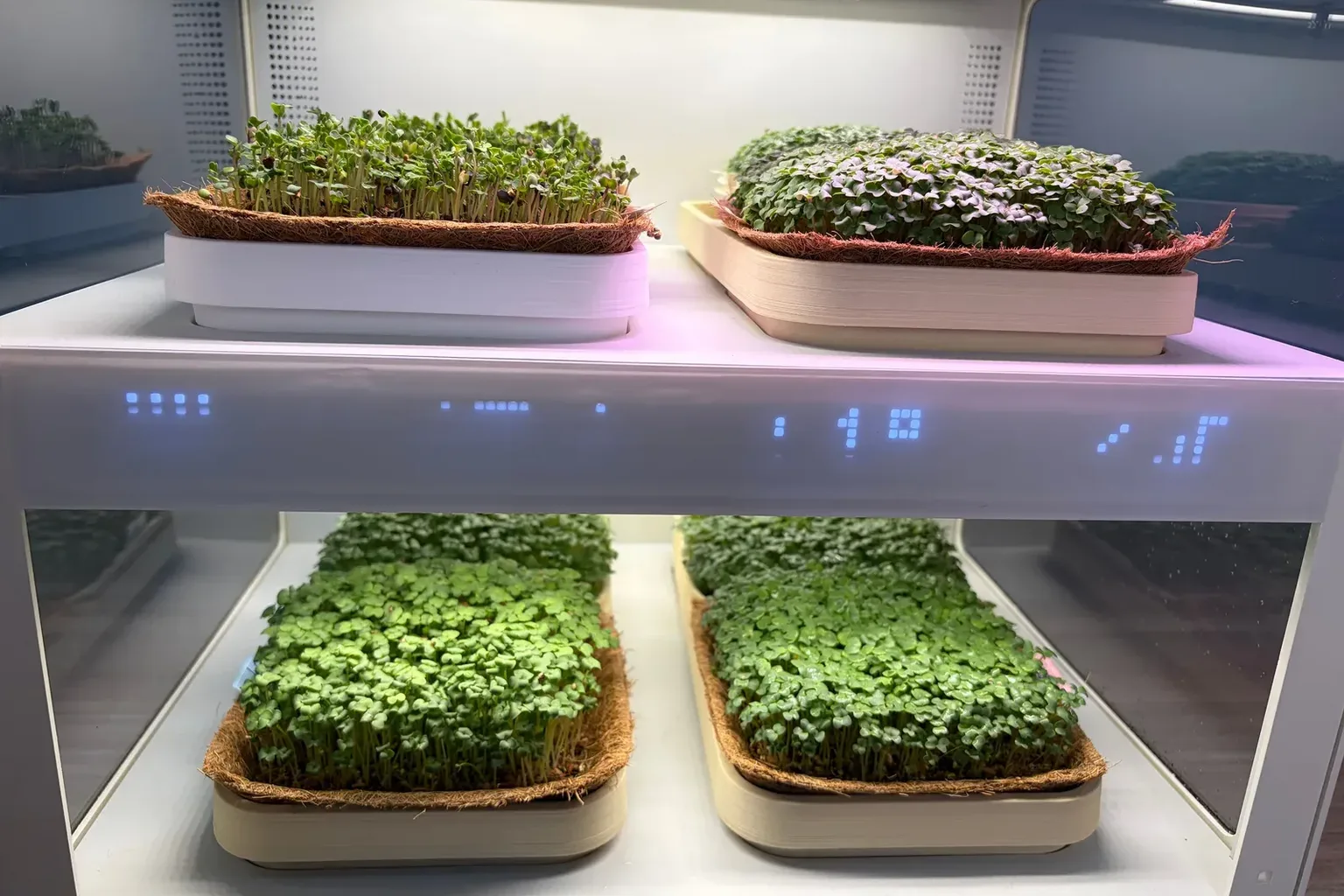
Luya is built around a closed loop rather than a timer. Onboard sensors watch the growing chamber, the controller compares those readings to crop-specific targets like the ones in the table above, and it adjusts light, airflow, and water to keep conditions in the right band as your kitchen warms up in the afternoon or cools down overnight. You are not programming a schedule and hoping. The device is reading the actual environment and correcting it, the way a greenhouse does, scaled down to a single tray. If you want the deeper mechanics, we cover them in how Luya works.
For you, that looks like very little. You drop in a pre-seeded tray, and the loop handles the moment-to-moment fussing that decides whether microgreens thrive or sulk. The reward is the part you can taste: dense, even trays of fresh greens ready to snip whenever you want them.
The takeaway
Closed-loop climate control is not a marketing flourish. It is the simple, durable idea that a growing system should look at its plants and respond, not just run a script. Sensors observe, a controller decides, actuators act, and the loop checks its own work and tries again. That feedback is what lets a system stay on target through changing weather, do it with far less wasted energy, and hold the steady conditions that fast crops like microgreens depend on. Whether it is a greenhouse in Brooklyn or a grower on your counter, the principle is the same: keep your eyes open, and keep correcting.