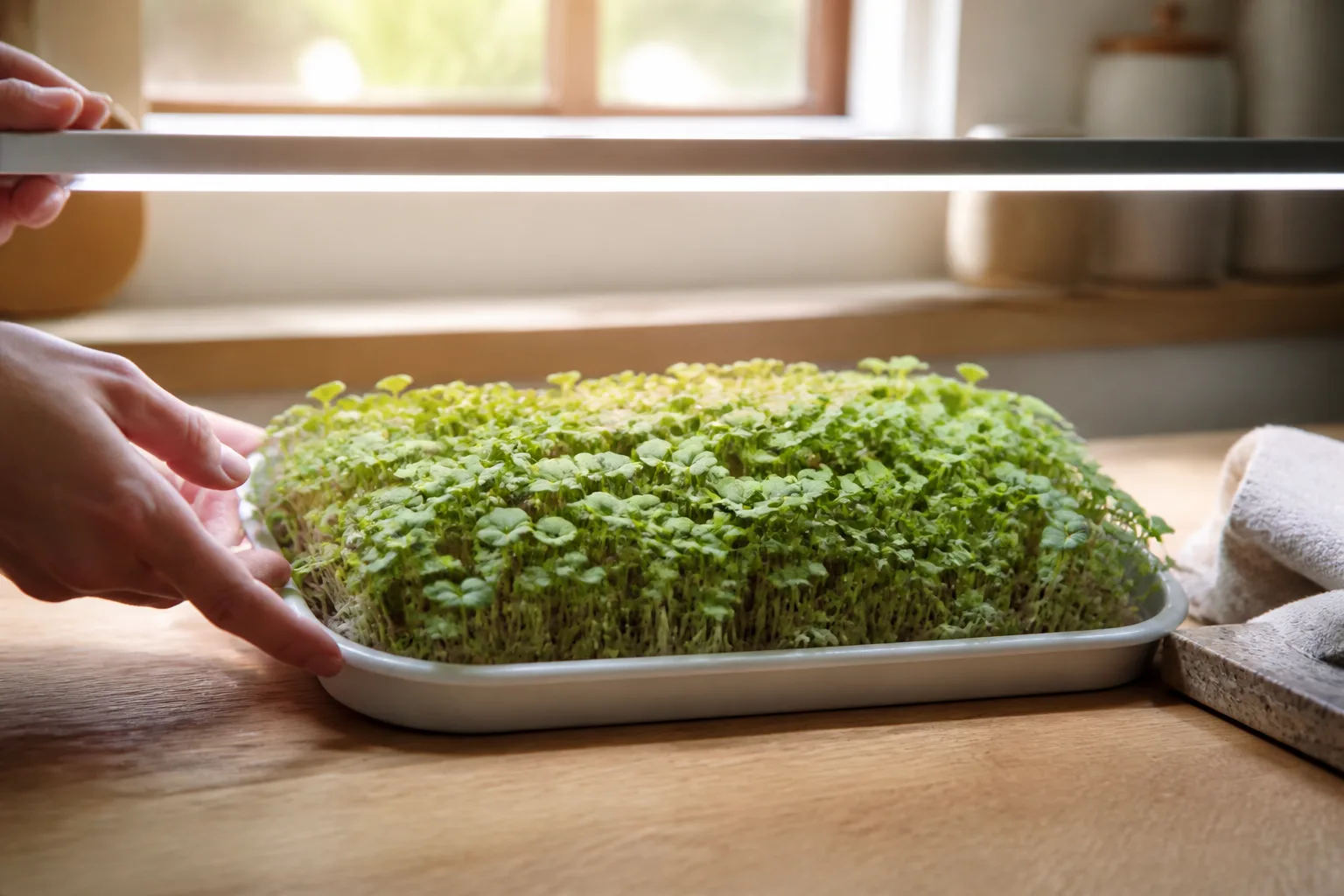
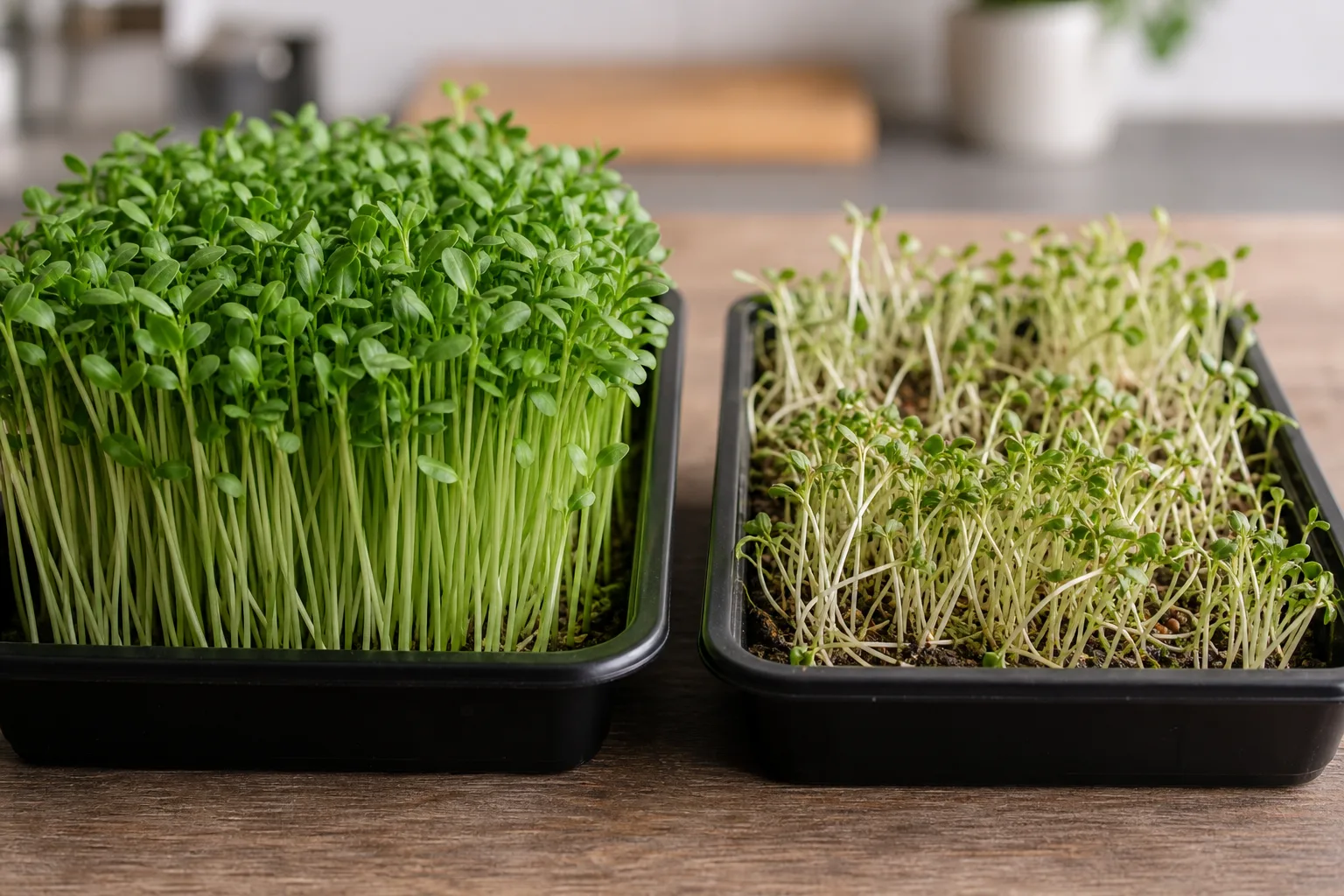
If you have ever grown a tray of microgreens on a windowsill, you already know the frustration. One batch comes up thick, sweet, and bright green. The next, grown from the same seed packet, turns out patchy, pale, and stretched, with a few sad spots of fuzzy mold. You did not change anything on purpose. So what happened?
The honest answer is that your kitchen changed around the seeds. A cold snap, a sunny afternoon, a closed window, a dry heating vent. Plants are exquisitely sensitive to their surroundings, and microgreens, harvested in their first week or two of life, feel every swing. The difference between a great tray and a mediocre one usually is not the seed or your skill. It is the stability of the environment. That is the whole case for precise climate control, and it is worth understanding why it matters so much.
Plants read their environment as instructions
A growing plant does not just passively soak up warmth and light. It actively reads temperature, humidity, airflow, and the color of the light hitting its leaves, and it adjusts its biology in response. Light is a particularly powerful signal. Plant cells carry specialized light sensors, and different wavelengths flip different switches. Blue light, for example, nudges plants to build up flavonoids and phenolic compounds, the same antioxidant families that make greens nutritious. Red light shapes how plants stretch and how they make certain defensive compounds. Ultraviolet light, used carefully, can push plants to ramp up protective pigments and antioxidants.
These are not curiosities. They are the everyday machinery behind the nutrients you actually eat. The catch is that the response depends on getting the dose right. A little of the right signal at the right time builds quality. Too much becomes stress that damages the plant and shuts production down. Researchers describe this as a "low dose helps, high dose harms" pattern, and it shows up again and again in how plants handle light. A windowsill cannot dose anything. It just gives you whatever the weather happens to deliver that day.
If you want to go deeper on the science here, our guide on how light affects microgreen nutrition walks through the specific wavelengths and what each one does.
Why variable home conditions hold your harvest back
Think about what a tray of seeds experiences in a normal home over a week. Daytime temperatures drift up when the sun hits the counter, then drop at night. Humidity spikes after a shower or while you cook, then crashes when the heater kicks on. Light is bright by the window and dim two feet away, and it disappears entirely on a cloudy day. Airflow is whatever happens to move through the room.
Each of those swings sends mixed messages to the plants. The result is uneven growth: some seeds race ahead, others lag, and a few never catch up. Tall, floppy, pale stems, what growers call "leggy" microgreens, are a classic sign that the light was too weak or too far away. We cover the fix in detail in how to fix leggy microgreens, but the root cause is almost always an environment that could not hold steady.
There is a hidden cost too. Warm, damp, still air is exactly what mold spores love. A lot of the mold problems home growers blame on bad seed are really humidity and airflow problems. If your trays keep fuzzing over, why microgreens keep molding explains how stable humidity and gentle air movement break the cycle.
What "precise" actually looks like
Precision is not about pushing conditions to extremes. It is about holding the sweet spot steady, hour after hour, so the plants never get a confusing signal. Most fast leafy microgreens do best in a fairly narrow band. Here is a reasonable set of targets for the growing phase, after germination:
| Condition | Comfortable range | Why it matters |
|---|---|---|
| Air temperature | 18-24 C (64-75 F) | Drives steady, even growth; cold stalls it, heat stretches stems |
| Relative humidity | 40-60% | Enough moisture to grow, dry enough to keep mold away |
| Daily light period | 12-16 hours | Sets the metabolic rhythm that builds color and nutrients |
| Airflow | Gentle, constant | Strengthens stems and dries leaf surfaces |
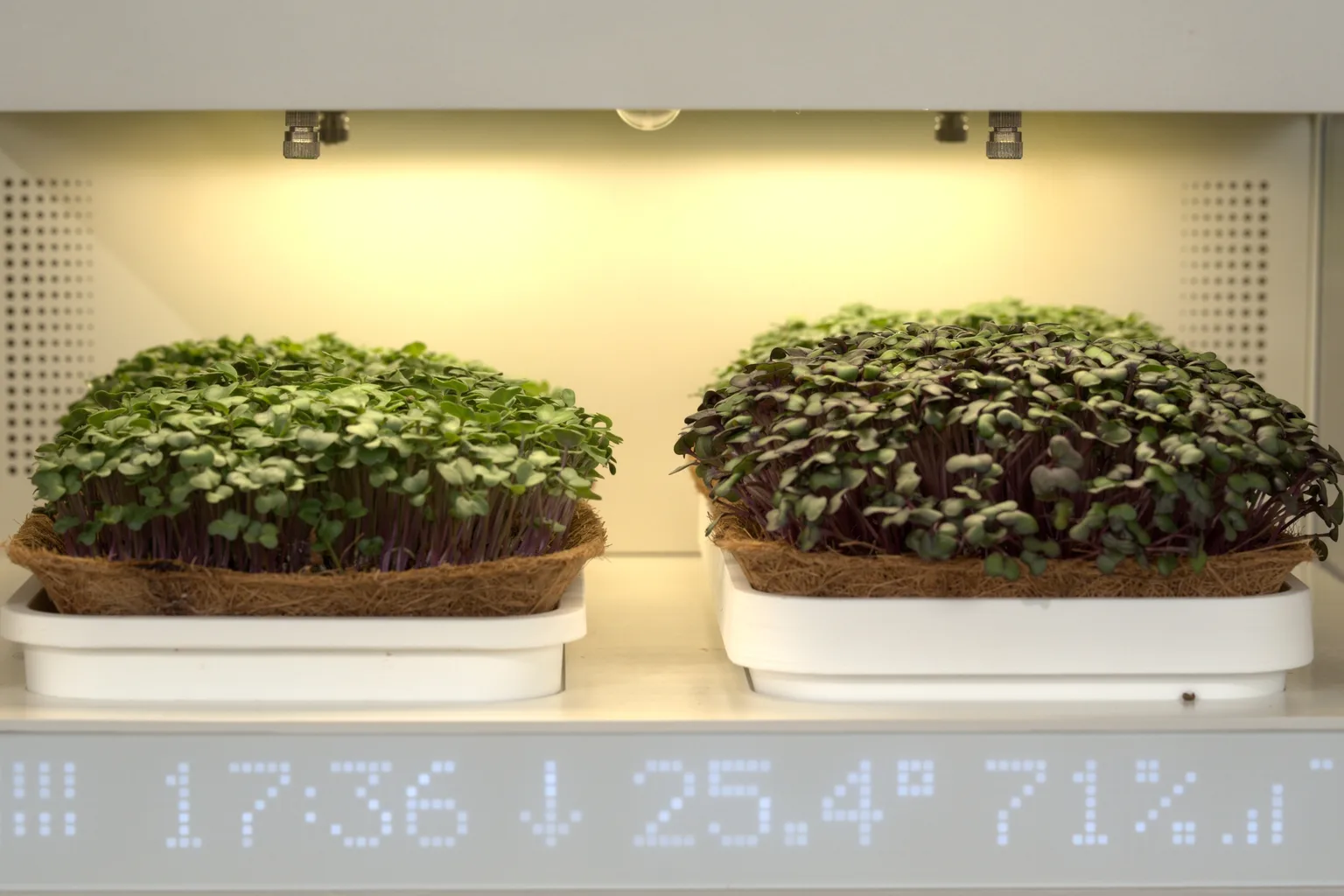
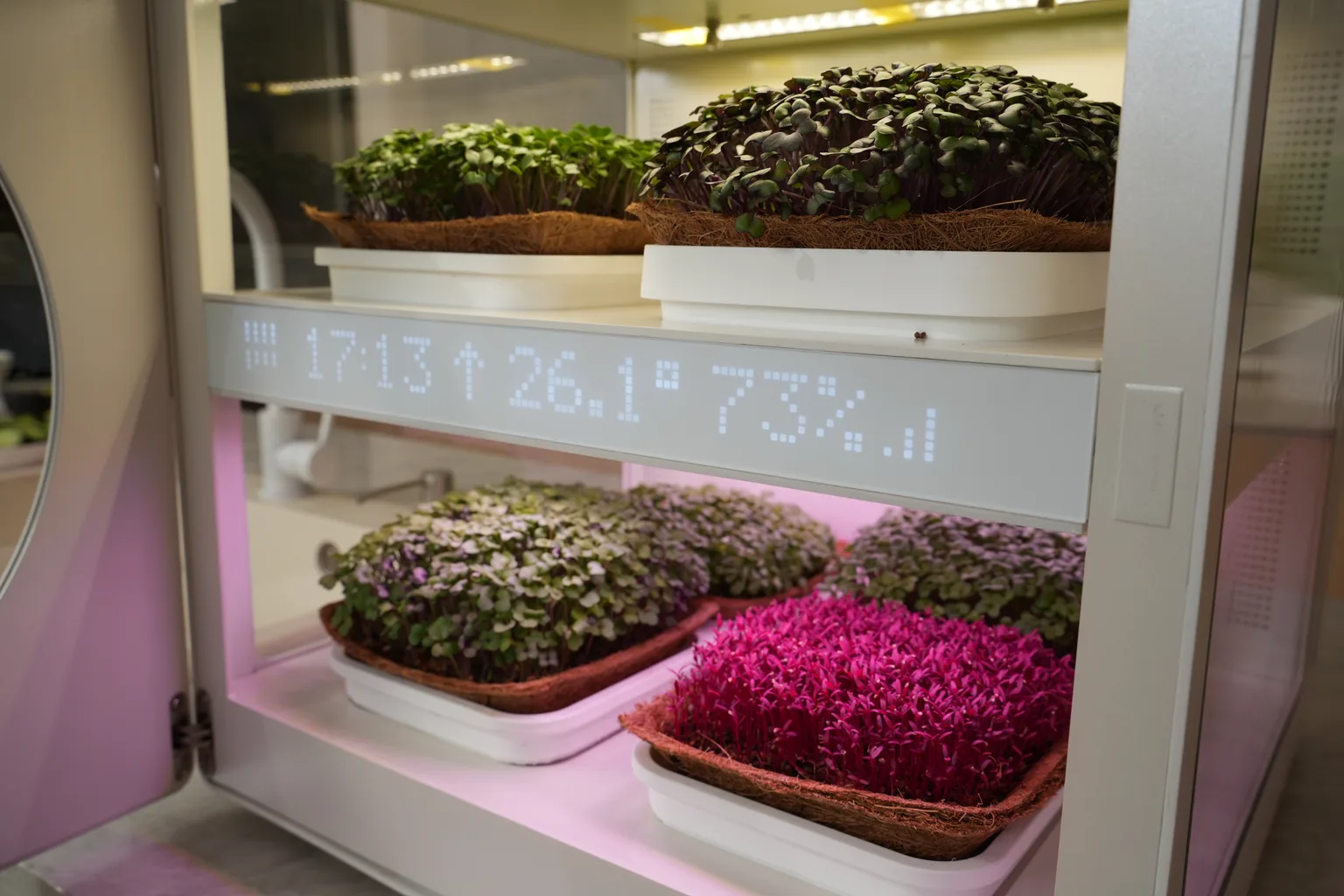
Notice how every range has both a floor and a ceiling. Drop below the floor and growth slows or nutrients stall. Push past the ceiling and you invite stress, legginess, or mold. The skill is staying inside the band consistently, which is hard to do by hand and easy to do with a system built for it. That is the design idea behind a countertop grower like Luya: hold the climate where the plants thrive and keep it there.
The payoff: uniform, nutrient-rich, reliable trays
When conditions stay steady, three good things happen together.
First, you get uniformity. Seeds germinate on the same schedule and grow at the same pace, so the whole tray matures evenly and you can harvest it all at once. No more cutting around the bald spots.
Second, you get better nutrition. Because steady light and temperature keep the plant's metabolism running smoothly, those antioxidant and pigment pathways stay productive instead of stop-starting. A consistent light period in particular keeps the daily rhythm that governs flavonoid and phenolic production. The same crop, grown in a controlled climate versus a chaotic one, can land in a meaningfully different place on quality.
Third, and maybe most underrated, you get reliability. Repeatable conditions mean repeatable results. The table below sketches the difference in plain terms.
| Outcome | Variable windowsill | Controlled climate |
|---|---|---|
| Germination | Staggered, uneven | Synchronized across the tray |
| Stem strength | Often leggy and pale | Sturdy and upright |
| Mold risk | Higher, unpredictable | Lower, manageable |
| Nutrient consistency | Swings batch to batch | Steady and repeatable |
| Harvest timing | Guesswork | Predictable |
Reliability is what turns microgreens from an occasional experiment into a real habit. If you know Thursday's tray will look like last Thursday's, you actually keep eating them, which is the entire point. For more on the nutrition side, are microgreens good for you and microgreens nutrition lay out what these tiny greens bring to the table.

How smart systems hold the line
Keeping a climate steady sounds simple until you try it. The environment is always drifting, the outside weather keeps interfering, and the right move for temperature might be the wrong move for humidity. This is the same hard problem that commercial greenhouses wrestle with, and it is where modern control thinking comes in.
Advanced greenhouse research has moved toward systems that do not just react to a single reading but actually plan ahead. One promising approach, called model predictive control, looks at the current state of the crop, predicts where conditions are heading, and chooses adjustments that keep everything inside safe limits while spending as little energy as possible. The control loop runs constantly, often re-deciding every fifteen minutes, so small drifts get corrected before they become problems.
The newer twist is pairing that planning with machine learning. Real growing environments never match a tidy textbook model exactly, because weather is uncertain and every space behaves a little differently. Researchers have shown that letting the controller learn from its own results over many growth cycles, using reinforcement learning, lets it tune itself to the real conditions it faces. In simulations, controllers that learn this way kept temperature and humidity inside healthy bounds far more reliably than fixed approaches, while still producing efficient growth. The lesson scales straight down to your counter: a grower that senses, predicts, and adapts will hold the sweet spot better than any timer or thermostat alone. If you are curious how that intelligence translates into a kitchen appliance, how Luya works goes under the hood.
The bottom line
Better microgreens are not really a secret of better seed or a greener thumb. They are the natural result of a stable environment. When temperature, humidity, and light hold steady, plants get clear instructions, grow evenly, build their nutrients without interruption, and shrug off mold. When those conditions swing, quality swings with them.
You can chase that stability by hand, fussing with windows, fans, and lamps, and plenty of dedicated growers do. Or you can let a purpose-built system hold the line for you. Either way, the principle is the same, and it is worth remembering the next time a tray surprises you: it was probably the climate talking. Want to start growing? How to grow microgreens at home is a friendly place to begin.