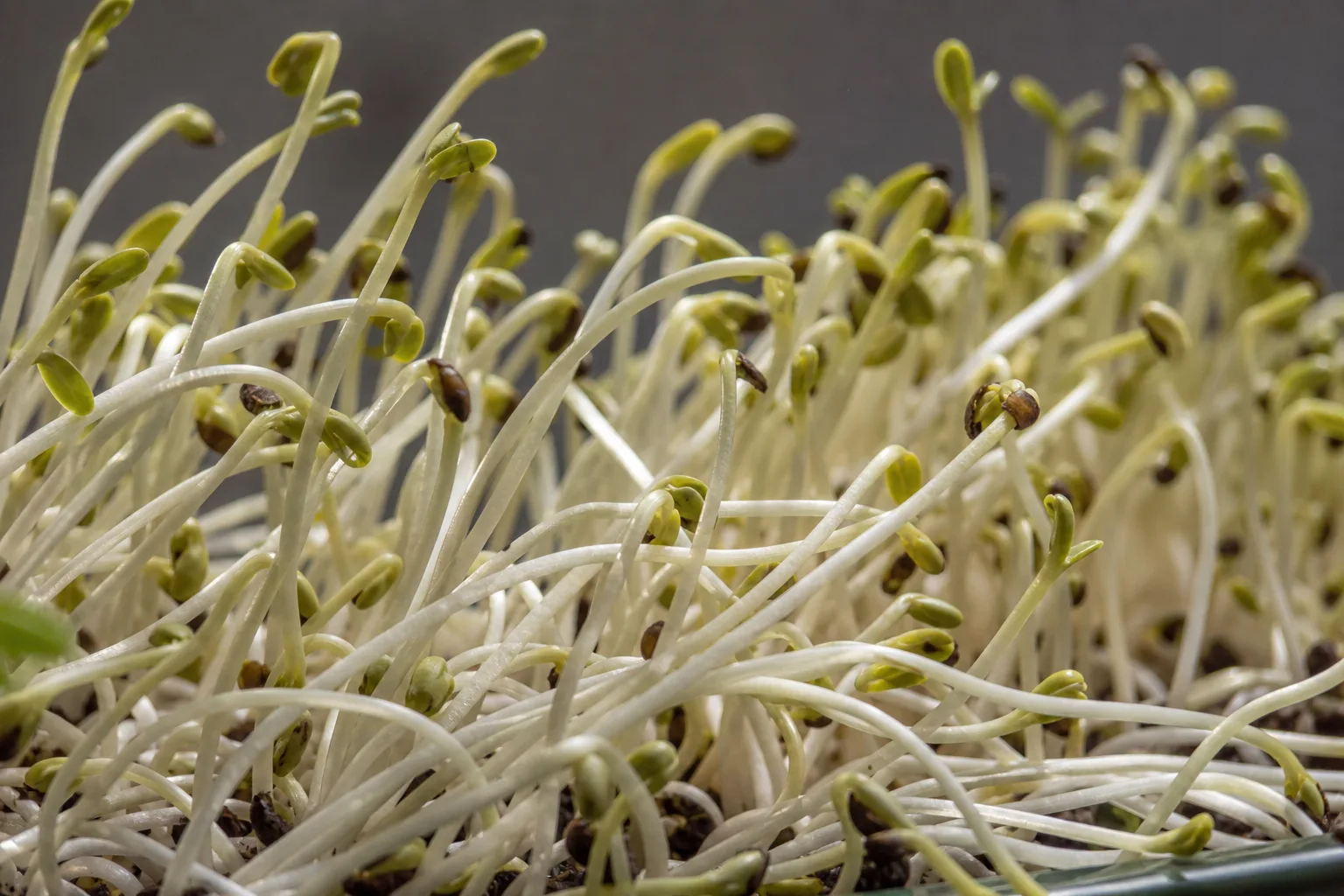
You lift the dome off your tray, expecting a tidy green carpet, and instead you get a tangle of pale stems leaning sideways like wheat after a storm. The seedlings are tall, sure, but they are thin, floppy, and barely holding their own heads up. This is the single most common complaint I hear from home growers, and it has a name: legginess, or in plant-science terms, etiolation.
The good news is that leggy microgreens are almost never about bad seed or bad luck. They are a predictable response to a single thing the plant is missing, and once you understand the signal the seedling is reacting to, the fix is usually quick. Let me walk you through what is actually happening inside those stems and how to grow short, sturdy trays every time.
What "leggy" actually means
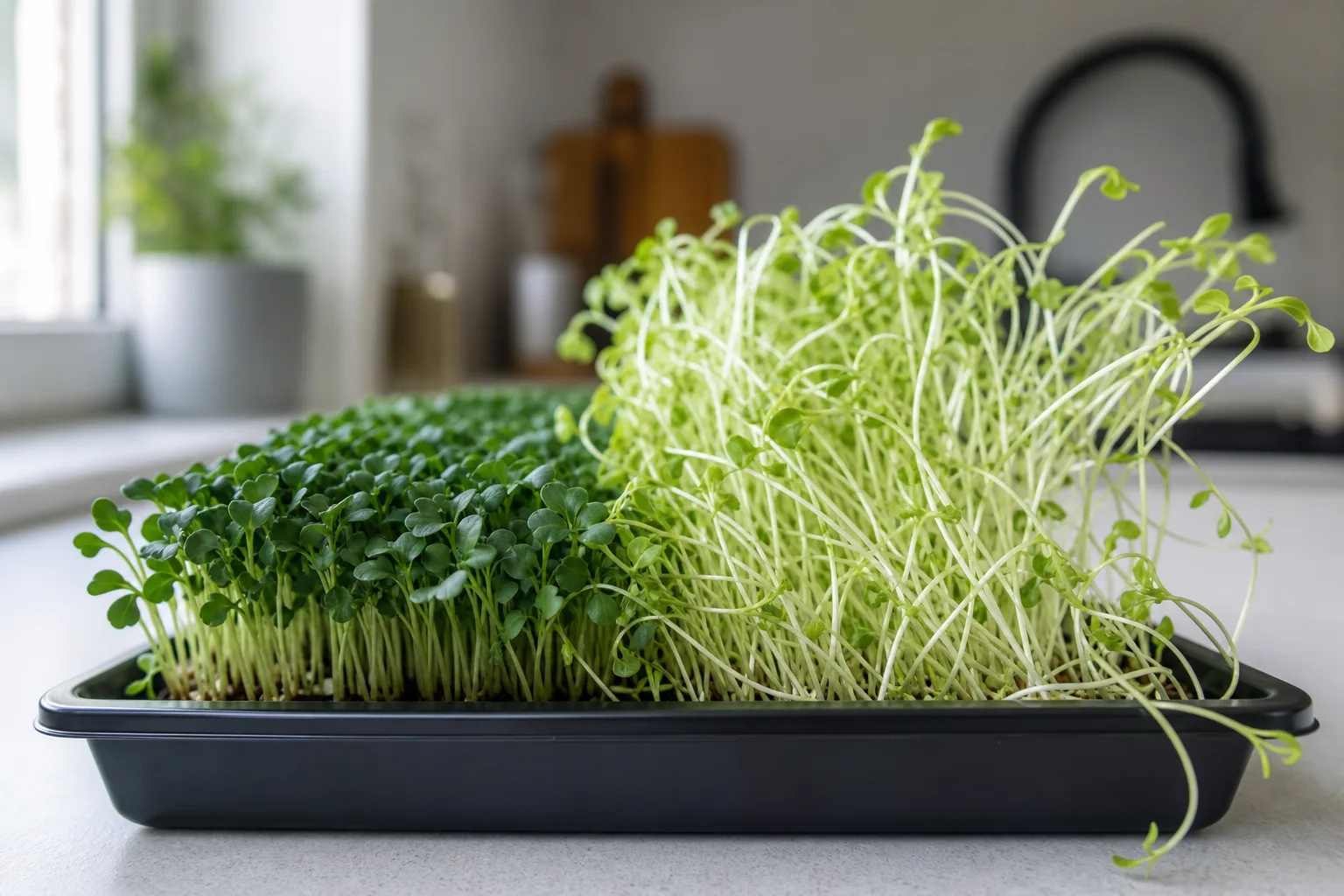
A leggy microgreen is one that has poured its energy into stem length instead of building a thick, self-supporting body. The stems run tall and thin, the color drifts toward pale yellow-green, and the seed leaves (the cotyledons) often stay small and slow to open. Push your hand gently across the canopy and the whole tray lies down rather than springing back.
This is etiolation, and it is a survival reflex. A seed that sprouts buried under soil cannot photosynthesize yet, so it does the only sensible thing: it stretches upward as fast as possible to reach the light it assumes is somewhere above. Elongated stems, closed leaves, pale color, minimal root investment. Every one of those traits is the plant betting everything on a sprint to the surface.
The catch is that this sprint is meant to be temporary. In nature it ends the moment the seedling breaks into daylight, which tells the plant to stop stretching and start bulking up. When that daylight signal arrives too late, too dim, or too far away, the sprint never ends, and you get a tray of overgrown, weak-stemmed micros.
Light is the master switch
Here is the part that surprises people: legginess is rarely a watering or nutrient problem. It is a light problem, and light is by far the strongest lever you have over how a microgreen grows.
Plants do not just use light as food. They read it as information. Specialized light sensors in the plant tissue, with names like phytochromes and cryptochromes, constantly measure how much light is hitting the seedling and what color it is, then decide in real time whether to keep stretching or thicken up and green out. Research on how light steers plant chemistry shows the same theme over and over: the amount of light a plant receives directly shapes what it builds, because brighter light fuels more photosynthesis and supplies the carbon needed for sturdy tissue. Under weak light, that carbon supply is throttled, and growth turns thin and stretchy.
Blue light in particular is a powerful "stop stretching" signal. When blue wavelengths reach a seedling, they act through those cryptochrome sensors to rein in stem elongation and encourage compact, leafy growth. A tray that gets plenty of bright, blue-rich white light tends to stay short and stocky. A tray sitting in dim, warm, yellowish light keeps reaching. If you want the deeper science, I dug into this in light and microgreen nutrition and blue light microgreens.
The three light mistakes that cause legginess
In practice, almost every leggy tray traces back to one of three things. Often more than one.
The light is too dim. Microgreens are not fussy about spectrum, but they are hungry for intensity. A weak desk lamp or a single low-output bulb simply does not deliver enough photons to switch off the stretch response. As a rule of thumb, you can hardly make microgreens too bright, but you can very easily make them too dim.
The light is too far away. Light falls off fast with distance. A fixture that would be perfect at a hand's width above the canopy becomes useless at three feet. This is the most common culprit I see, because people hang a light "above the shelf" without thinking about how far above.
The light arrives too late. Microgreens spend their first days in the dark on purpose (more on that below). But if you forget to uncover them on time, those extra dark days pile on extra, useless stretch.
| Symptom | Likely cause | Fix |
|---|---|---|
| Tall, pale, floppy across the whole tray | Light too dim or too far | Move the light closer; add more output |
| Stretchy only after uncovering | Stayed in blackout too long | Uncover a day earlier next grow |
| Stems lean toward one side | Light coming from a window or off-center | Center the light directly overhead |
| Tall stems but good color | Mild stretch, often fine | Usually cosmetic; tighten light next time |
How close, how bright, how long
Let me put real numbers on it, because "bright enough" is too vague to act on.
For light color, microgreens do beautifully under plain white LED in the daylight range, roughly 5000K to 6500K. You do not need fancy red-and-blue spectrum panels; a basic white "shop light" or even household LED bulbs in that range work fine, as long as there is enough of it. LEDs are my standard recommendation: cheap to run, cool to the touch, and long-lived.
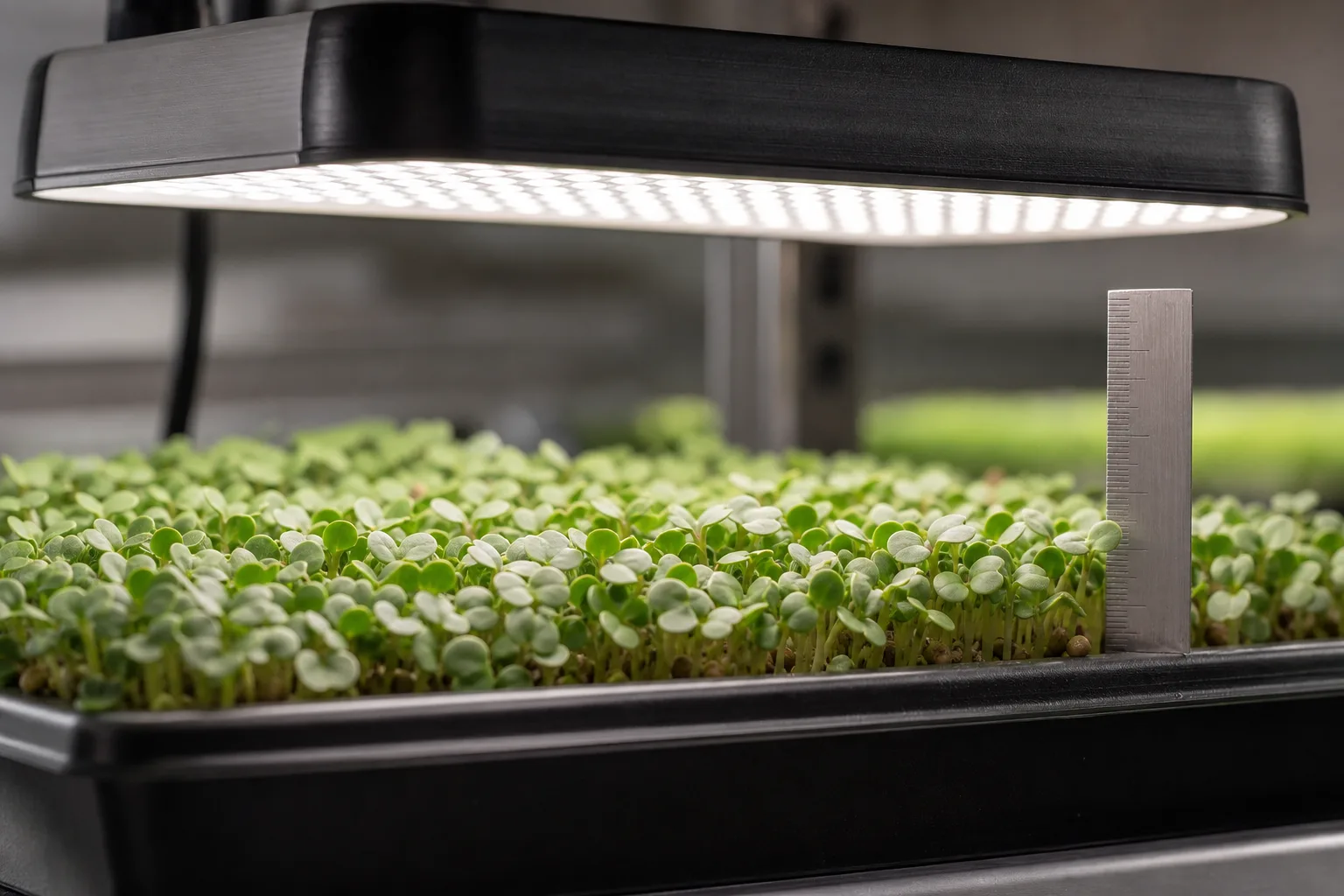
For distance, get the light close. On my own racks I keep white LED shop lights right around 12 to 14 inches above the canopy, and I would not push them much farther. If your trays are leggy, the very first thing to try is simply lowering the fixture.
For the photoperiod, 16 hours of light a day is my sweet spot. It maximizes growth while still giving the plants a nightly rest, and it lines up with the natural day-night rhythm that plants are wired to expect. Anywhere from 12 to 24 hours can work, but 16 is the dependable default.
| Setting | Target for sturdy micros |
|---|---|
| Color temperature | 5000K–6500K (daylight white) |
| Light distance from canopy | 12–14 inches, closer if dim |
| Daily light period | 16 hours on, 8 hours off |
| Light type | White LED (shop light or bulbs) |
This is also exactly the kind of finicky balancing that automation handles well. A countertop grower like Luya keeps the light at a fixed, correct distance and runs the same tuned photoperiod every single day, which quietly removes two of the three legginess mistakes before you ever make them.
When a little leg is actually good
Now for the twist that trips up a lot of beginners. Not all stretch is bad. In fact, a controlled dose of it is part of the recipe.
During the first few days, microgreens are meant to grow in the dark under a cover and dome. This blackout period deliberately encourages some leggy growth before the cotyledons fully open, and that early stretch is a feature, not a bug. Longer stems mean more harvest weight, a cleaner-looking tray, and more length to grip when you cut. Some experienced producers spend roughly half the grow cycle in the dark precisely to bank that extra stem mass.
The difference between good stretch and bad stretch is timing. Stretch that happens in the dark, on purpose, then stops the moment you bring the tray into bright light: that is exactly right. Stretch that keeps going after the lights are on, or that never firms up, is the problem. The whole game is to harvest that early elongation, then hit the brakes hard with strong light. For the full blackout routine, see the blackout method.
A quick rescue plan for a tray that is already leggy
If you are staring at a floppy tray right now, do not toss it. Try this:
- Lower your light immediately to within a foot of the canopy, or move the tray under your brightest light source. Even mid-grow, stronger light helps the stems firm up and green out.
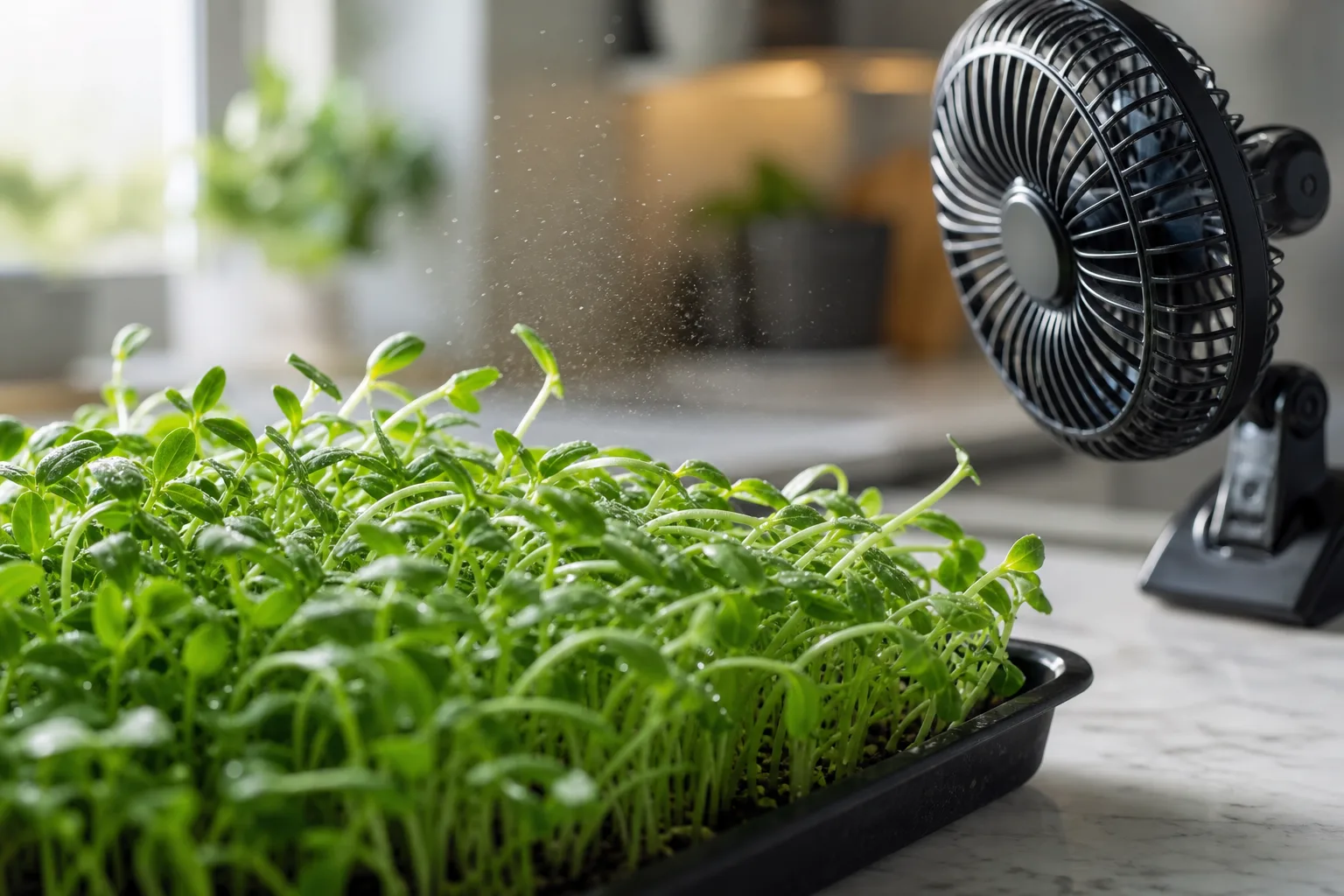
- Add gentle airflow. A small fan nudging the canopy encourages thicker, sturdier stems, the same way a breeze toughens up outdoor plants. It also keeps humidity down and mold at bay.
- Harvest a touch early if they are flopping badly. Leggy micros are still perfectly edible and nutritious; legginess is mostly a sturdiness and looks issue, not a safety one.
- Adjust for next time. Uncover a day sooner, drop the light closer, and keep your room in that comfortable 70–80°F (21–27°C) range, since cool temperatures slow growth and drag out the stretchy phase.
If mold is also showing up in your leggy trays, the two problems often share a root cause in stale, humid air. Our notes on why microgreens keep molding pair well with this fix.
The bottom line
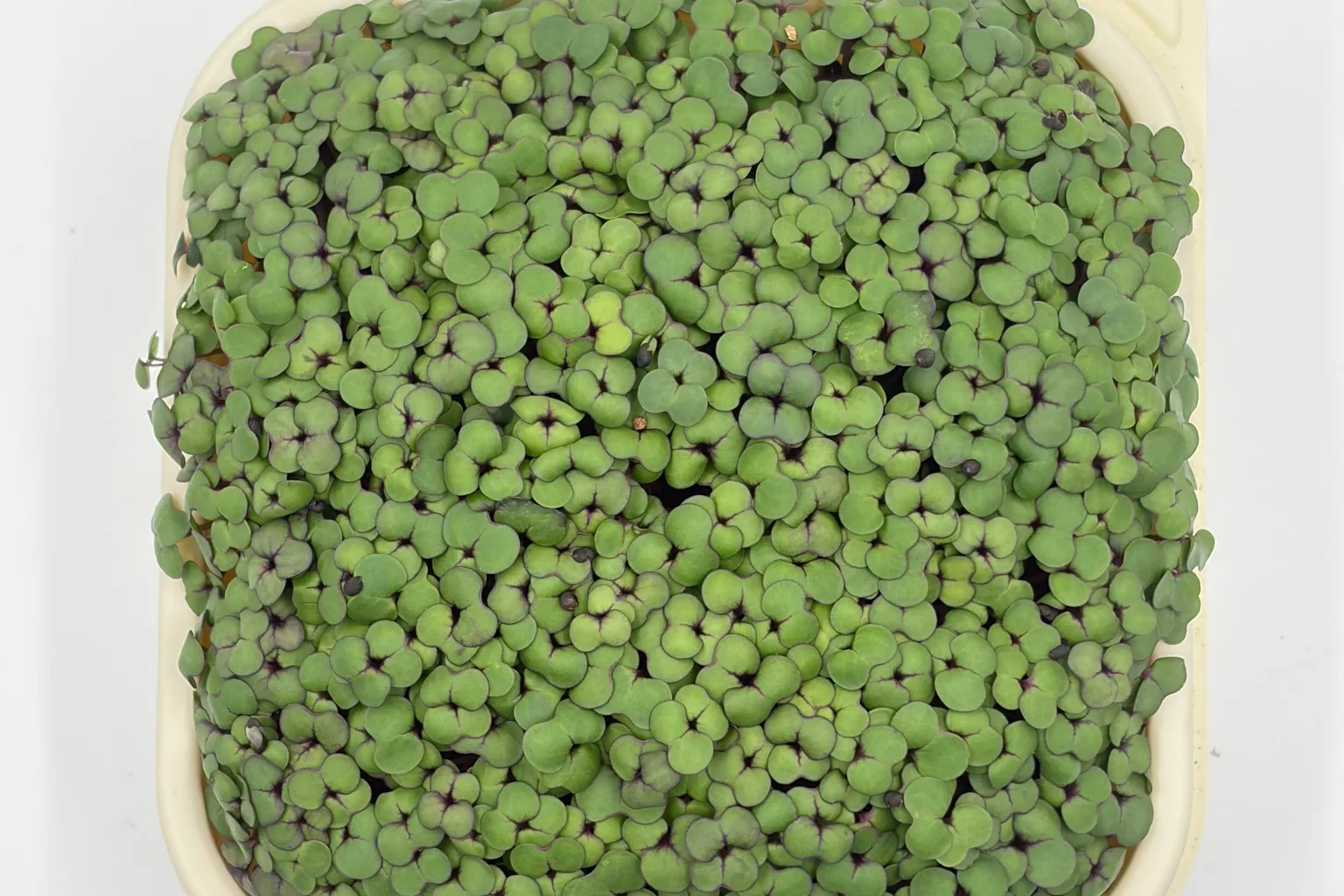
Leggy microgreens are your plants telling you, very clearly, that they are still hunting for light. A little stretch early in the dark is exactly what you want, because it builds harvest weight. The trouble starts when bright light arrives too late, too dim, or too far away, and the stretch never stops.
Fix the light and you fix the leg. Get a good white LED close to the canopy, run it 16 hours a day, uncover on schedule, and give the canopy a little breeze. Do that, and your next tray will stand up straight, color up deep and green, and hold together beautifully on the cutting board. Short and sturdy beats tall and floppy every time.