This article is for general education and is not medical advice. Talk to your doctor before changing your diet for a health condition or if you take medication.
A bag of washed salad reaches you through a chain with at least five named stages: reception and storage of the raw material, manual selection and cutting, disinfection by washing and drying, packaging, and distribution through local storage to the shelf. [1] Each one is an opportunity, and bagged salad safety is really a question about that chain rather than about lettuce.
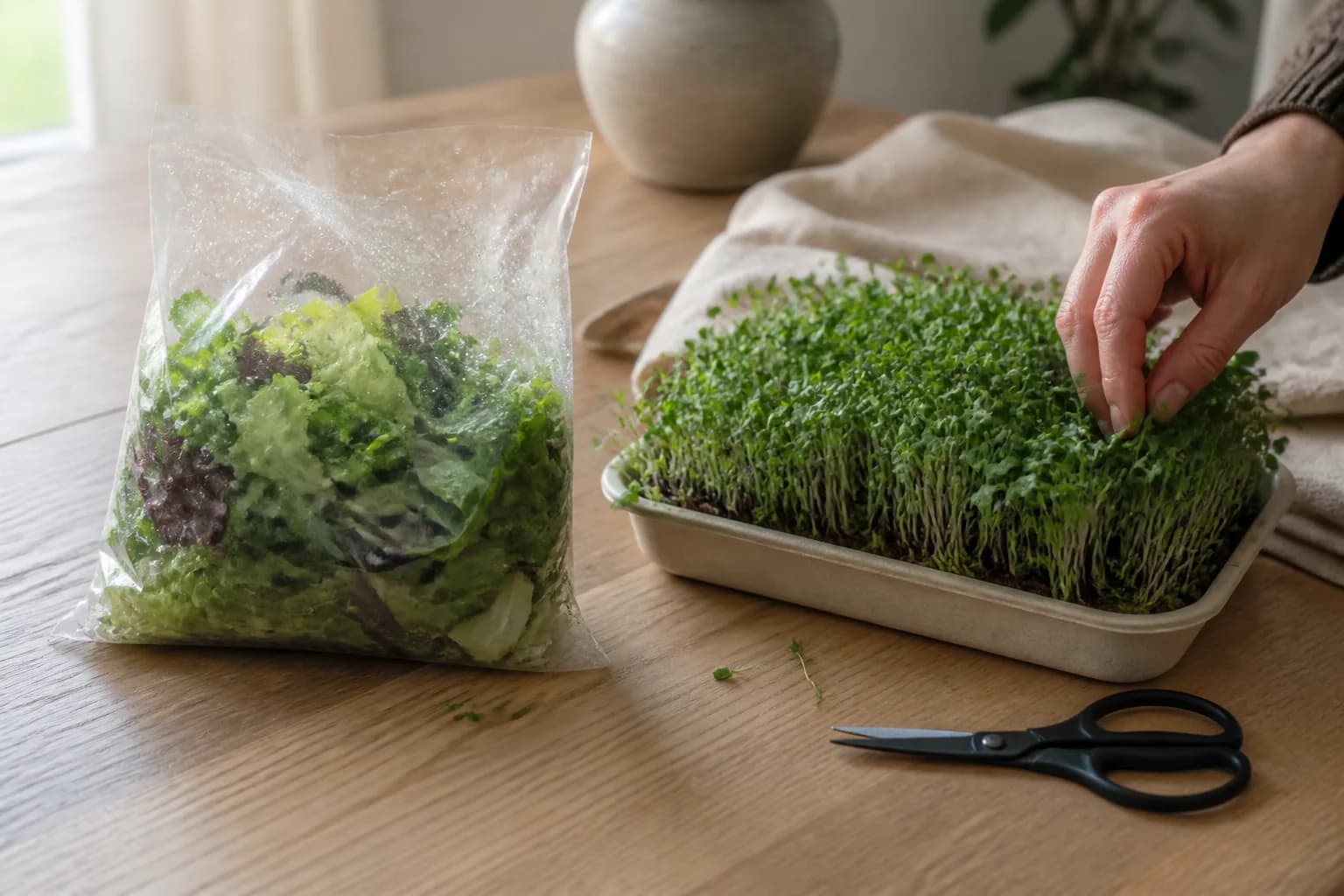
Growing greens at home does not make the risk disappear. It replaces the chain with a much shorter one that you own. That is a genuine difference, and it is worth being precise about what it does and does not buy you.
Where bagged salad safety actually gets decided
A 2024 review in Trends in Food Science & Technology walks the ready-to-eat salad supply chain looking for where fungal and bacterial contaminants enter and persist. Its framing is that microbiological quality "depends on the conditions and methods of cultivation, washing, bagging, storage, transport, and distribution" — cultivation is one item on a list of six. [1]
The washing step deserves particular attention, because it is the step consumers assume makes the product safe. Wash water is shared across a great deal of product. A disinfection stage that removes most surface organisms from most leaves is also, structurally, a stage where one contaminated batch meets everything else in the tank.
The review is also careful about proportion, and so should we be: foodborne pathogens do turn up in leafy greens in outbreaks, recalls and surveys, but they are usually present in a low fraction of samples and are genuinely hard to detect. [1] This is not a reason to fear bagged salad. It is a reason to understand that "washed and ready to eat" describes a process, not a guarantee.
What home growing removes, and what it hands you instead
Grow the greens where you eat them and the whole middle of that chain — shared wash water, bagging equipment, pallets, cold chain, days of distribution — is simply not in the story. There is no transport, so there is no cold chain to break. There is no shared tank, so there is no vehicle for one batch to contaminate a hundred.
What you take on instead is the front of the chain. You become the person responsible for the inputs, and for microgreens specifically the input that matters most is seed. Seed carries whatever it was harvested and stored with, and a warm, humid, densely-sown tray is close to ideal conditions for anything that arrives on it. That is the actual risk surface of home growing, and it is well enough understood to be manageable — we have written it up separately in seed safety.
The other input is the medium and the water, which decide not just cleanliness but the mineral content of what you harvest — a bigger effect than most people expect, covered in what the growing medium decides.
The comparison, stated fairly
- Bagged salad spreads a small risk across an industrial process with several handling stages and a distribution tail. It is heavily regulated and usually fine; the failure mode, when it happens, is wide.
- Home-grown collapses the chain to seed → medium → water → you. The failure mode is narrow and yours. There is no recall, and there is also no one else's batch in your tray.
- Neither is "safe" as a category. Both are processes, and both are only as good as their inputs and handling.
The thing worth internalising is that the freshness argument and the safety argument are not the same argument, and they do not point in quite the same direction. Freshness is about time since harvest — the subject of how fresh store-bought really is. Safety is about how many hands and how much shared water sat between a seed and your plate.
References
- Klištincová N, Pin L, Puškárová A, Giannino D, Bučková M, Lambreva MD, Manfredini A, Canfora L, Pangallo D, Pinzari F. From farm to fork: Fungal and bacterial contaminants and their diagnostics in the production steps of ready-to-eat salads. Trends in Food Science & Technology. 2024;150:104573. https://doi.org/10.1016/j.tifs.2024.104573