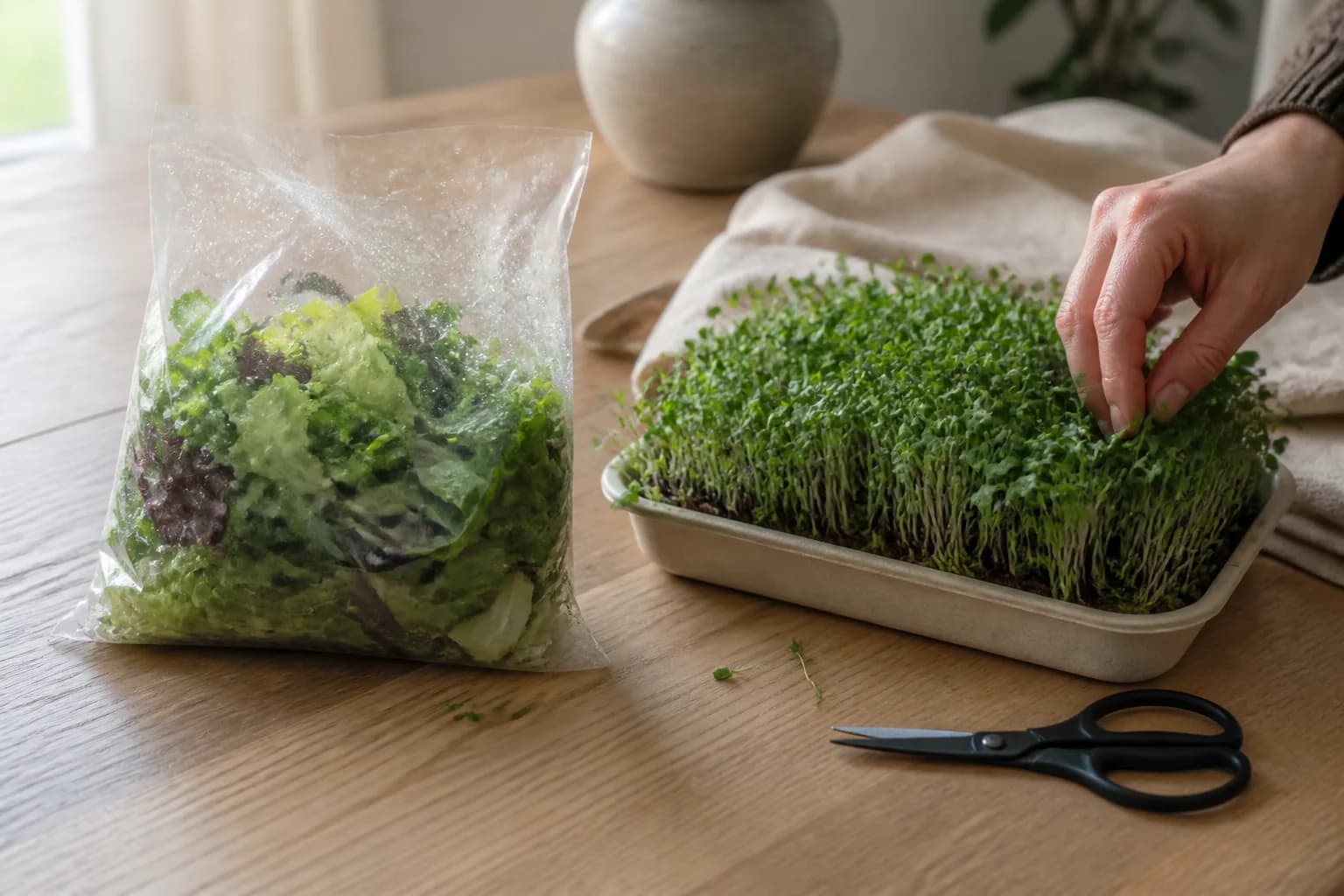
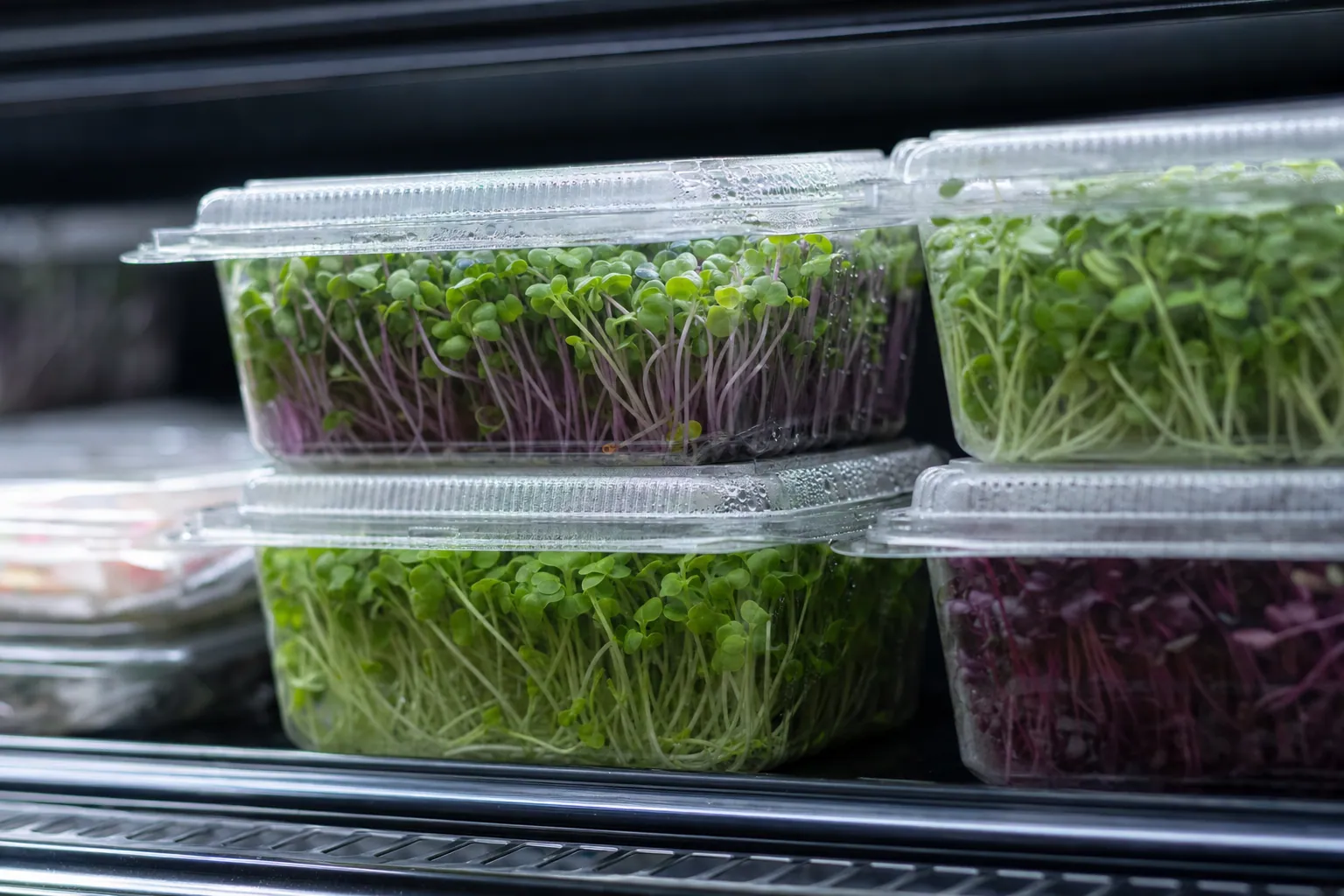
You spot a tidy plastic clamshell of bright green microgreens in the produce aisle, toss it in your cart, and feel good about it. But are store-bought microgreens fresh by the time they reach your kitchen? The honest answer: often less fresh than they look. Microgreens are one of the most delicate crops in the grocery store, and the journey from farm to shelf quietly works against them every step of the way.
This guide walks through what actually happens to those greens before you buy them, how to read the signs of freshness, and how to get the most out of whatever you bring home.
Why Freshness Matters More for Microgreens Than Almost Anything Else
Microgreens are harvested young, usually 7 to 14 days after seeding. They have tiny stems, thin leaves, and a high water content, which is exactly why they taste so vivid. It's also why they wilt fast.
Freshness isn't just about texture and flavor, either. Microgreens are prized because they're roughly 2 to 3.5 times more nutrient-dense than their full-grown counterparts, with radish microgreens often topping the list in peer-reviewed reviews (MDPI Plants) and USDA data. Their value is concentrated in living, recently cut tissue. The longer they sit, the more that edge fades.
That fade isn't hypothetical. Tender leafy greens are mostly water and metabolically active even after cutting, so they keep "breathing," burning through their own sugars, vitamins, and antioxidants. Water-soluble and heat-sensitive nutrients like vitamin C go first, while the chlorophyll that signals freshness breaks down into the dull yellow you eventually see. Microgreens are rich in vitamins C, K, and E plus polyphenols, and those are exactly the fragile compounds that erode fastest once the greens are off the plant and sitting in a warm display case.
So when we ask whether store-bought microgreens are fresh, we're really asking two questions: How long ago were they cut, and how well were they treated since? A clamshell that looks identical to its neighbor can be days apart in both, and there's nothing on the label to tell you which.
So Are Store-Bought Microgreens Fresh? Follow the Supply Chain
Here's the part most shoppers never see. By the time a clamshell reaches the cooler, it has usually passed through several hands:
| Stage | Typical time | What happens to the greens |
|---|---|---|
| Harvest at farm | Day 0 | Cut, rinsed, packed into clamshells |
| Farm to distributor/truck | 1–2 days | Refrigerated transit, some handling |
| Warehouse/store delivery | 1–3 days | Sorting, restocking, more cold storage |
| On the store shelf | 1–4 days | Light, temperature swings, customer handling |
| In your fridge | 1–5 days | You finally eat them |
Add it up and the microgreens in your salad may be 5 to 10 days past harvest before you take the first bite. For a crop this fragile, that's a long time. Each handoff adds temperature fluctuations and physical handling, and microgreens bruise easily.
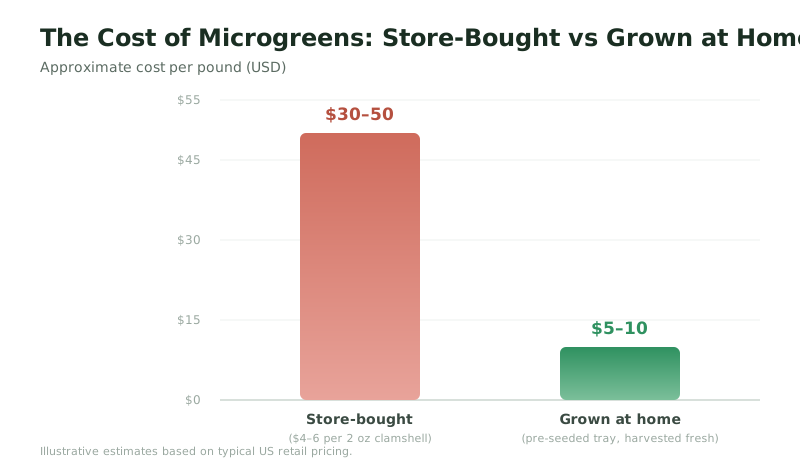
The result is a double frustration buyers know well: they're expensive, often $4 to $6 for a 2 oz clamshell (roughly $30 to $50 per pound), and they're frequently not as fresh as that price implies. A lot of that pricey produce ends up slimy in the crisper drawer before you finish it. If sticker shock is your main concern, we dig deeper into pricing in why store-bought microgreens are expensive and not fresh.
How to Tell If Microgreens Are Still Fresh
You can't see the supply chain, but you can read the greens. Use these quick checks before you buy and before you eat.
Look at the stems. Fresh microgreens stand upright and perky. Limp, bent, or translucent stems signal age.
Check the leaves. They should be vivid and dry to the touch. Yellowing leaves mean nutrients and chlorophyll are breaking down.
Smell the container. A clean, green, grassy scent is good. Any sour or musty smell means decay or mold has started.
Inspect for moisture and mold. Beads of water pooling in the clamshell speed up spoilage. Fuzzy white or gray patches mean it's time to toss them. (Mold is also the number-one headache for people who grow at home; here's why microgreens keep molding and how to prevent it.)
Here's a simple freshness scorecard you can run in the aisle:
| Sign | Fresh | Past its prime |
|---|---|---|
| Stems | Upright, firm | Limp, mushy |
| Color | Bright green | Yellowing, dull |
| Smell | Grassy, clean | Sour, musty |
| Moisture | Dry leaves | Pooled water, slime |
| Texture | Crisp | Wilted, slimy |
Getting the Most from Store-Bought Microgreens
If you're buying from the store, a few habits will stretch both freshness and value.
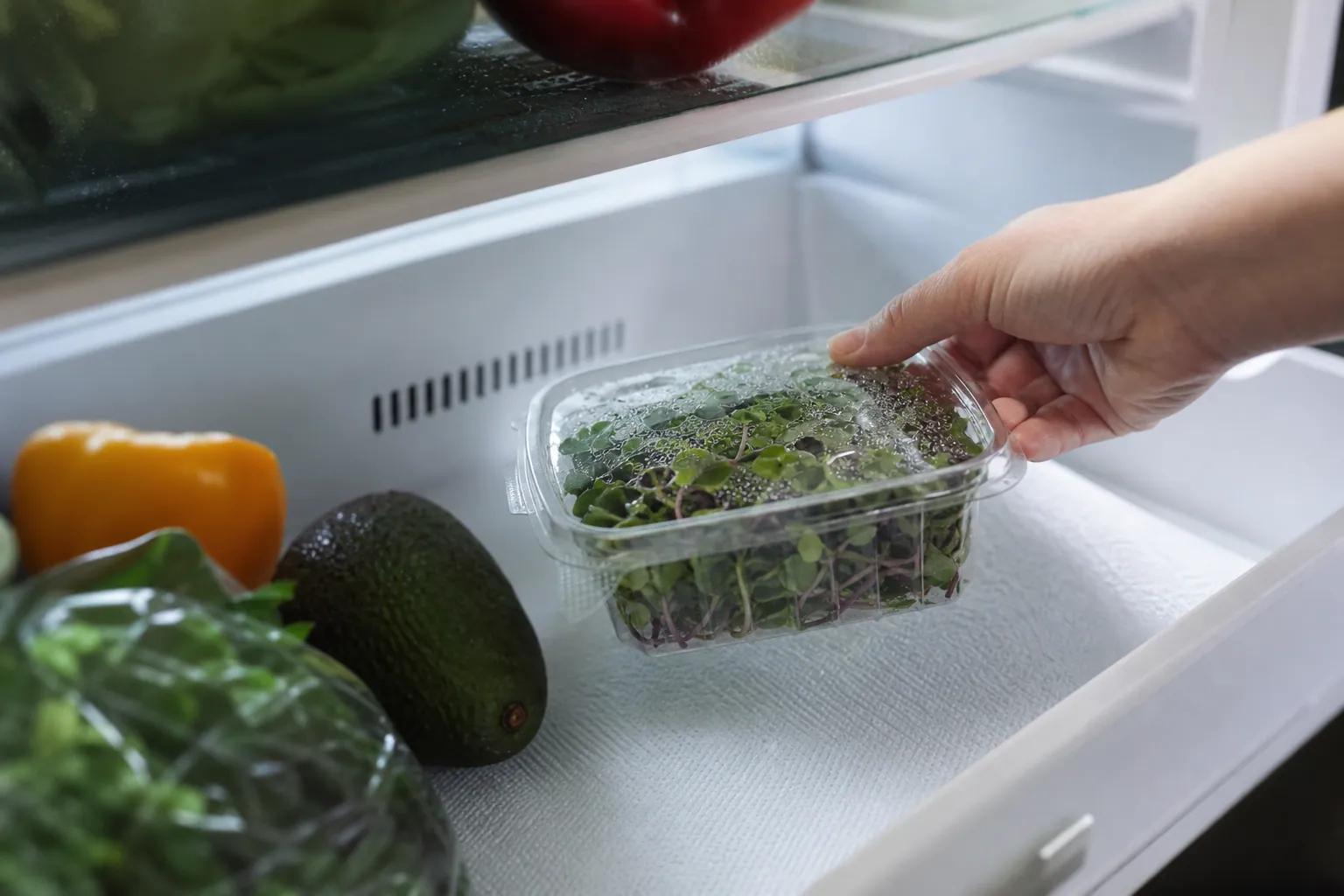
Buy the freshest clamshell on the shelf, not the front one, and use it within a day or two. Keep microgreens cold and dry: line the container with a clean paper towel to absorb excess moisture, and store them in the warmest part of the fridge, not the coldest, since freezing temperatures damage the leaves.
Eat them raw whenever possible. Many of the compounds that make microgreens special are heat-sensitive. Broccoli microgreens, for example, are a standout source of the sulforaphane precursor: Johns Hopkins research found broccoli sprouts and microgreens carry roughly 10 to 100 times more glucoraphanin than mature broccoli, though the finished sulforaphane you actually get varies widely by variety, growing conditions, and harvest timing. But that potential only converts to actual sulforaphane when the precursor glucoraphanin meets the enzyme myrosinase as you chew or chop, and myrosinase is degraded by heat. Raw, fresh, and well chewed is the combination that preserves it. We cover the chemistry in detail in what sulforaphane is and why it matters and in how to maximize sulforaphane.
Different crops carry different rewards, which is another reason freshness is worth chasing:
| Microgreen | Standout for | Why fresh matters |
|---|---|---|
| Broccoli | Sulforaphane precursor (10–100× the glucoraphanin of mature broccoli) | Myrosinase, the activating enzyme, degrades with age and heat |
| Radish | Highest overall nutrient density | Peppery flavor and vitamin C fade quickly once wilted |
| Pea shoots | Plant protein (one of the more protein-dense microgreens) | Sweet, crisp texture collapses as they go limp |
| Red cabbage | Antioxidants and polyphenols | Color and compounds tied to vivid pigment dull with decay |
These are food-first benefits, not medical claims; compounds like sulforaphane are studied for blood-sugar regulation and inflammation but remain research-stage rather than proven cures. The takeaway is simpler: the closer to harvest you eat, the more of all of it you get. If protein is your angle, high-protein microgreens digs into pea shoots specifically.
To use them up before they fade, fold them into finished dishes at the last second: on top of toast, eggs, soups, tacos, or grain bowls. For more ideas, see how to eat microgreens.
The Freshness Problem No Clamshell Can Solve
The uncomfortable truth is that even a perfectly handled clamshell is fighting physics. Microgreens are happiest alive and growing. The moment they're cut, the clock starts, and the supply chain eats most of that window before the greens ever reach you.
That's the gap a lot of home growers try to close. Growing your own means harvesting seconds before eating, when nutrient density and flavor peak. The catch is that traditional DIY growing trades the supply-chain problem for a maintenance problem: daily watering over roughly 10-day cycles, mess from soil, and a real risk of mold if airflow or moisture isn't just right. Miss a few days during a busy week or a trip, and the tray is lost. If you're weighing the options, grow vs. buy microgreens lays out the tradeoffs honestly.
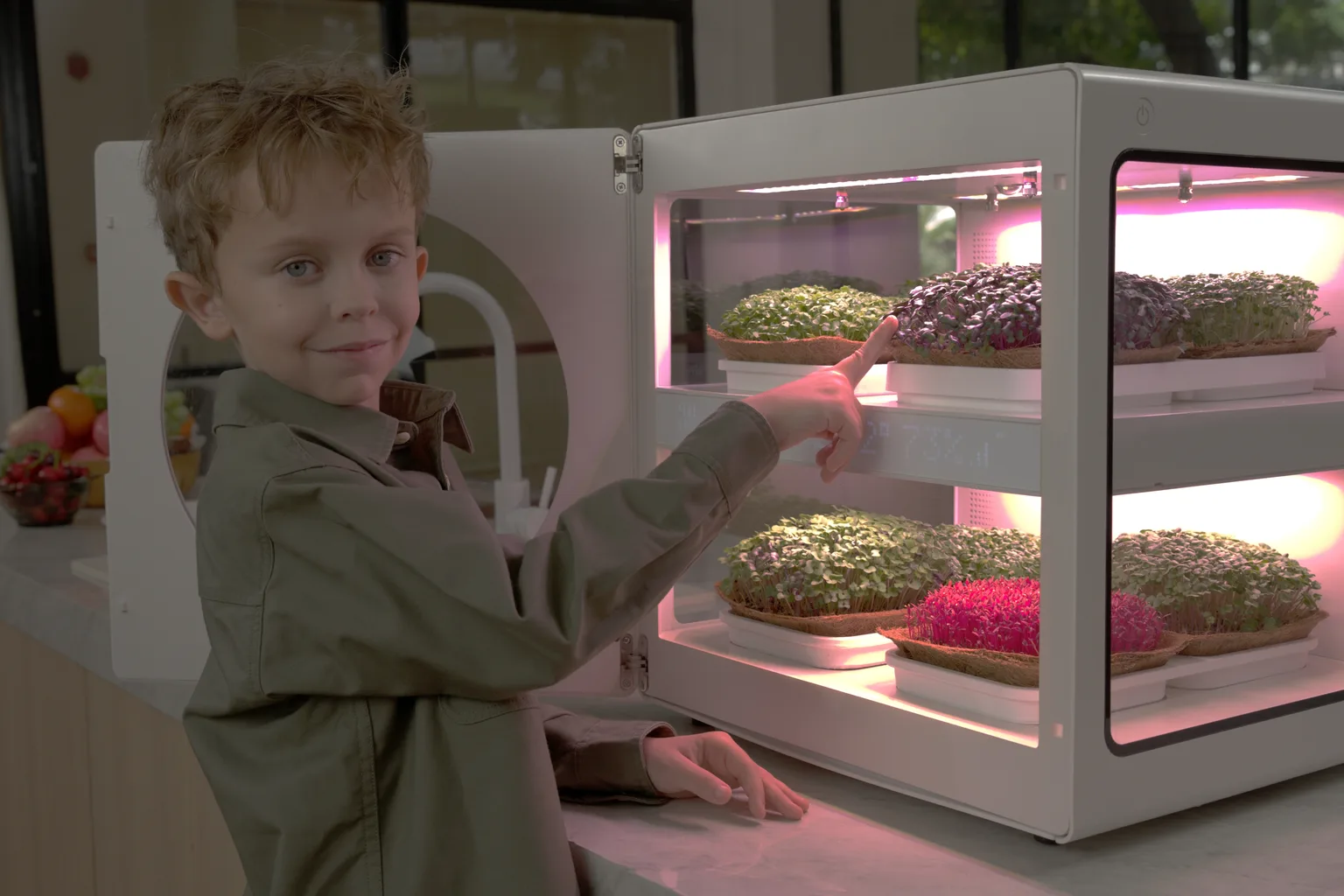
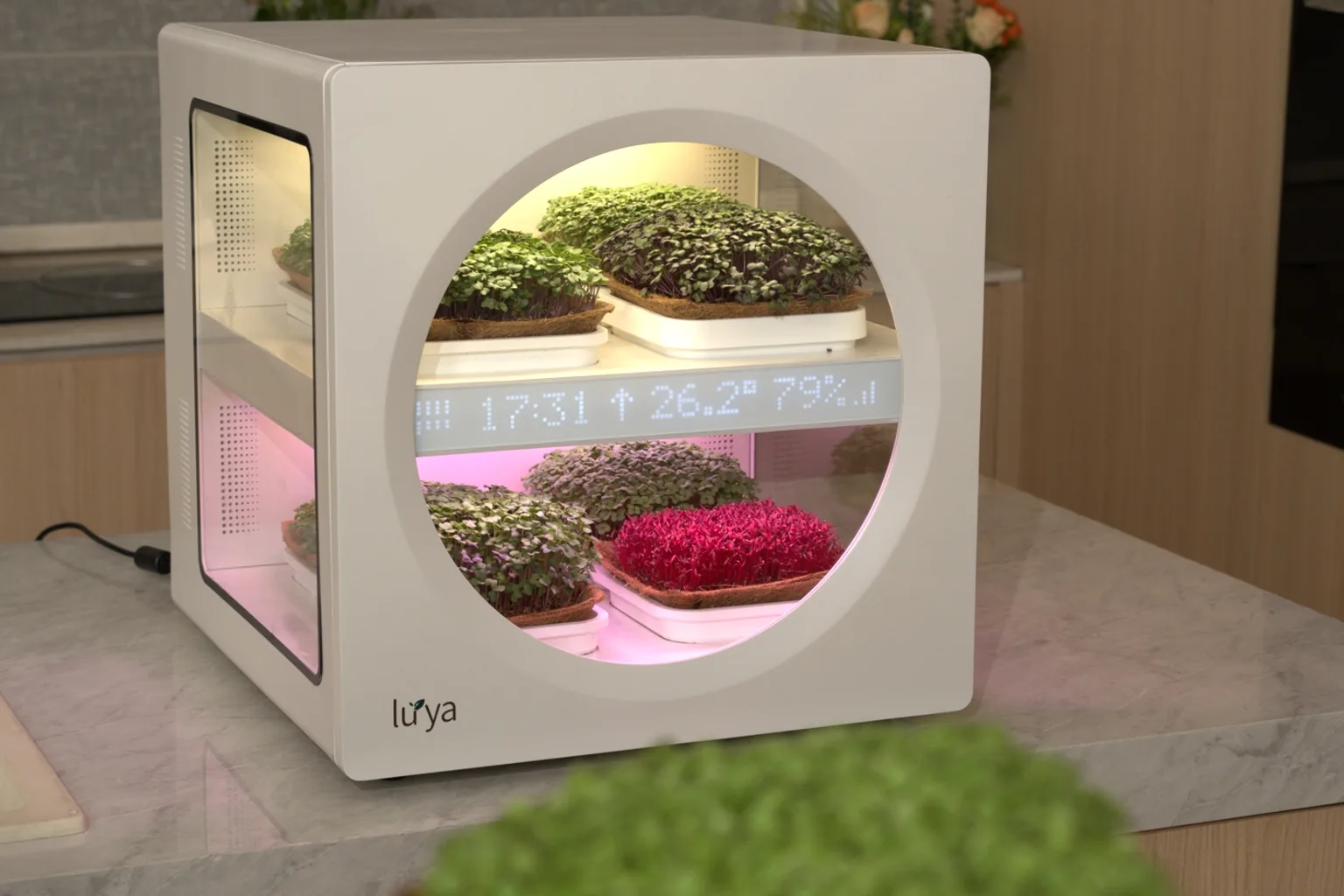
This is where Luya comes in. Luya is a countertop appliance, a bit like a Nespresso but for greens, that grows microgreens in a sealed, climate-controlled chamber. You drop in a pre-seeded tray, and it handles temperature, watering, and nutrients automatically, harvesting fresh greens in about 7 to 10 days while the rest of the tray keeps growing alive. No farm-to-truck-to-shelf delay, and no daily chores. You snip what you need, seconds before it hits your plate.
So, are store-bought microgreens fresh? Sometimes, if you shop carefully and eat them fast. But "fresh seconds before eating" is a different category entirely, and it's the one your salad really wants.
Curious how harvest-on-demand greens actually work? See how it works, or keep reading with fresh microgreens at home.
References
- Dewhirst RA, Clarkson GJJ, Rothwell SD, Fry SC. Ascorbate retention and degradation in spinach and other salad leaves. Food Chemistry. 2017;233:237–246. https://doi.org/10.1016/j.foodchem.2017.04.049
- Fahey JW, Zhang Y, Talalay P. Broccoli sprouts: an exceptionally rich source of inducers of enzymes that protect against chemical carcinogens. PNAS. 1997;94(19):10367–10372. https://doi.org/10.1073/pnas.94.19.10367
- Kyriacou MC, Rouphael Y, Di Gioia F, et al. Micro-scale vegetable production and the rise of microgreens. Trends Food Sci Technol. 2016;57:103–115. https://doi.org/10.1016/j.tifs.2016.09.005