This article is for general education and is not medical advice. Talk to your doctor before changing your diet for a health condition or if you take medication.
Plants do something quietly remarkable: they read color. A leaf can tell the difference between the blue of an open midday sky and the deep red of late afternoon, and it adjusts its chemistry accordingly. For anyone growing microgreens, that means the light you choose is not just about whether the plants grow at all. It shapes how they look, how compact they get, and how much of the good stuff, the antioxidant pigments and protective compounds, ends up in the leaf.
Blue light is one of the most powerful levers in that toolkit. It tends to make microgreens shorter and sturdier, deepen their color, and push up the antioxidants that make these tiny greens worth eating in the first place. Here is what the science actually says, and how to use it on your own counter.
The cells that "see" blue
Plants sense blue wavelengths through a family of light-detecting proteins. The two main ones are cryptochromes and phototropins. When blue photons hit these receptors, they kick off a chain of signals that travels all the way to the plant's DNA and changes which genes switch on.
One of the key moves is stabilizing a master regulator called HY5, along with a related family of MYB transcription factors. Think of HY5 and MYB as foremen on a construction site: once blue light puts them to work, they activate the genes that build pigments and protective molecules. They turn on enzymes with names like PAL, CHS, and 4CL, which are the early steps of the phenylpropanoid pathway, the plant's main assembly line for flavonoids, anthocyanins, and phenolic compounds.
In plain terms, blue light flips on the factory that produces a microgreen's most valuable nutrients. This is not a fringe effect; it has been documented across many species, from rice and basil to kale-family greens.
Why anthocyanins matter on your plate
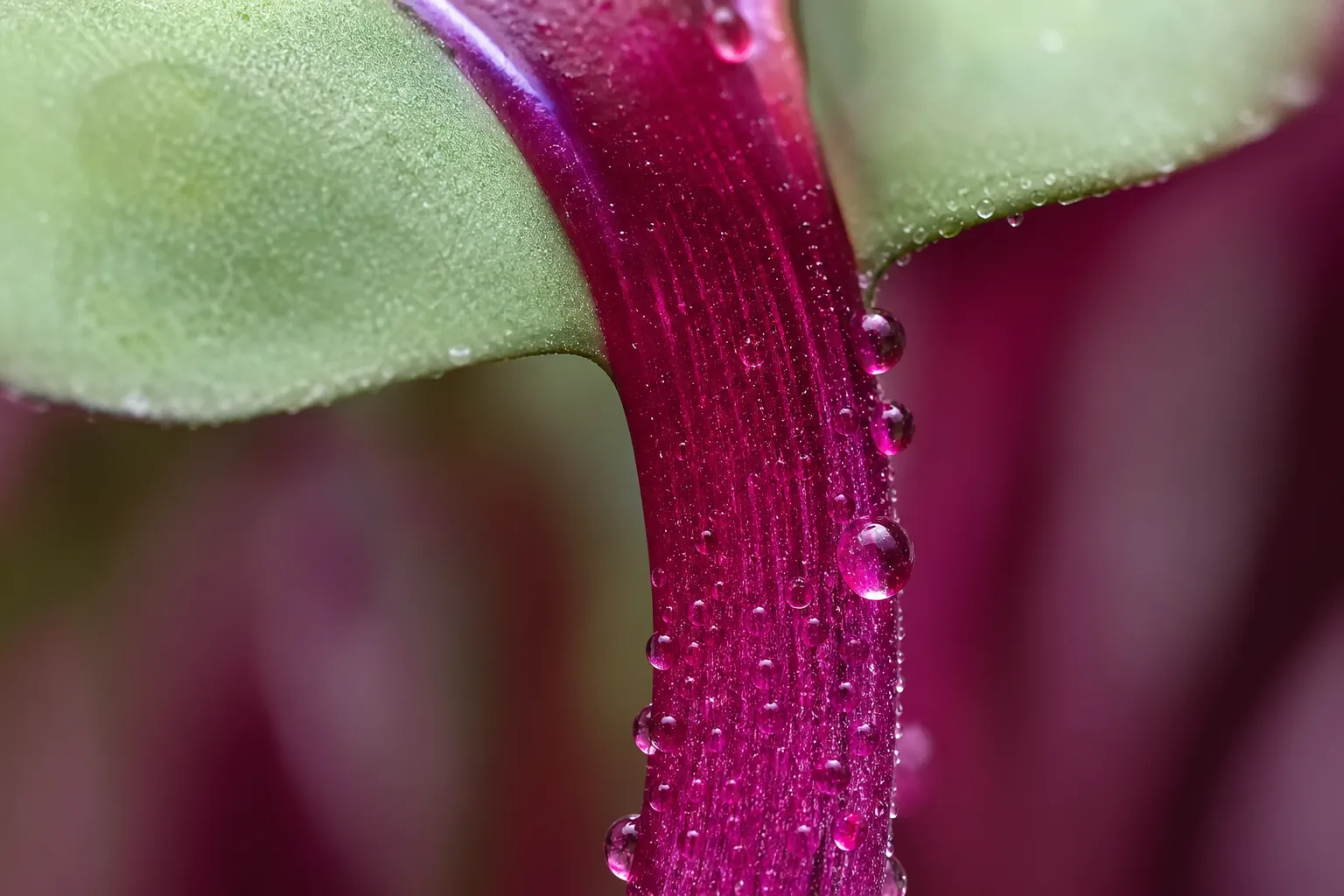
Anthocyanins are the pigments behind the purple-to-red coloring in many microgreens, think red cabbage, red amaranth, or purple radish. They belong to the flavonoid family, and they pull double duty. In the plant, they help shield tissue from light stress. For us, they act as dietary antioxidants and are among the compounds researchers study for their role in everyday health.
When microgreens get a healthy dose of blue light, the cryptochrome-HY5-MYB pathway ramps up anthocyanin production. The visible result is deeper, richer color. The invisible result is a leaf carrying more of these protective molecules per bite. It is one of the rare cases where what looks better genuinely tends to be better. If you want to go deeper on the pigments themselves, our guide to microgreens anthocyanins breaks down the chemistry, and microgreens color and taste explains how color tracks with flavor.
Shorter, sturdier, denser greens
Blue light does not only change chemistry. It changes shape. One of its most reliable effects is suppressing hypocotyl elongation, which is the technical way of saying it keeps stems from stretching out and getting leggy. At the same time, it encourages leaves to expand and stomata to open.
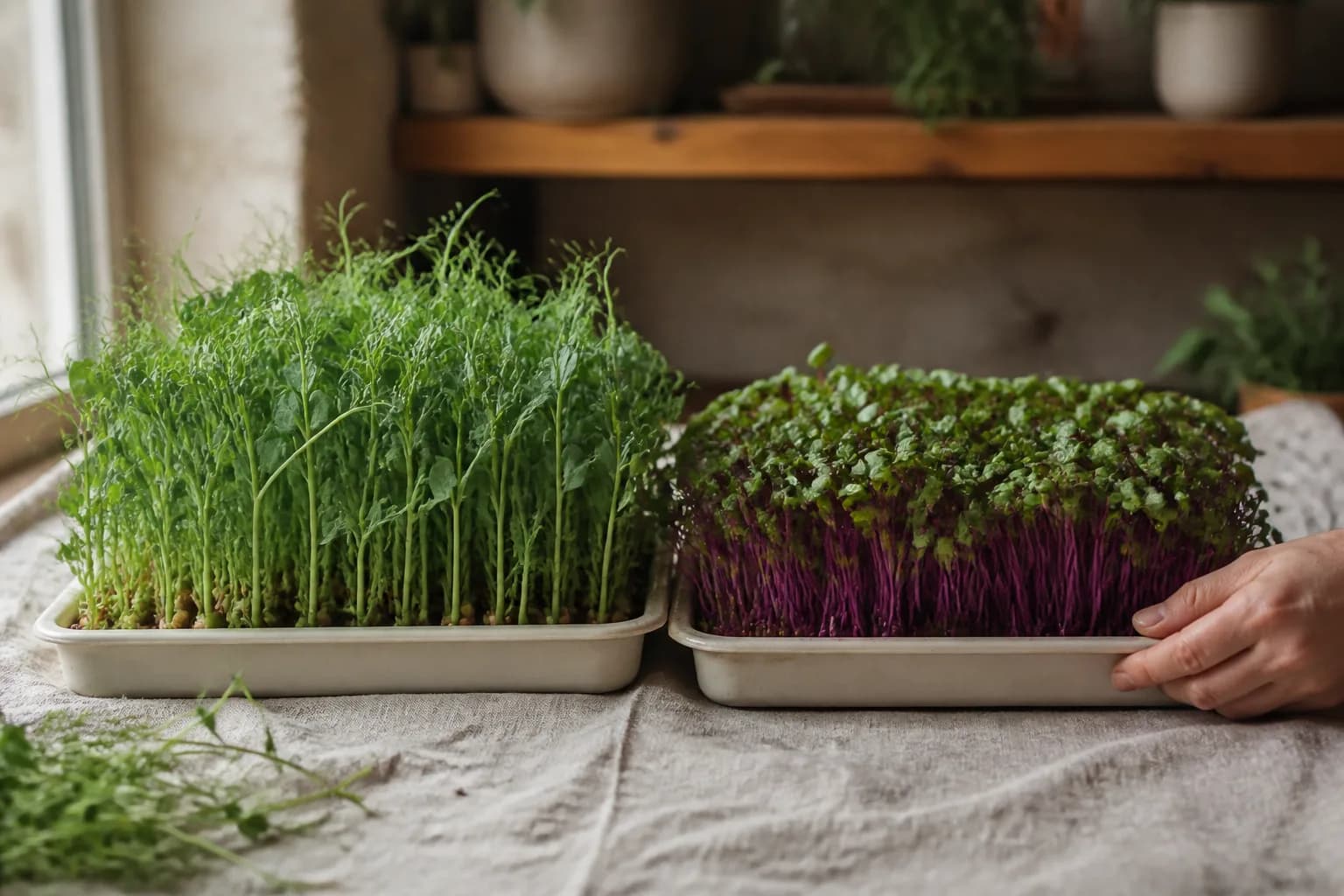
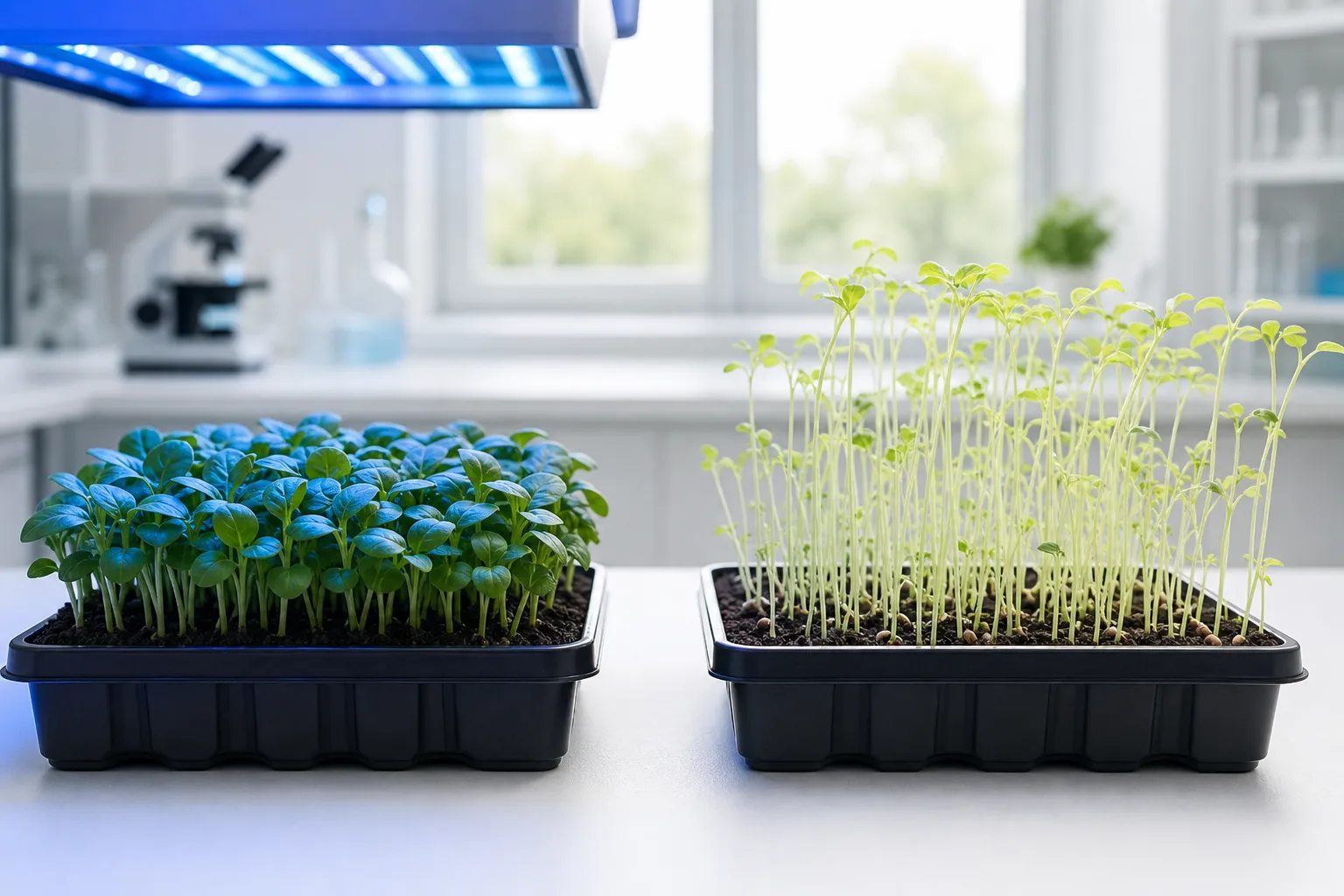
For a home grower, this is a big practical win. Microgreens grown with too little blue light, or in dim conditions generally, tend to stretch tall and floppy, reaching for a light source they cannot find. That makes them fragile, harder to harvest, and prone to falling over into the moisture where mold takes hold. A good blue component keeps plants compact and self-supporting. If your trays keep stretching, our piece on how to fix leggy microgreens walks through the fixes, and why microgreens keep molding covers the airflow side of the same problem.
| Trait | Low blue light | Adequate blue light |
|---|---|---|
| Stem height | Tall, stretched | Short, compact |
| Stem strength | Weak, floppy | Sturdy, upright |
| Leaf color | Pale, light green | Deeper, often richer pigment |
| Anthocyanins / flavonoids | Lower | Higher |
| Mold risk from sprawl | Higher | Lower |
What the research shows across crops
The blue-light effect is not a one-species fluke. Controlled studies keep finding the same direction of travel: more flavonoids, more phenolics, stronger antioxidant capacity. A few examples grounded in the plant-science literature:
- In rice seedlings, blue light turned up a whole set of flavonoid-building genes (PAL, 4CL, CHS, CHI, F3H, FLS) and raised flavonoid content.
- In basil, blue light increased both total flavonoids and total phenolics, along with antioxidant activity.
- In several other crops, including sweet pepper, the kale-and-cabbage family (Brassica), and the medicinal herb Rhodiola, blue light lifted phenolic and flavonoid levels.
- In peach fruit, blue light at 445 nm pushed up carotenoid pigments by shifting the genes that govern them.
The numbers below are illustrative ranges drawn from this body of work, not a promise for any single tray. Real gains depend on the crop, the dose, and the rest of your setup.
| Crop type | Compound affected | Typical direction under blue light |
|---|---|---|
| Rice seedlings | Total flavonoids | Increase |
| Basil | Phenolics + flavonoids | Increase |
| Brassica greens | Flavonoids, glucosinolate-linked pathways | Increase |
| Red/purple varieties | Anthocyanins | Strong increase |
| Peach (445 nm) | Carotenoids | Increase |
The throughline is simple: blue light is a stress-and-signal cue that tells the plant to invest in its protective chemistry. Many of those protective molecules are exactly the antioxidants we are after. For the bigger picture on how the whole spectrum plays in, see light and microgreen nutrition, and for the warm end of the spectrum, red light microgreens.
Blue is powerful, but not the whole answer
A few honest caveats keep this useful rather than hype.
First, more is not always better. Plants can only use so much light before they hit photoinhibition, a point where excess light damages the photosynthetic machinery and metabolism suffers. Blasting trays with intense blue around the clock can backfire.
Second, blue rarely works best alone. In practice, growers blend blue with red and sometimes other wavelengths. Red light supports biomass and yield, while blue sharpens color, compactness, and antioxidant content. Many quality results come from combinations, not a single color. The right ratio depends on the crop and even its growth stage, which is why precise spectral control matters so much in serious indoor growing. Our overview of controlled environment agriculture covers why this dialing-in is the heart of modern indoor farming.
Third, the response is species-specific. A spectrum that deepens a red cabbage's color may do something subtler to a pea shoot. Tolerance and optimal dose shift from plant to plant.
Putting it to work at home
You do not need a research greenhouse to benefit from this. A few principles carry most of the value:
- Give your greens real light, not an afterthought on a dim windowsill. Stretched, pale microgreens are a sign the light is too weak or too far away.
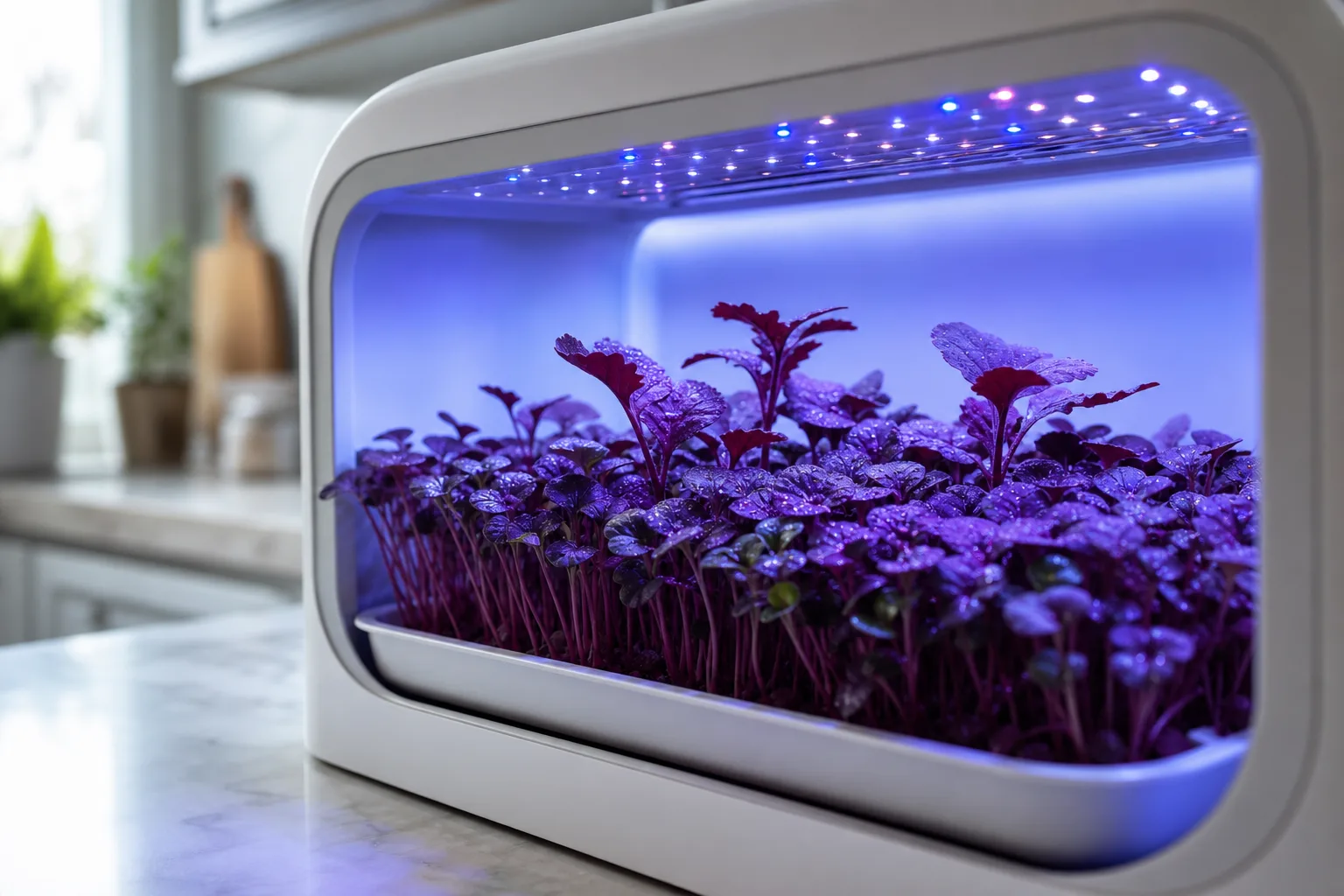
- Favor a full-spectrum LED with a healthy blue component rather than a warm bulb heavy on red and yellow. The blue is what locks in compact growth and color.
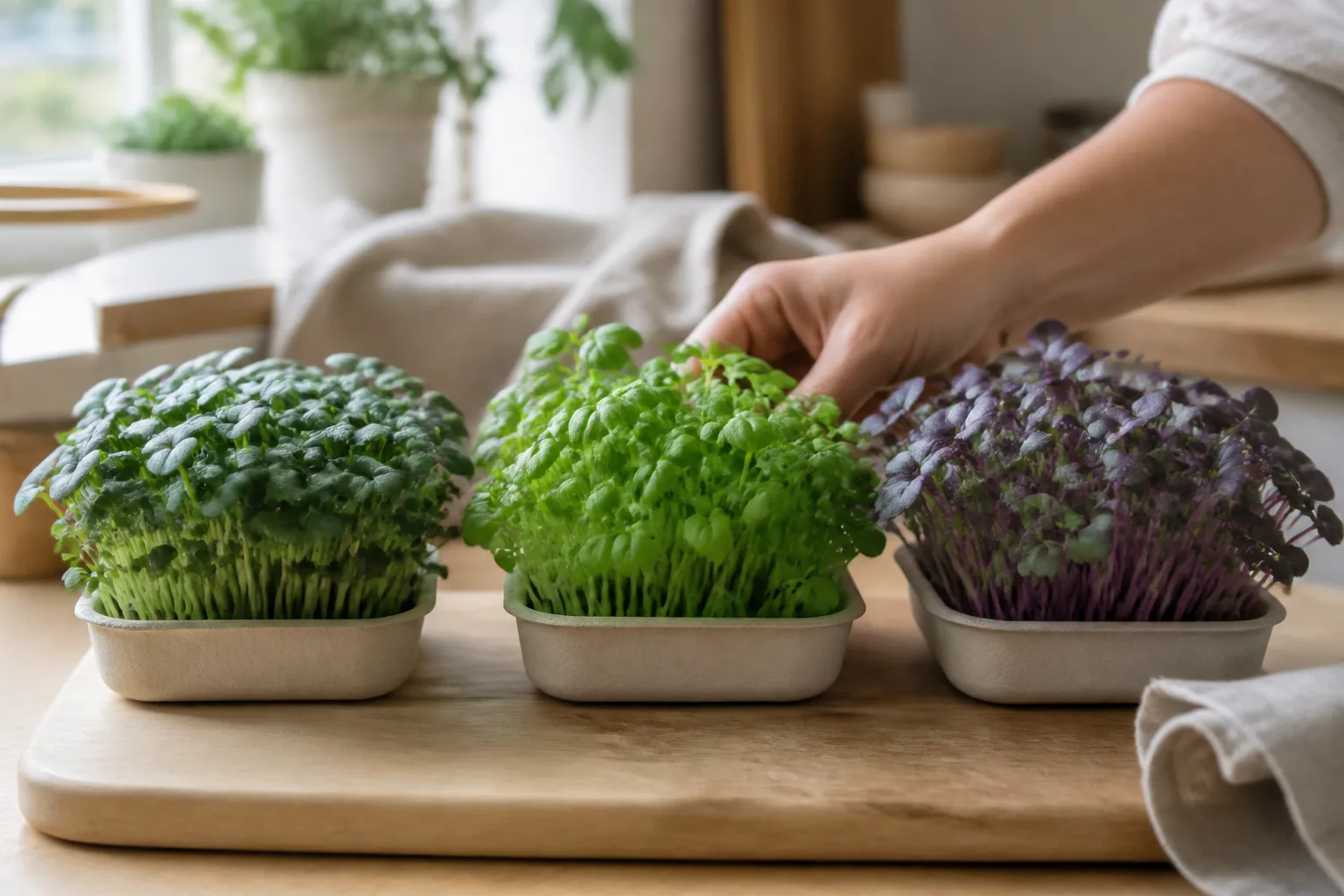
- Lean into colorful varieties if antioxidants are your goal. Red cabbage, purple radish, and red amaranth respond visibly to good light. Browse microgreens color and taste for ideas.
- Do not overdo intensity or duration. Steady, sensible light beats a punishing blast.
This is one of the reasons a purpose-built grower can outperform a DIY shelf-and-lamp rig. A device like the Luya countertop grower manages the spectrum, timing, and intensity for you, so the plants get the blue-rich light they need to color up and stay compact, without you having to guess. If you are deciding between growing your own and buying trays, grow vs buy microgreens lays out the trade-offs.
The takeaway
Blue light is one of the clearest examples of how growing conditions shape nutrition, not just appearance. Through cryptochromes and the HY5 and MYB regulators, it switches on the genes that build anthocyanins, flavonoids, and phenolics, while keeping plants short and sturdy. The result is microgreens that look richer and tend to carry more of the antioxidants worth eating.
You cannot control everything about a tiny plant, but light is one knob you genuinely can turn. Give your microgreens a good blue-rich spectrum, do not overdo the intensity, and let the plant's own chemistry do the rest. If you want to keep exploring, are microgreens good for you puts the nutrition in context, and what are microgreens is a solid starting point.
References
- Effect of Different Ratios of Blue and Red LED Light on Brassicaceae Microgreens under a Controlled Environment. Plants (Basel). 2021;10(4):801. https://doi.org/10.3390/plants10040801