
When people think about keeping microgreens clean, they think about the seed and the tray. Water tends to be treated as neutral — the medium that carries everything else, not a thing in itself. The research does not support that assumption.
What the irrigation study found
A team from USDA-ARS and the University of Maryland irrigated microgreens with contaminated water and tracked three pathogens — E. coli O157:H7, Listeria monocytogenes and Salmonella enterica — on both the plants and the growing medium [1].
The word in their title is the finding: persistence. The pathogens did not arrive and fade. They established and remained, on the edible plants and in the medium beneath them, through the production stage. Microgreens, the authors note, are susceptible to contamination at the preharvest stage much as leafy greens are — and recalls associated with microgreens have underlined the point.
A second study supplies the other half of the picture. Pathogens inoculated into nutrient-solution-soaked perlite transferred to the edible parts of 20 different microgreen types, at levels driven by the pathogen and the crop rather than by the amount introduced [2].
Together they describe a complete route: water carries it in, the substrate holds it, and the warm humid week that follows does the rest. No step in that chain requires anything to go unusually wrong.
Why microgreens are a special case
Mature field crops get things a microgreen tray does not. Time, for one — weeks in which surfaces dry, sunlight delivers some UV, and populations decline. A wash step, usually. Often a cooking step. Each is a chance for a mistake to be corrected downstream.
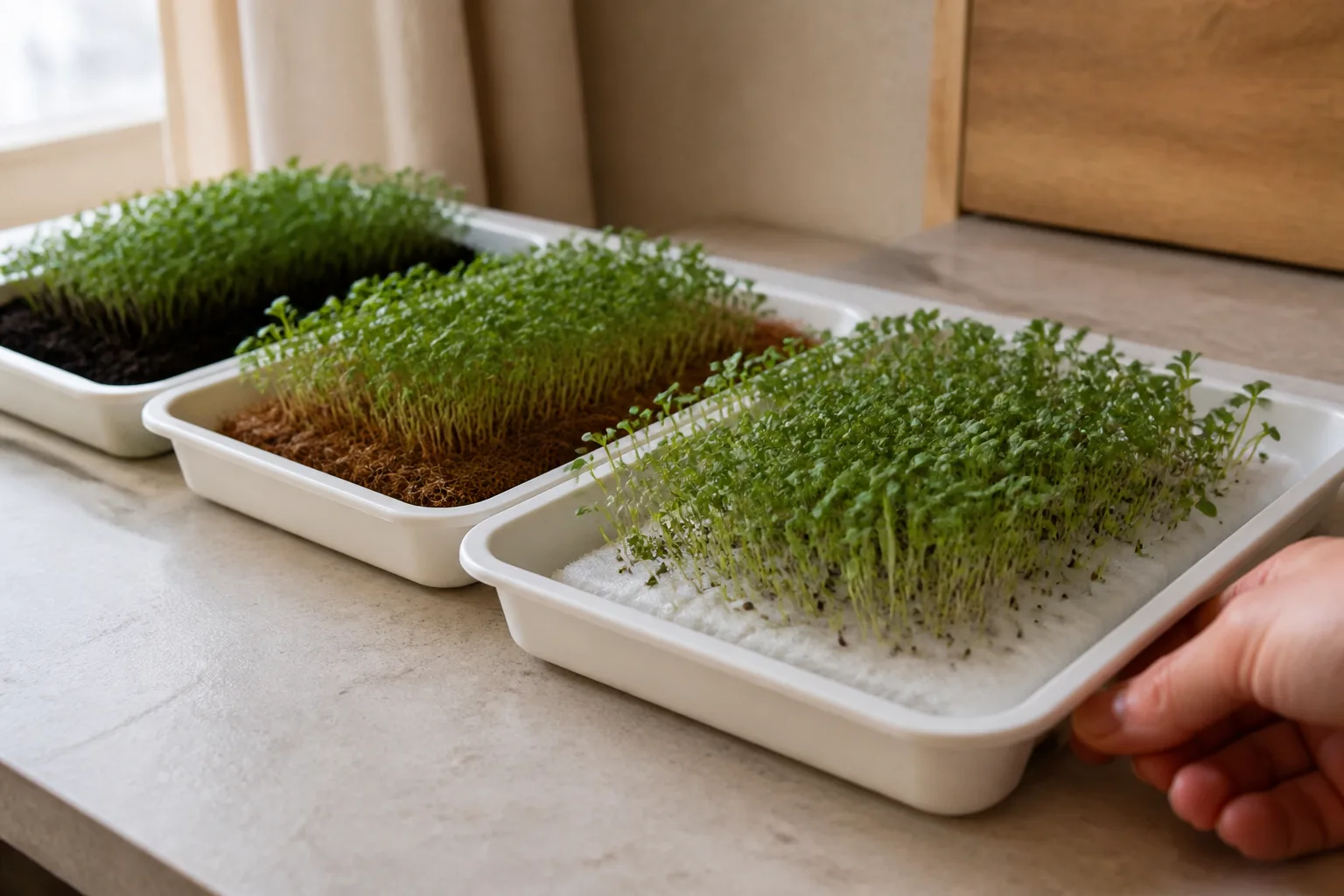
A microgreen tray is the inverse: continuously moist, warm, densely planted, and dark for the first days [3]. Then it is cut and eaten raw. There is no later stage at which an early error gets fixed. Everything that enters is still there at harvest, possibly in greater quantity.
What this changes in practice
- Use potable water. Straightforward, and the highest-value habit on this list. Water you would not drink is water you should not irrigate a raw crop with.
- Do not let water stand warm between cycles. A reservoir at room temperature for a week is an incubator, not storage. Empty it.
- Clean the reservoir and the lines, not just the tray. Biofilm forms on surfaces that stay wet, is invisible until substantial, and is the mechanism by which one bad cycle becomes several. This is the step most often skipped, because the visible parts look clean.
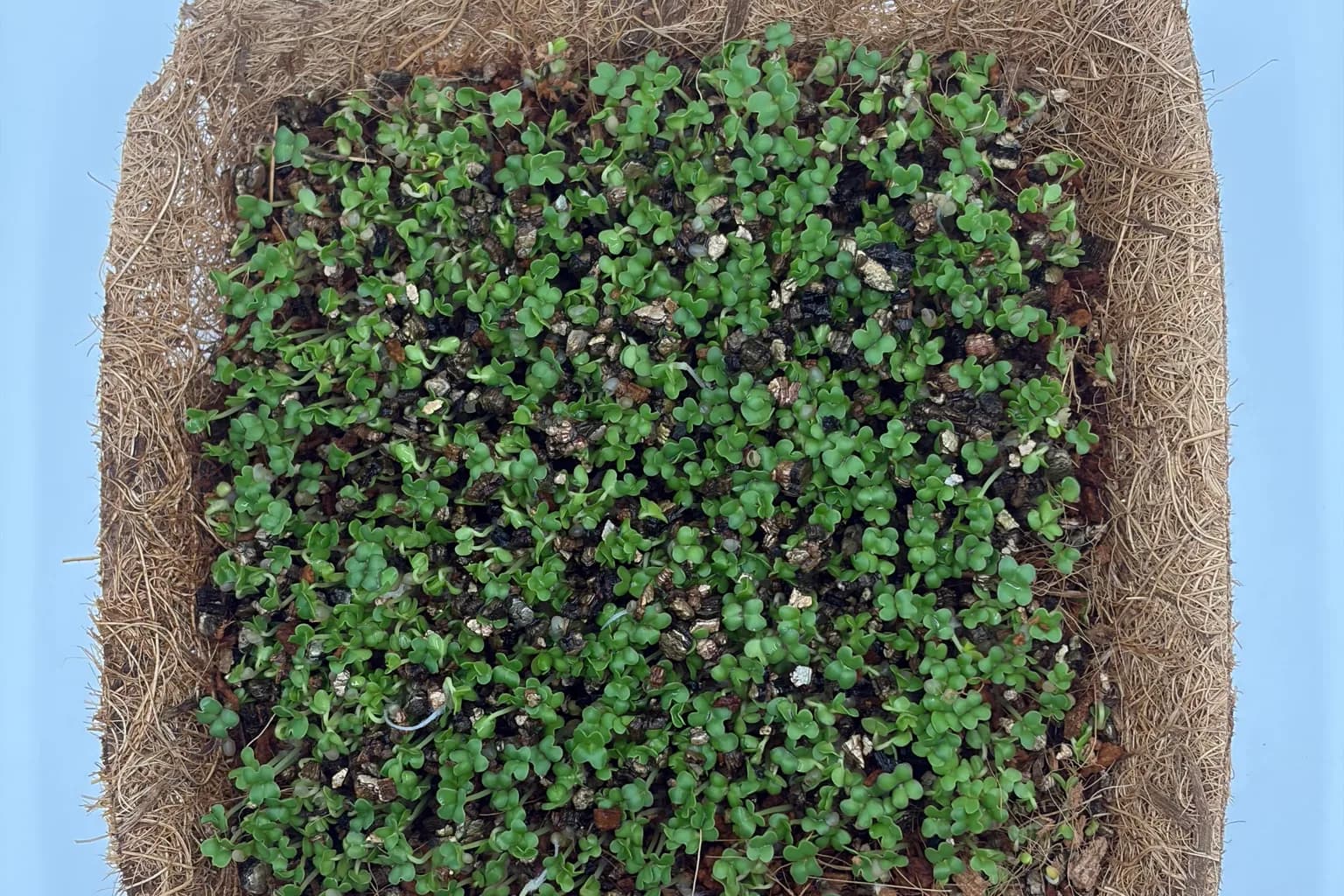
- Do not reuse growing medium. Persistence was documented in the medium as well as on plants [1]. Reused medium carries whatever the last cycle left.
- Bottom-water where the crop allows. Keeping the canopy dry reduces the wet-leaf conditions that favour both bacteria and mould, and it is easier on delicate seedlings anyway.
- Separate what touches water from what touches food. The jug that fills the reservoir and the bowl that receives the harvest should not be the same object.
Most of these overlap with what you would already do for quality. The conditions that produce damping-off are the conditions that suit pathogens — stagnant air, standing water, warm dense canopy. The habits are the same ones; what changes is how much they are worth.
Context
Water is one of several documented entry points, and closing it does not close the others. Are microgreens safe to eat maps the full set and explains the counter-intuitive finding that contamination amount did not predict outcome. Seed decontamination covers the route the literature calls primary. And for the agronomic side of water — what should be dissolved in it and at what pH — see water pH and EC.
Sources
Every figure in this article comes from one of the papers below, each read in full before being cited. Where a study measured one species under one set of conditions, we say so rather than generalising it to every crop. Follow the DOI to check any number yourself.
- Rao, Pradhan & Patel — Persistence of foodborne bacterial pathogens on microgreens and soil irrigated with contaminated water (USDA-ARS / University of Maryland). Journal of Food Protection 88 (2025) 100594. doi.org/10.1016/j.jfp.2025.100594
- Transfer of Salmonella, Escherichia coli O157:H7 and Listeria monocytogenes to microgreens from contaminated substrate or seed. International Journal of Food Microbiology 414 (2024) 110612. doi.org/10.1016/j.ijfoodmicro.2024.110612
- Understanding food safety on sprouts and microgreens: contamination factors and decontamination strategies. Food Research International 214 (2025) 116589. doi.org/10.1016/j.foodres.2025.116589