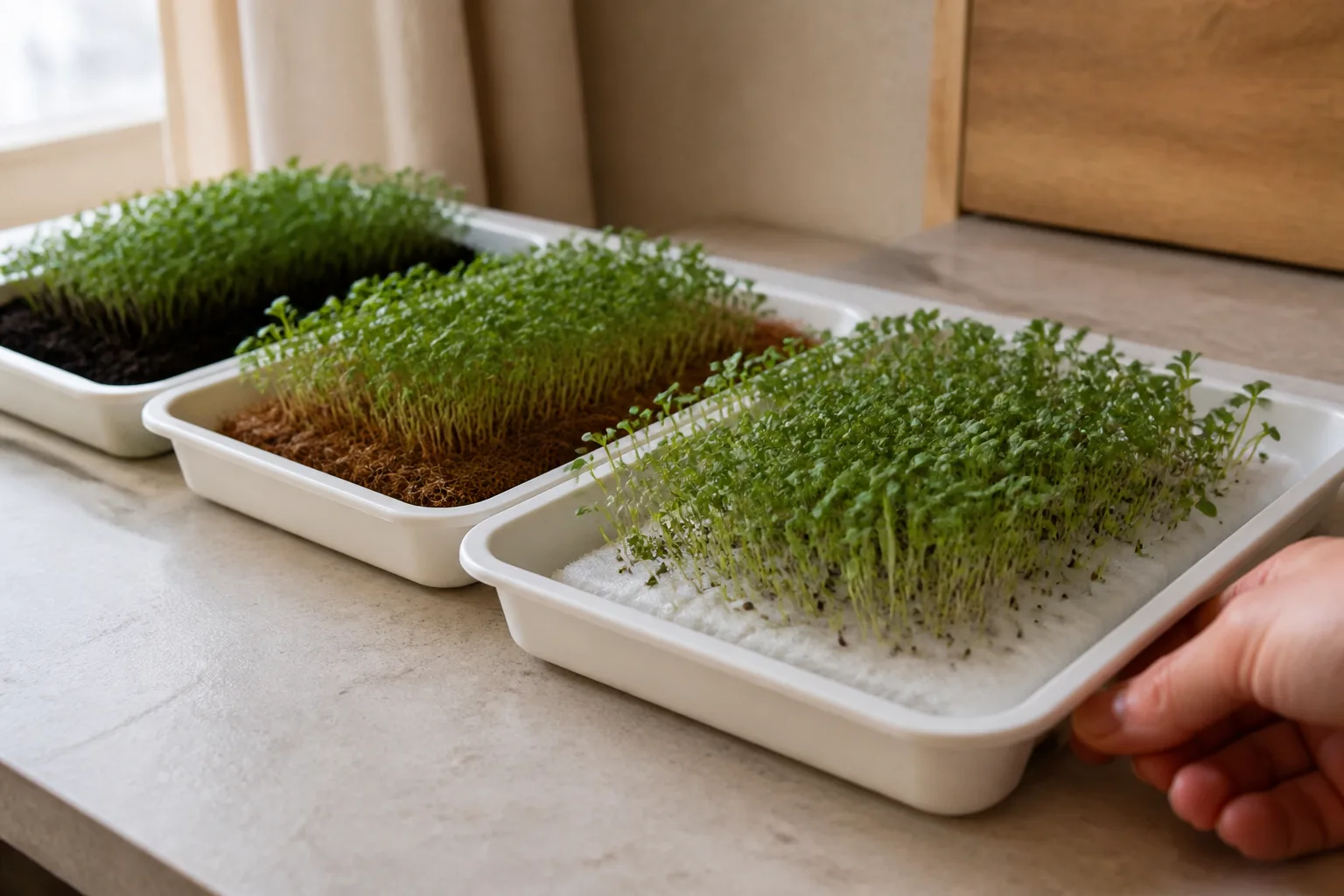
Microgreens are grown warm, humid, densely planted, and eaten raw. Every one of those is good for the plant and good for bacteria. A review of the field states it without hedging: cultivation conditions such as high humidity and high nutrient content favour the development of pathogens including Salmonella enterica, Escherichia coli and Listeria monocytogenes [1].
This article is not here to alarm anyone. It is here because "home-grown is cleaner" is a claim we make, and a claim like that should rest on evidence rather than on sounding obviously true. As it turns out the evidence supports a version of it — but a narrower and more specific version than the slogan.
The finding that reframes the problem
Researchers tested contamination routes directly. They inoculated two entry points — growing substrate (perlite soaked in nutrient solution) and seed — at both low (10²–10³ CFU/g) and high (10⁵–10⁶ CFU/g) levels, grew 20 different types of microgreens, and measured what reached the edible portion [2].
Pathogen populations transferred to the microgreens ranged from 1.6 to 7.7 log CFU/g. And the determining variables were not the ones you would guess:
Transfer depended on the pathogen and the microgreen type — and was not affected by the contamination source or the inoculation level.
Read that twice, because it is counter-intuitive and it matters. A little contamination and a lot of contamination ended up in a broadly similar place. Whether it came from the substrate or the seed did not decide the outcome either. What decided it was which organism and which crop.
The mechanism is not mysterious: a warm, wet, nutrient-rich tray held for a week is close to ideal growth conditions. A small starting population is not a small problem; it is an early one, with time to catch up. Bacterial growth is exponential, and exponential curves erase head starts.
The practical implication is uncomfortable and clear: "only a little got in" is not a defence. Keeping contamination out entirely is the only strategy that behaves the way intuition expects it to.
A separate modelling study of Salmonella Enteritidis in a controlled-environment microgreen system approaches the same territory quantitatively — building predictive models of how the organism behaves in exactly these production conditions [3].
Water is the entry point people forget
A USDA-ARS and University of Maryland team irrigated microgreens with contaminated water and tracked E. coli O157:H7, Listeria monocytogenes and Salmonella enterica on both the plants and the growing medium [4]. The pathogens did not simply arrive and dilute away. They persisted — on the edible plants and in the medium, through the production stage.
That makes water quality a food-safety variable rather than merely an agronomic one. Anything shared between trays, refilled from an open container, or left standing warm between cycles is worth a second thought. We have given this its own article: the water is a food-safety ingredient.
Why commercial microgreens get recalled
Recalls tied to Listeria monocytogenes have become a real concern in the sector, and contaminated seed is a primary route of introduction [5].
Look closely at where that risk lives: in the seed lot, and in the handling, packing and cold-chain stages between a growing facility and your kitchen. Those are the stages a countertop system does not have.
This is the honest version of "home-grown is cleaner." It is not that a home grower is more careful than a commercial food-safety team — they are not, and the professionals have testing regimes no household can match. It is that growing where you eat removes several of the steps at which contamination is documented to enter: harvest handling, packing lines, transport, days on a shelf. Fewer steps, fewer opportunities.
It says nothing whatsoever about the seed, which a home grower inherits from the same supply chain as everyone else. That is precisely why seed gets its own article.
What actually reduces risk
- Buy seed intended for sprouting or microgreens. Suppliers serving this market test lots for pathogens. Seed sold for field planting is not held to that standard, and may carry treatments not intended for eating.
- Clean water every cycle, and do not let it stand warm. Persistence in irrigation water is documented [4].
- Do not reuse growing medium. The same study found persistence in the medium, not only on the plants.
- Treat airflow as a safety measure. The stagnant humidity that produces mould is the same condition that favours bacteria — see airflow and humidity.
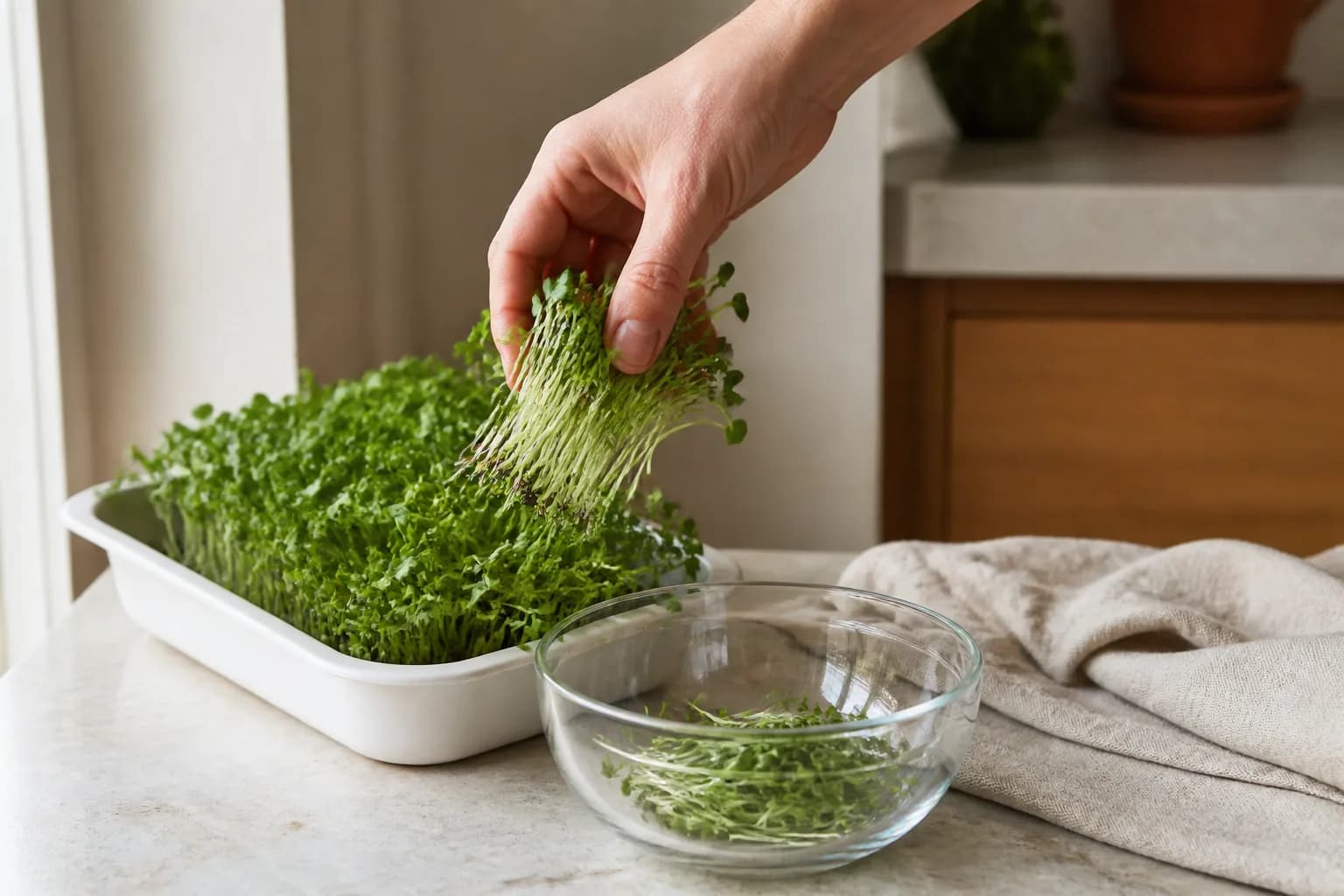
- Harvest into a clean container and refrigerate promptly. Time at room temperature is growth time — see harvest and storage.
- Wash your hands and the scissors. Unglamorous, and the step most often skipped because the tray looks clean.
Who should be more careful
Raw sprouts and microgreens carry a higher baseline risk for people who are pregnant, elderly, very young, or immunocompromised. That is a well-established public-health position and not something a growing method changes. For those groups, cooking is the reliable answer — what heat does to microgreens covers what you trade away nutritionally when you do, which is less than people assume.
The honest summary: microgreens are not a dangerous food, they are a raw food with specific and well-documented entry points for contamination. Knowing where those are is worth more than a general reassurance.
Sources
Every figure in this article comes from one of the papers below, each read in full before being cited. Where a study measured one species under one set of conditions, we say so rather than generalising it to every crop. Follow the DOI to check any number yourself.
- Understanding food safety on sprouts and microgreens: contamination factors and decontamination strategies. Food Research International 214 (2025) 116589. doi.org/10.1016/j.foodres.2025.116589
- Transfer of Salmonella, Escherichia coli O157:H7 and Listeria monocytogenes to microgreens from contaminated substrate or seed. International Journal of Food Microbiology 414 (2024) 110612. doi.org/10.1016/j.ijfoodmicro.2024.110612
- Xavier et al. — Salmonella in microgreens: quantitative modelling of Salmonella Enteritidis in a controlled environment system. Food Research International 235 (2026) 119209. doi.org/10.1016/j.foodres.2026.119209
- Rao, Pradhan & Patel — Persistence of foodborne bacterial pathogens on microgreens and soil irrigated with contaminated water (USDA-ARS / University of Maryland). Journal of Food Protection 88 (2025) 100594. doi.org/10.1016/j.jfp.2025.100594
- Ayilaran, McHugh & Jung — Microgreen seed decontamination: efficacy of hydrogen peroxide, hydrogen peroxide–peroxyacetic acid, and dry heat against Listeria monocytogenes. Journal of Agriculture and Food Research 27 (2026) 102882. doi.org/10.1016/j.jafr.2026.102882