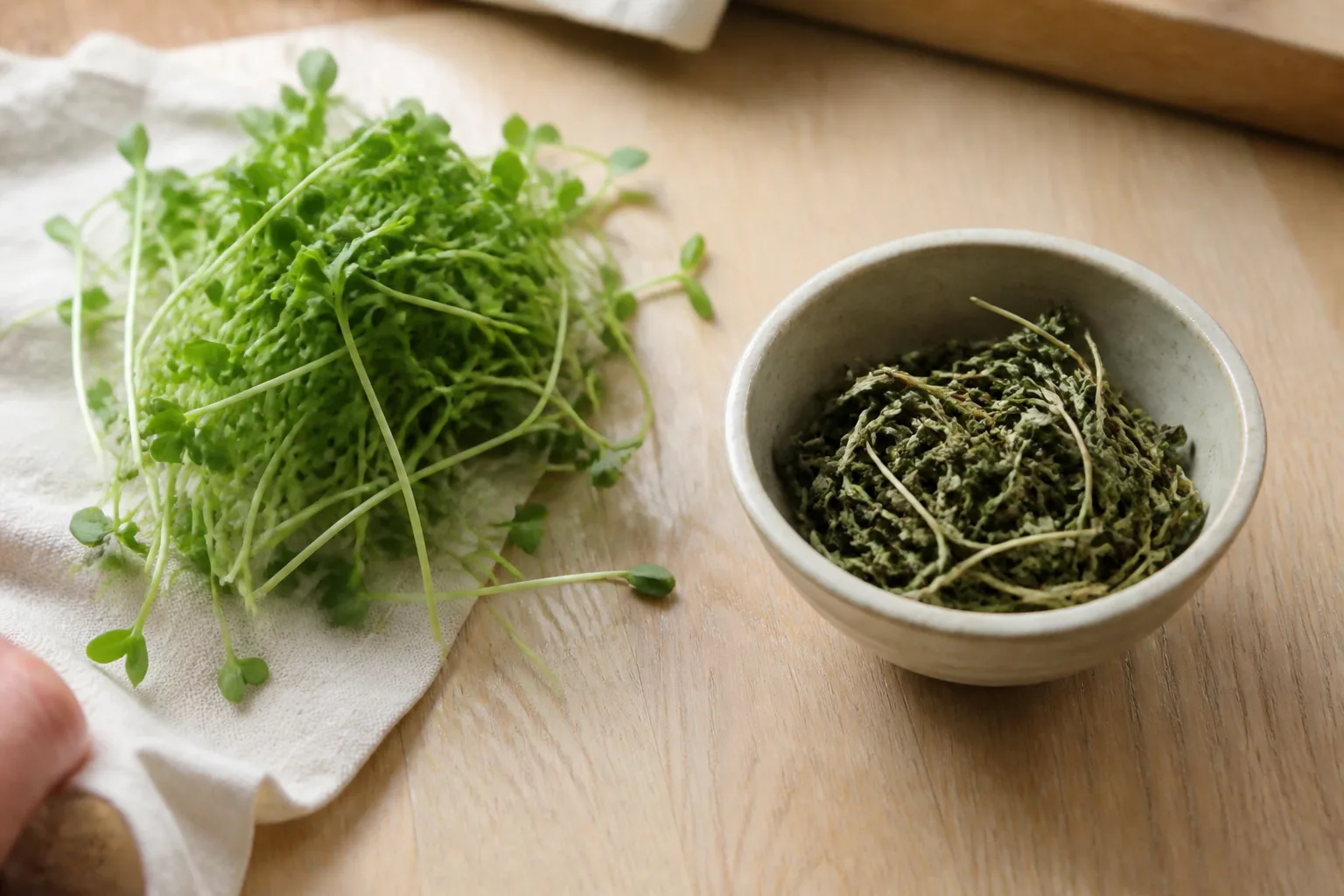
Microgreens go over fast. Anyone who has grown more than a household can eat has looked at a tray past its best and wondered whether drying is a way to keep the value rather than lose it.
Two studies answer that from different angles, and the interesting part is that they disagree — not because either is wrong, but because they measured different things. Taken together they say something more useful than either says alone.
Sorghum: freeze-drying preserved the most, but not everything
Researchers compared oven drying, conductive hydro drying and freeze-drying on sorghum microgreens against a fresh control, measuring drying kinetics, physicochemical properties and phytochemical retention [1].
Freeze-drying led on most measures:
| Measure | Freeze-dried |
|---|---|
| Total phenolics | 40.92 mg/g — highest of any method |
| Total flavonoids | 10.10 mg/g — highest |
| Pigment retention | 54.62% more than oven drying, 42.22% more than conductive hydro |
| Moisture / water activity | 4.34% / 0.42 — the lowest, which is what makes a dried product shelf-stable |
But conductive hydro drying was not simply the runner-up. It retained more ascorbic acid — vitamin C, at 12.42 mg/g — than freeze-drying did, and the authors flagged it as the time- and cost-effective option. For reference, the fresh material held 58.42 mg/100 g total chlorophyll and 5.97 mg/100 g carotenoids.
So even the narrow question "which drying method is best" has no single answer. It depends which compound you are trying to keep. A method can win on phenolics and lose on vitamin C in the same experiment.
Broccoli: the total held, the composition shifted
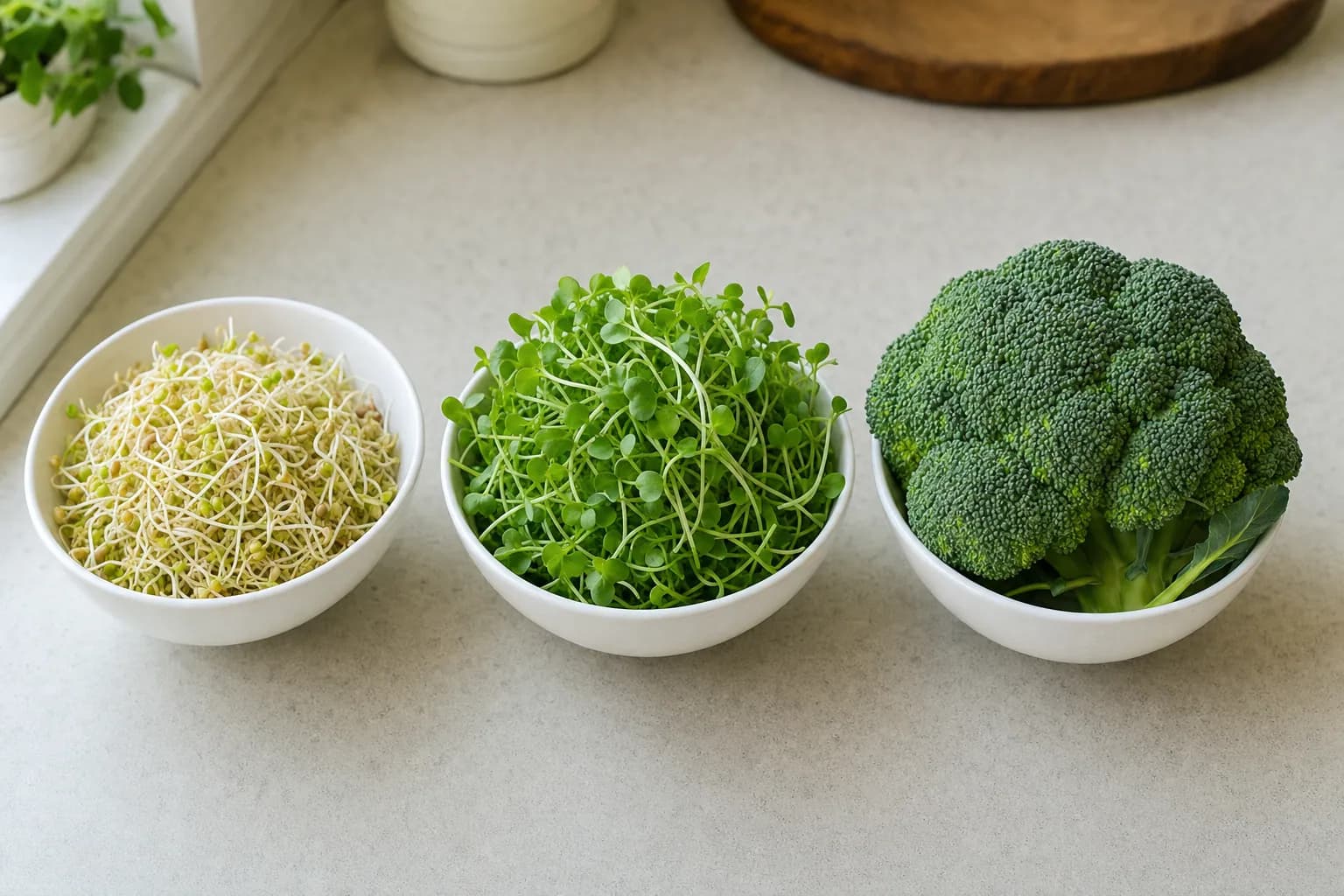
The second study took broccoli microgreens harvested at 12 days and compared fresh, microwave-dried and air-fryer-dried samples by LC-MS/MS, with the results run through ANOVA, clustering and pathway analysis [2].
The result is subtler and, I think, the more important of the two. The total quantity of compounds showed no significant difference between methods (P > 0.05). But the presence or absence of specific compounds differed significantly (P < 0.05).
Drying did not shrink the pool so much as change its membership. And the affected routes were metabolic and secondary biosynthesis pathways — exactly where the compounds that make microgreens interesting live.
Across all three preparations, the fresh sample showed the highest mean antioxidant and anticancer activity.
Reading two studies that appear to disagree
They are not really in conflict. Different crops, different methods, different measurements. Put together, four things follow:
- A "total compounds" figure can conceal the change that matters. Broccoli's totals held while its composition shifted. If a label tells you total phenolics survived processing, that is not the same claim as the same phenolics surviving — and the difference is invisible in the number.
- Gentler and colder retains more. Freeze-drying beat oven drying on pigment by a wide margin. Heat and time are what you are paying with.
- No method beat fresh on activity in either study.
- Home methods sit at the harsh end. Microwave and air-fryer drying are heat-and-speed approaches. Freeze-drying — the method that performed best — is not kitchen equipment, and the gap between what a lab can do and what a countertop can do is exactly where most of the loss happens.
Where that leaves drying
Drying is a preservation technique, not a nutrition-neutral one. It exists so that food does not get thrown away, which is a real and sufficient benefit — dried microgreen powder is a genuine way to carry colour, flavour and some of the profile into something you cook later. If the alternative is compost, dry it.
But if the goal is the nutritional profile that makes microgreens worth growing in the first place, both studies point the same direction: grow what you will eat, and eat it near harvest.
Which is an argument for growing them where you eat them rather than an argument for a better dehydrator. That is the same conclusion the freshness research reaches from the other end — see how fresh store-bought microgreens really are for what happens in the days between a farm and a shelf, harvest and storage for keeping fresh material at its best, and cooking with microgreens for the same question applied to heat rather than time.
Sources
Every figure in this article comes from one of the papers below, each read in full before being cited. Where a study measured one species under one set of conditions, we say so rather than generalising it to every crop. Follow the DOI to check any number yourself.
- Comparative assessment of drying techniques on the quality of sorghum microgreens. Food Chemistry 508 (2026) 148375. doi.org/10.1016/j.foodchem.2026.148375
- A comparative analysis on impact of drying methods on metabolite composition of broccoli microgreens. LWT — Food Science and Technology 210 (2024) 116866. doi.org/10.1016/j.lwt.2024.116866