This article is for general education and is not medical advice. Talk to your doctor before changing your diet for a health condition or if you take medication.
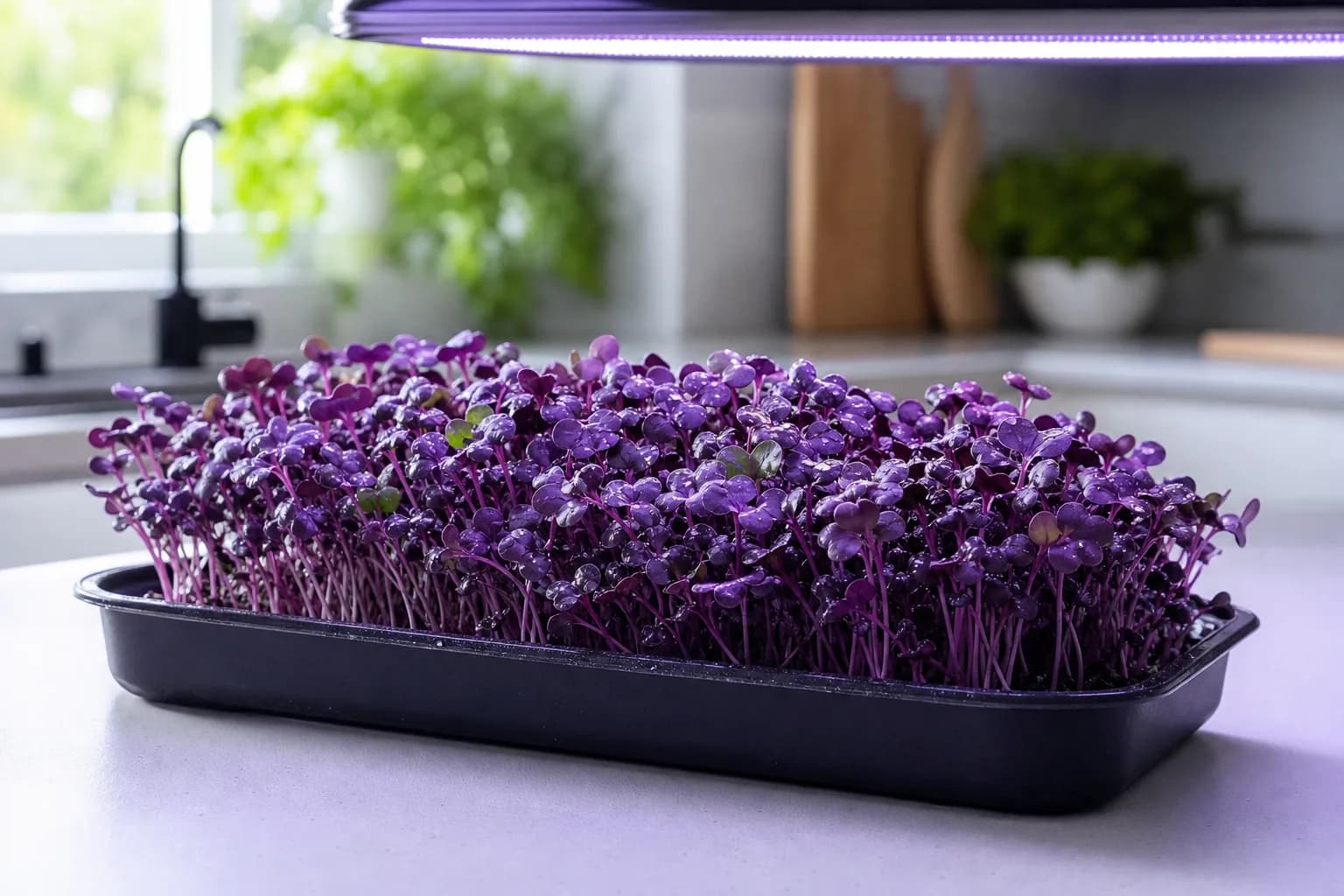
Plants can't run from a sunburn. When sunlight gets harsh, they do the only thing a rooted organism can: they build chemical sunscreen. A lot of that sunscreen happens to be the exact compounds we prize in food — the flavonoids and phenolic acids behind a microgreen's color, its slightly bitter edge, and much of its antioxidant punch. This is the quietly fascinating idea behind UV light and microgreens. A carefully measured dose of ultraviolet light is, to a young seedling, a mild threat. And a mildly threatened plant makes more of the good stuff.
Below is what the science actually says, where the trade-offs hide, and how to think about it if you grow at home.
Why a little stress is a good thing
Biologists have a name for the phenomenon where a small dose of something stressful triggers a beneficial response: hormesis, or "eustress" — good stress. Lift a weight and your muscle rebuilds stronger. Expose a seedling to a touch more ultraviolet than it's used to, and it ramps up its defenses.
The ultraviolet band that matters most here is UV-B, the slice of sunlight running roughly 280 to 315 nanometers. (UV-A sits above it at 315-400 nm, and the harsher UV-C below it at 200-280 nm.) UV-B is energetic enough to register as a threat but, in the right dose, not so intense that it wrecks the plant. That window is the whole game.
If you're newer to these greens, our explainer on what are microgreens is a good place to start, and microgreens nutrition covers why they're so concentrated in the first place.
The molecular switch UV-B flips
Here's the part that turns a vague "stress makes plants healthier" into real biochemistry. Plants carry a dedicated UV-B sensor called UVR8. When UV-B hits it, UVR8 partners with a protein called COP1 and switches on a master regulator named HY5.
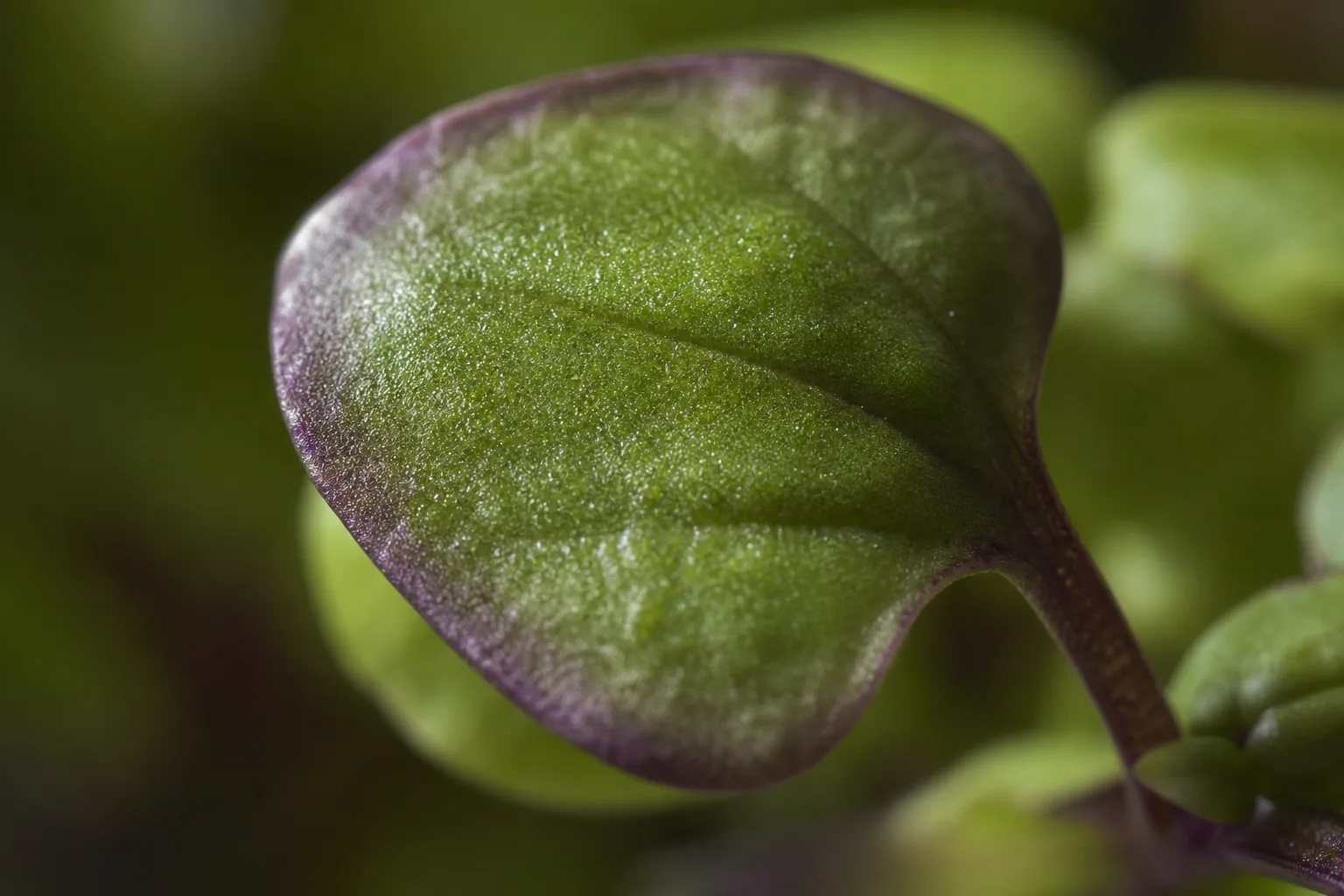
HY5 is essentially a foreman. Once active, it tells the cell to crank up the enzymes of the phenylpropanoid pathway — enzymes with names like PAL and CHS — which is the assembly line that builds flavonoids, anthocyanins (the red-purple pigments), and phenolic acids. In rapeseed seedlings, genes including PAL, C4H, 4CL, CHS, and CHI were measurably switched up within 24 hours of UV-B exposure. The plant isn't slowly drifting toward more antioxidants; it's flipping a switch.
What the studies actually found
The pattern repeats across a striking range of crops. Under UV-B, total flavonoid and phenolic content rose in lettuce, basil, mango, rice, stevia, and more — and antioxidant activity climbed alongside. In grapes, UV-B didn't just lift secondary metabolites; tasters found it improved flavor, too. UV-A, the gentler band, also nudges things up: in basil it boosted PAL activity and total phenolics.
Here's a rough picture of the direction and size of these shifts. Treat these as illustrative ranges drawn from the literature, not guarantees — every crop and setup is different.
| Crop | UV band | What went up | Typical direction |
|---|---|---|---|
| Lettuce | UV-B | Flavonoids, phenolics | +15% to +40% |
| Basil | UV-A / UV-B | Total phenolics, antioxidant capacity | +20% to +50% |
| Mango (young tissue) | UV-B | Anthocyanins, flavonoids, phenolics | Marked increase |
| Rice seedlings | UV-B | Flavonoids, phenolics | Moderate increase |
| Rapeseed | UV-B | Phenylpropanoids, flavonoids, anthocyanins | Genes up within 24 h |
There's also a clever timing wrinkle. In mulberry, a short 15-minute UV-B hit followed by a stretch of darkness pushed up protective compounds — a hint that the plant does some of its building after the lights go off, not only during exposure. The point isn't to copy that recipe at home; it's that dose and timing, not raw intensity, are what shape the result.
The trade-off nobody mentions: yield
Now the honest part. UV-B is a stress, and stress costs something. The defining rule of UV in plants is biphasic — researchers literally describe it as "low-dose stimulation, high-dose inhibition." A measured dose enriches your greens. Too much does the opposite: it damages the photosynthetic machinery (photosystem II in particular), slows growth, and can drag secondary-metabolite production back down instead of up.
So you're trading on two axes at once:
| More UV-B does this | The catch |
|---|---|
| Raises flavonoids and phenolics | Only up to a crop-specific ceiling |
| Deepens color and antioxidant levels | Can slow growth and trim yield |
| Strengthens the plant's stress defenses | Past the threshold, it injures the plant |
| Improves flavor in some crops | Tolerance differs by species and growth stage |
That tolerance threshold isn't fixed. It varies markedly between plant families — and even within one species at different growth stages. A dose that's perfect for radish at day five might be too much for it at day three, or wrong for basil entirely. This is exactly why "just add a UV bulb" is poor advice. The same logic shows up in our piece on how to maximize sulforaphane in brassica greens: the protective compounds we want are downstream of carefully managed conditions, not brute force.
Safety: for the plant and for you
Two different safety conversations get tangled here, so let's separate them.
For the plant. Stay in the UV-B window and keep doses modest and brief. UV-C (the 200-280 nm band) is a different animal — it's the germicidal wavelength used to sterilize surfaces, and while a flash of it can spike specific compounds like resveratrol in grapevine cells, it's genuinely harsh on living tissue and easy to overdo. For everyday eating greens, gentle UV-B or UV-A is the sane lane.
For you. UV-B and UV-C are the same wavelengths that burn skin and damage eyes. This matters far more in a kitchen than in a sealed research chamber. Never look at a UV grow lamp, never run an exposed UV source where it shines on people or pets, and don't improvise with hardware-store UV bulbs on an open counter. If a system uses UV, it should be fully enclosed and shielded — full stop.
This is also where a closed, managed grower earns its keep. A countertop unit like Luya runs its light recipe inside an enclosure on a controlled schedule, so any spectrum tuning happens safely and consistently rather than as a science experiment next to your toaster. If you want the broader picture of how spectrum shapes nutrition, see light and microgreen nutrition and our deep dive on microgreens anthocyanins.
Should you chase UV at home?
For most home growers, the better takeaway isn't "buy a UV rig." It's understanding why a good grow recipe is more than just brightness. The plants you eat are responding to a whole light environment — wavelength, intensity, and timing — and small, deliberate stresses are part of how growers coax out richer color and higher antioxidant levels. UV-B is one tool in that kit, alongside blue and red light, that controlled-environment systems are beginning to use with real precision. (See controlled environment agriculture for how that field thinks about it.)
If you do nothing with UV at all, your microgreens are still excellent — they're already one of the most nutrient-dense things you can grow on a counter, as we cover in are microgreens good for you. UV is a way to nudge an already-great food a notch further, not a requirement.
The bottom line
UV-B works on microgreens because it scares them, just a little. That mild eustress flips the UVR8-HY5 switch and sends the plant building flavonoids, anthocyanins, and phenolics — the same compounds we eat them for. The catch is that the dose-response curve cuts both ways: stay under the crop's threshold and you gain antioxidants, color, and sometimes flavor; cross it and you lose yield and can injure the plant. And because UV-B and UV-C are the same rays that hurt human skin and eyes, any UV used for growing belongs safely enclosed, never on an open counter. Respect the dose, respect the shielding, and a small stress becomes a genuine upgrade.
References
- Effect of Different Ratios of Blue and Red LED Light on Brassicaceae Microgreens under a Controlled Environment. Plants (Basel). 2021;10(4):801. https://doi.org/10.3390/plants10040801
- Kyriacou MC, Rouphael Y, Di Gioia F, et al. Micro-scale vegetable production and the rise of microgreens. Trends Food Sci Technol. 2016;57:103–115. https://doi.org/10.1016/j.tifs.2016.09.005