This article is for general education and is not medical advice. Talk to your doctor before changing your diet for a health condition or if you take medication.
If you have ever wondered why two trays of the same seed can look so different — one short and stocky, the other tall and leggy — the answer often comes down to a color of light you can barely tell apart with your eyes. Plants, it turns out, are far better at reading red light than we are. They use it to measure where they are, how crowded they are, and whether it is time to stretch toward the sun or stay compact and build up their defenses.
For anyone growing microgreens, that is a useful thing to understand. The red part of the spectrum quietly steers two things you care about: how your greens look on the plate, and how much of the good stuff — antioxidants, flavor compounds, pigments — ends up inside them. Let's unpack how it works and what it means for your countertop.
Meet phytochrome, the plant's red-light sensor
Plants carry a pigment protein called phytochrome that acts like a built-in light switch. It exists in two interconvertible forms. Red light (around 660 nm) flips it into its active state, known as Pfr. Far-red light (around 720–730 nm) flips it back to the inactive state, called Pr. Because the switch toggles back and forth depending on which color is hitting it, phytochrome is essentially measuring the balance of red to far-red light in the environment at any given moment.
That balance matters because it carries information. In open sunlight, red and far-red arrive in roughly equal amounts. But leaves absorb red light strongly and let far-red pass through. So when a plant sits under or beside other plants, the light reaching it becomes far-red-heavy. A low red:far-red ratio is the plant's signal for "I'm being shaded — I have competition."
When red light dominates and phytochrome is in its active Pfr form, it sets off a cascade inside the cell. Active phytochrome interferes with a protein complex (COP1/SPA) that would normally degrade a master regulator called HY5. With that complex held back, HY5 builds up — and HY5 is one of the main switches that turns on genes for protective compounds. If you'd like a primer on the crop these signals act on, see what are microgreens.
Stem elongation and the shade-avoidance response
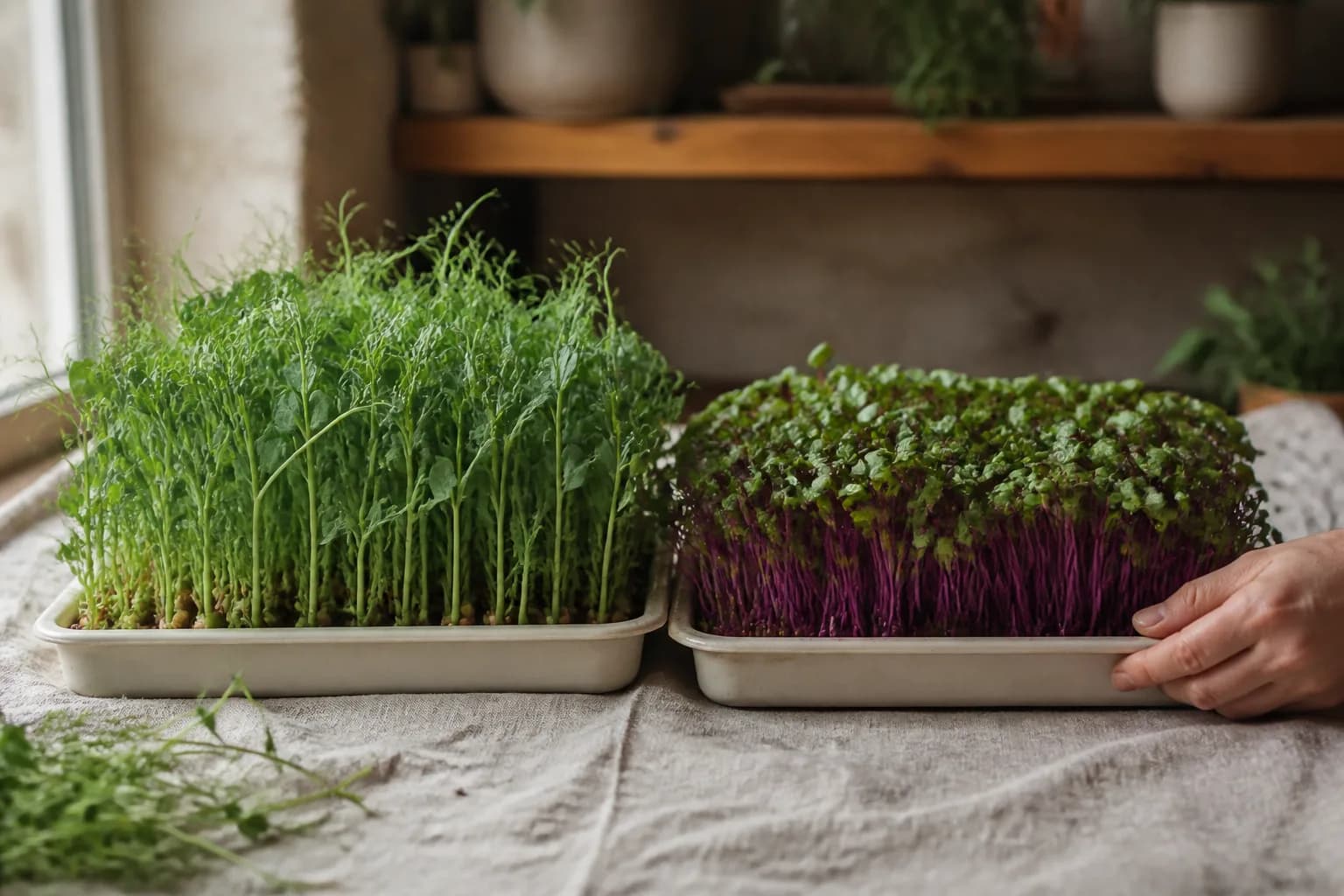
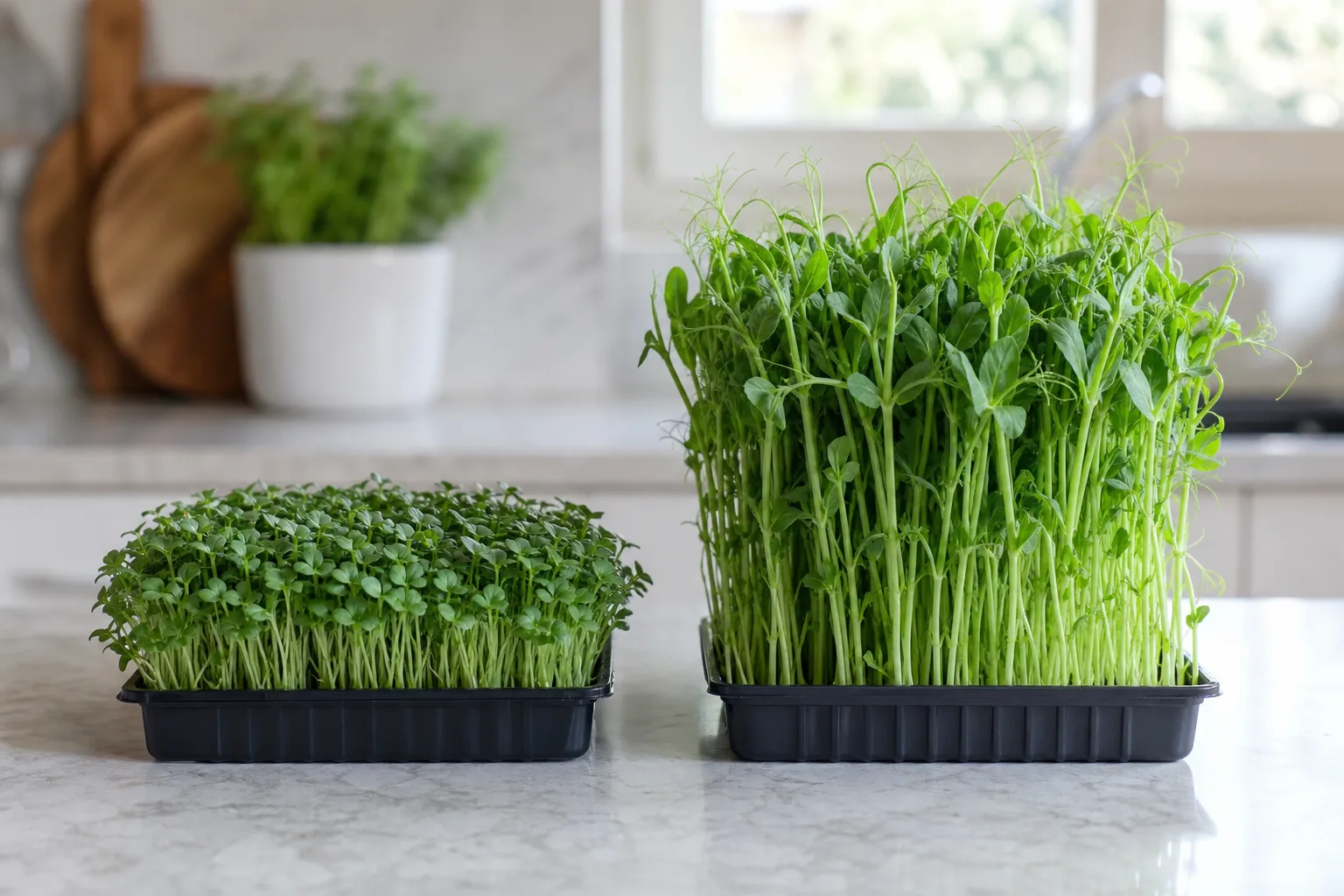
The most visible effect of the red:far-red ratio is on height. When far-red light is abundant — meaning the ratio is low — plants launch what botanists call the shade-avoidance response. They pour energy into stem elongation, racing upward to outcompete neighbors for light. Hypocotyls (the seedling stem) stretch, internodes lengthen, and the plant prioritizes height over thickness.
For microgreens, that response is a double-edged sword. A little stretch is fine. Too much gives you the dreaded "leggy" look: pale, floppy, weak-stemmed seedlings that flop over and don't hold up in a sandwich or a bowl. Stronger red light (a higher red:far-red ratio) does the opposite — it keeps phytochrome active, suppresses excessive elongation, and tends to produce shorter, sturdier, more uniform greens.
This is also why leggy trays are so often a light problem rather than a watering or seed problem. If your greens are reaching and pale, they are usually telling you the light is too dim or too far-red-shifted, and they think they're buried in shade. We go deeper into the fixes in how to fix leggy microgreens and cover the broader light picture in light and microgreen nutrition.
| Lighting condition | Red:far-red signal | Typical effect on microgreens |
|---|---|---|
| Bright, red-rich light | High (phytochrome active) | Short, stocky stems; uniform stand; often higher pigment |
| Balanced full-spectrum | Moderate | Healthy growth, good height and color balance |
| Dim or far-red-heavy | Low (phytochrome inactive) | Stem elongation, leggy/pale seedlings, weak structure |
| Darkness (germination) | None active | Rapid elongation, no greening — useful only briefly |
Red light and the compounds inside your greens
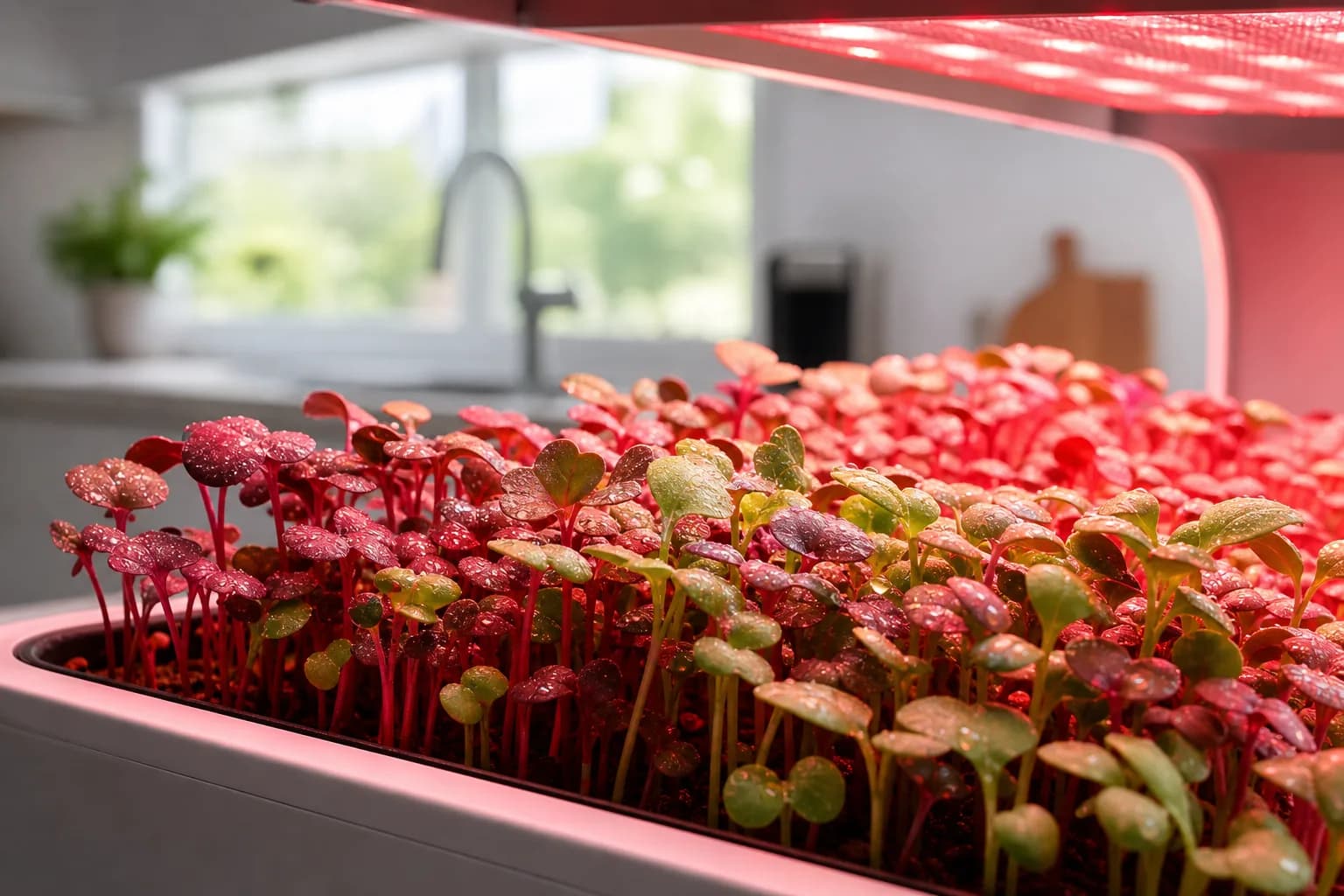
Height is the obvious story, but the more interesting one happens at the molecular level. By stabilizing HY5, red light turns up the volume on the phenylpropanoid pathway — the cell's main assembly line for phenolic compounds and flavonoids. Two key enzymes in that pathway, PAL and CHS, get upregulated under red light, and they sit right at the start of the route that produces anthocyanins (the red-purple pigments), flavonoids, and a wide range of phenolic antioxidants.
The research bears this out across very different plants. Wheat sprouts grown under red LEDs for four days showed higher activity of the PAL, C4H, and 4CL enzymes, which boosted total phenolics and antioxidant capacity. Scots pine seedlings under red and far-red light accumulated more proanthocyanidins and catechins, apparently by ramping up the CHS and related genes. In sage shoots, red light raised polyphenol and rosmarinic acid content through the PAL, TAT, and RAS genes. The mechanism repeats: red signal in, more phenylpropanoid output.
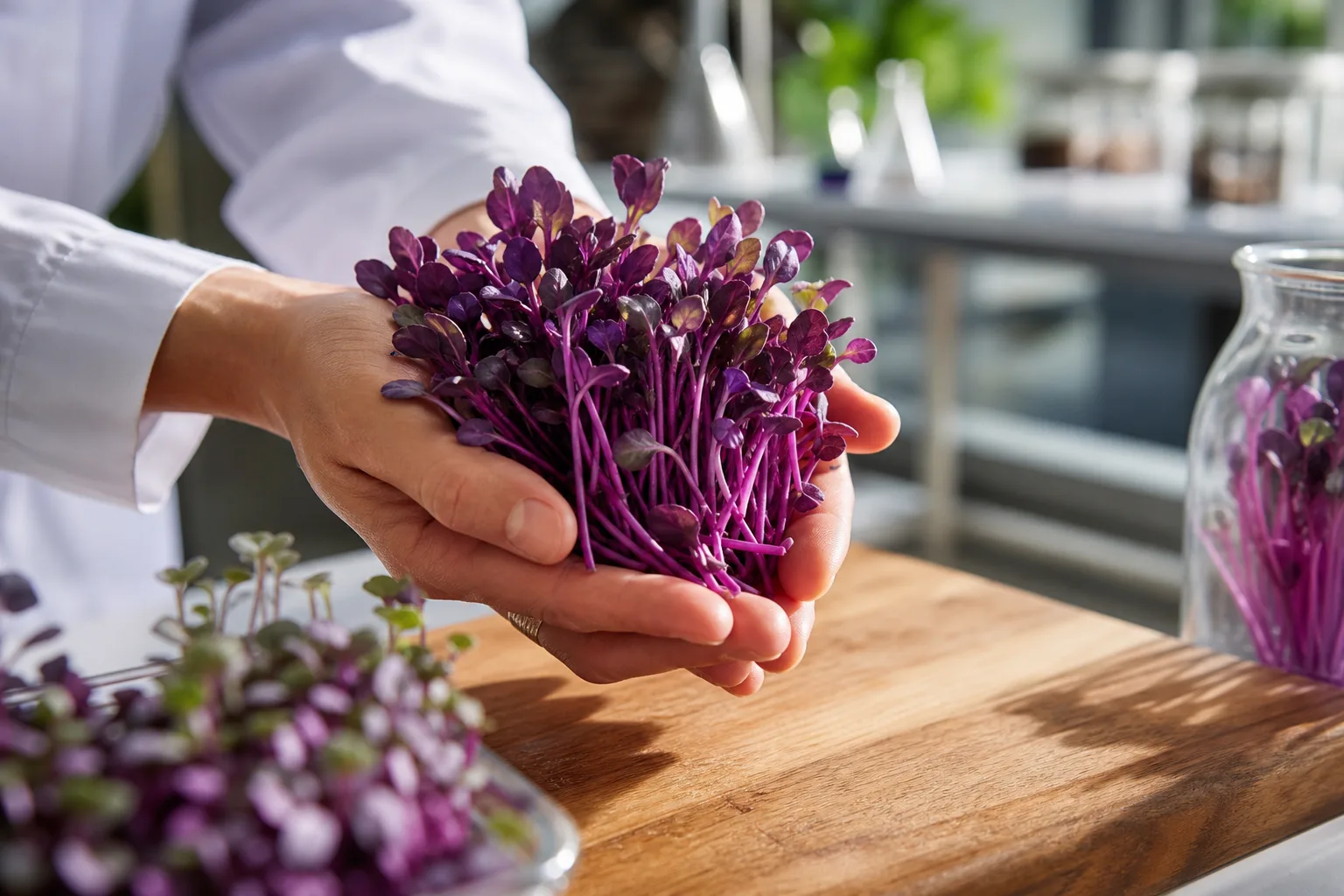
Red light also reaches beyond phenolics. It can nudge the MEP and MVA pathways — the routes that build terpenoids — by boosting an enzyme called DXR, and it works hand in hand with the plant's jasmonate (JA) and salicylate (SA) hormone systems to coordinate a broader defense response. In one striking example, red light enhanced nitrogen metabolism and precursor supply in belladonna, increasing its alkaloids. The takeaway for the kitchen is simpler: the same light that keeps a green compact is often the light that helps it pack in pigment and antioxidants. For more on those nutrients, see microgreens nutrition and are microgreens good for you.
Far-red has its own job
It would be easy to write far-red off as the "bad" light that makes plants leggy, but that's not the full picture. Far-red is a legitimate signal, not just an absence of red. In some studies, including those mixed light recipes used on Scots pine and other species, a measured dose of far-red alongside red still supported strong proanthocyanidin and catechin levels. And far-red has a known role in driving stem and leaf expansion, which can be desirable when you specifically want longer, more tender shoots.
The practical lesson is about ratio and timing, not banishing one color. A red-dominant spectrum during the main grow-out keeps greens compact and pigment-rich. A touch of far-red can be a deliberate tool if you want a particular texture or length. What you want to avoid is an accidental far-red-heavy environment — a dim windowsill, light filtered through other foliage, or low-quality bulbs — that tricks every tray into thinking it's being shaded.
Putting it to work on your countertop
You don't need a spectrometer to benefit from any of this. A few principles go a long way:
- Bright beats far. Most leggy, pale trays are starved of usable light. Getting plenty of red-rich light close to the canopy is the single biggest lever for short, sturdy greens.
- Keep the source consistent. Plants read the balance of the spectrum, so a stable, full-spectrum-but-red-rich light gives more predictable results than a wandering sunbeam.
- Use blackout only at the start. A short dark germination period encourages even sprouting; we cover the why in microgreens germination and the blackout phase. After that, get them into light promptly so they don't over-elongate.
- Pair light with the right crop. Naturally pigmented greens like radish microgreens and red amaranth show the antioxidant payoff most vividly under good red-rich light.
This is exactly the kind of thing a countertop food computer like Luya is built to take off your plate. Instead of guessing whether the windowsill is bright enough or far-red-shifted, the grower delivers a consistent, tuned light recipe at the right intensity and distance, day after day — which is why home-grown trays so reliably come out compact and richly colored. If you want the full breakdown of the system, see how Luya works.
| Goal | Lighting approach | What you'll notice |
|---|---|---|
| Short, sturdy greens | Bright, red-rich light close to canopy | Thick stems, less flopping, even tray |
| Maximum color and antioxidants | Red-rich spectrum, adequate intensity | Deeper pigment, especially in red varieties |
| Longer, tender shoots | Slightly more far-red in the mix | Increased stem and leaf length |
| Even germination | Short blackout, then bright light | Uniform sprouting, then controlled greening |
The bottom line
Red and far-red light in microgreen growing is really a conversation between your seedlings and their environment, conducted through a single pigment switch. Red light tells plants they have room and good conditions, so they stay compact and invest in protective compounds like phenolics, flavonoids, and pigments. Far-red light says "you're crowded," prompting them to stretch. Tip the balance toward red-rich light at a sensible intensity, and you get the best of both worlds: greens that look good on the plate and carry more of the nutrients you're growing them for. Whether you dial it in by hand on a sunny shelf or let a countertop grower handle the recipe, the science points the same direction — give your microgreens the right red, and they'll reward you for it.
References
- Effect of Different Ratios of Blue and Red LED Light on Brassicaceae Microgreens under a Controlled Environment. Plants (Basel). 2021;10(4):801. https://doi.org/10.3390/plants10040801
- Kyriacou MC, Rouphael Y, Di Gioia F, et al. Micro-scale vegetable production and the rise of microgreens. Trends Food Sci Technol. 2016;57:103–115. https://doi.org/10.1016/j.tifs.2016.09.005