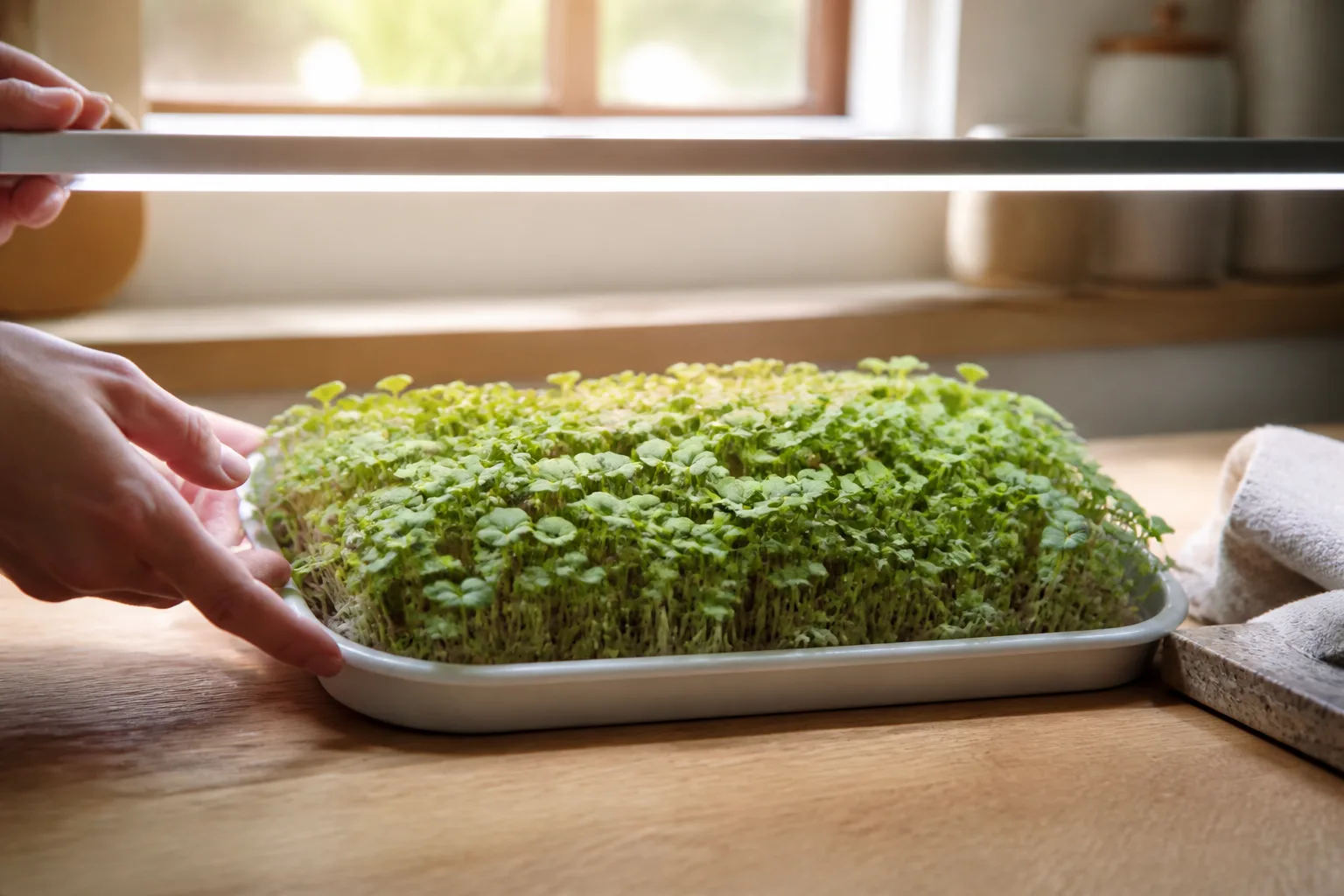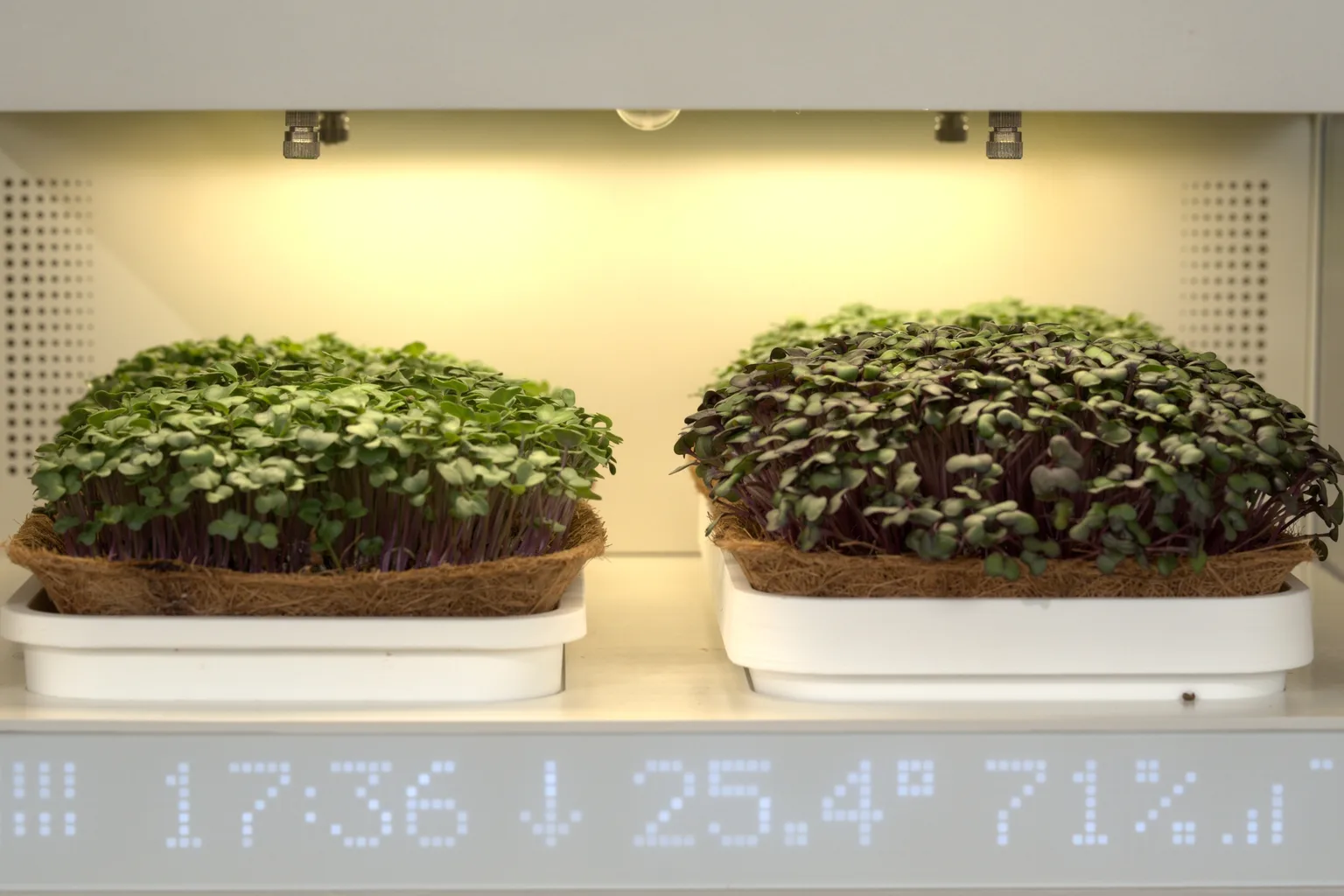
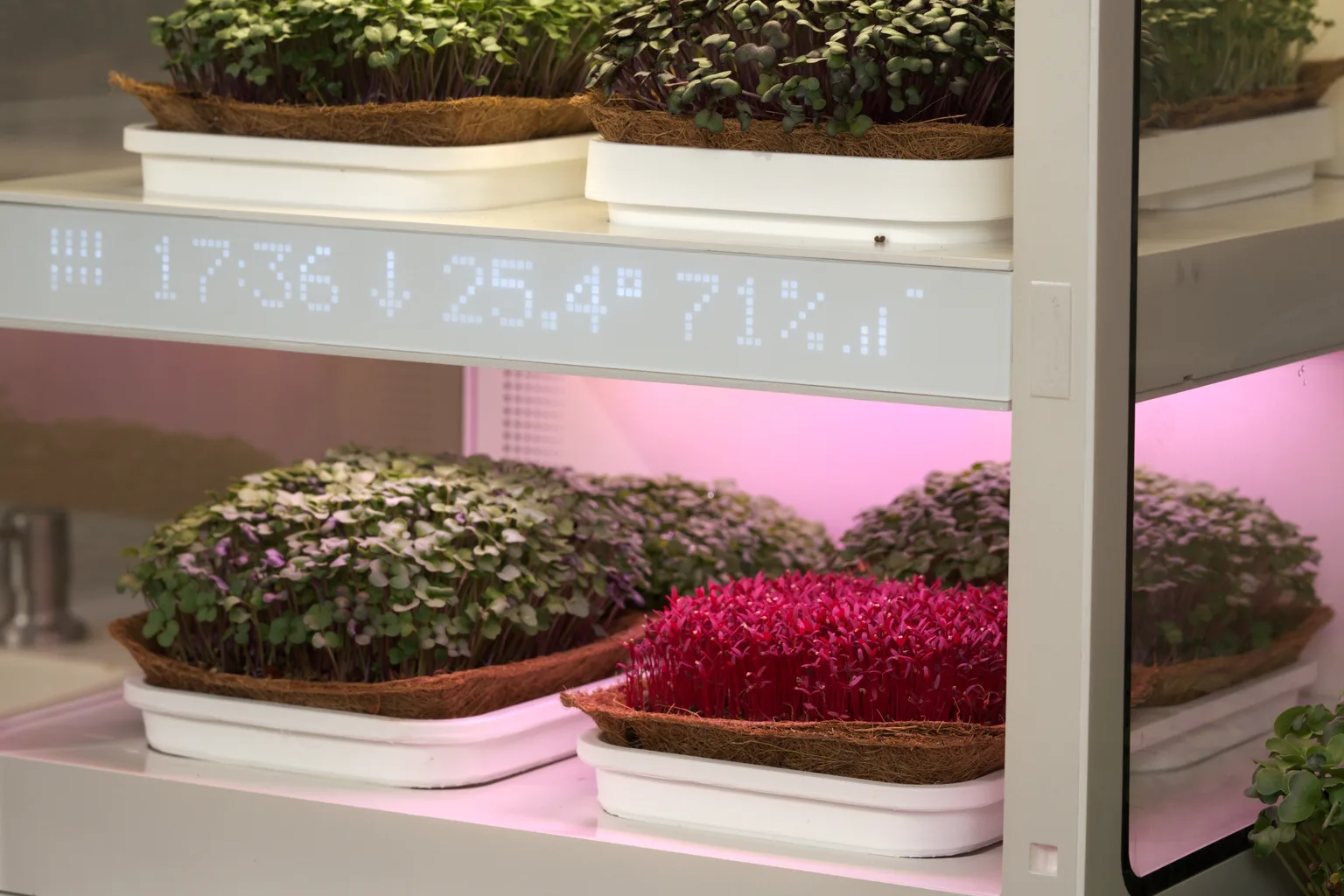
Picture a tiny indoor farm that never sleeps. It checks the air a hundred times an hour, nudges a light up or down, gives a sip of water exactly when the roots need it, and does all of this while you're at work or asleep. No green thumb required. That's roughly what happens inside an AI-controlled growing chamber, and once you see the loop it runs on, the "magic" turns into something pleasingly logical.
The same ideas that researchers use to automate full-size greenhouses now fit on a kitchen counter. You don't need a PhD to understand them. In this guide I'll walk through the four-part loop that lets software grow plants on its own, what each piece actually does, and why this approach tends to beat a fixed timer or a manual routine. If you're new to the crops we grow this way, what are microgreens is a friendly place to start.
The loop in four words: sense, think, decide, act
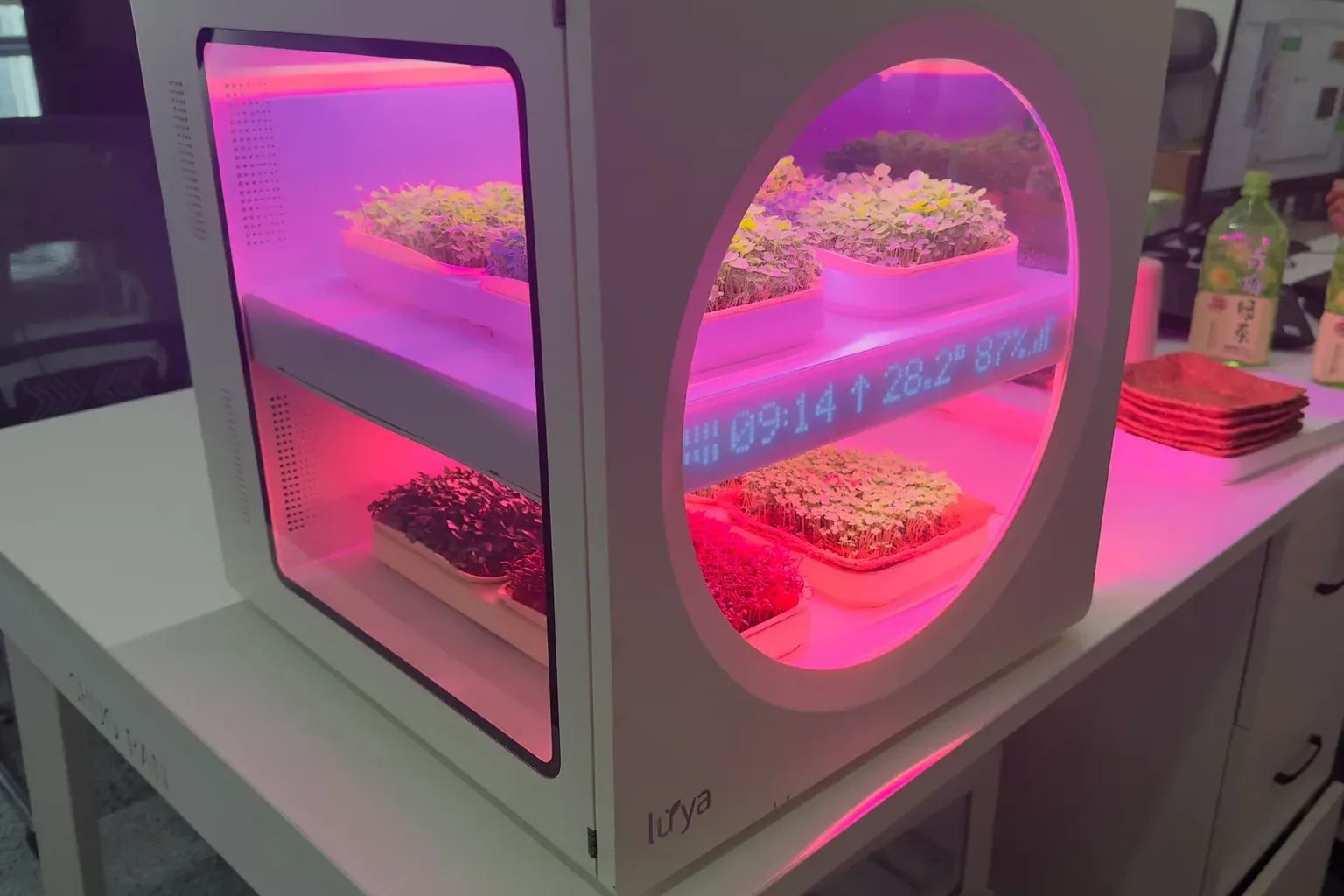
Every automated grower, from a research greenhouse to the Luya countertop food computer, runs the same basic cycle:
- Sense — sensors read the current conditions (temperature, humidity, light, moisture).
- Think — a model uses those readings to predict what happens next.
- Decide — the system picks the action that best balances plant health against energy use.
- Act — actuators (heaters, fans, lights, pumps) carry out that decision.
Then it repeats. A greenhouse study from Cornell ran this loop once an hour. A more recent Delft and Wageningen project ran it every 15 minutes. A countertop chamber can cycle even faster because the space is small and changes quickly. The shorter the loop, the more responsive the system, and the less any single mistake can drift before it gets corrected.
Step one: sensing the world
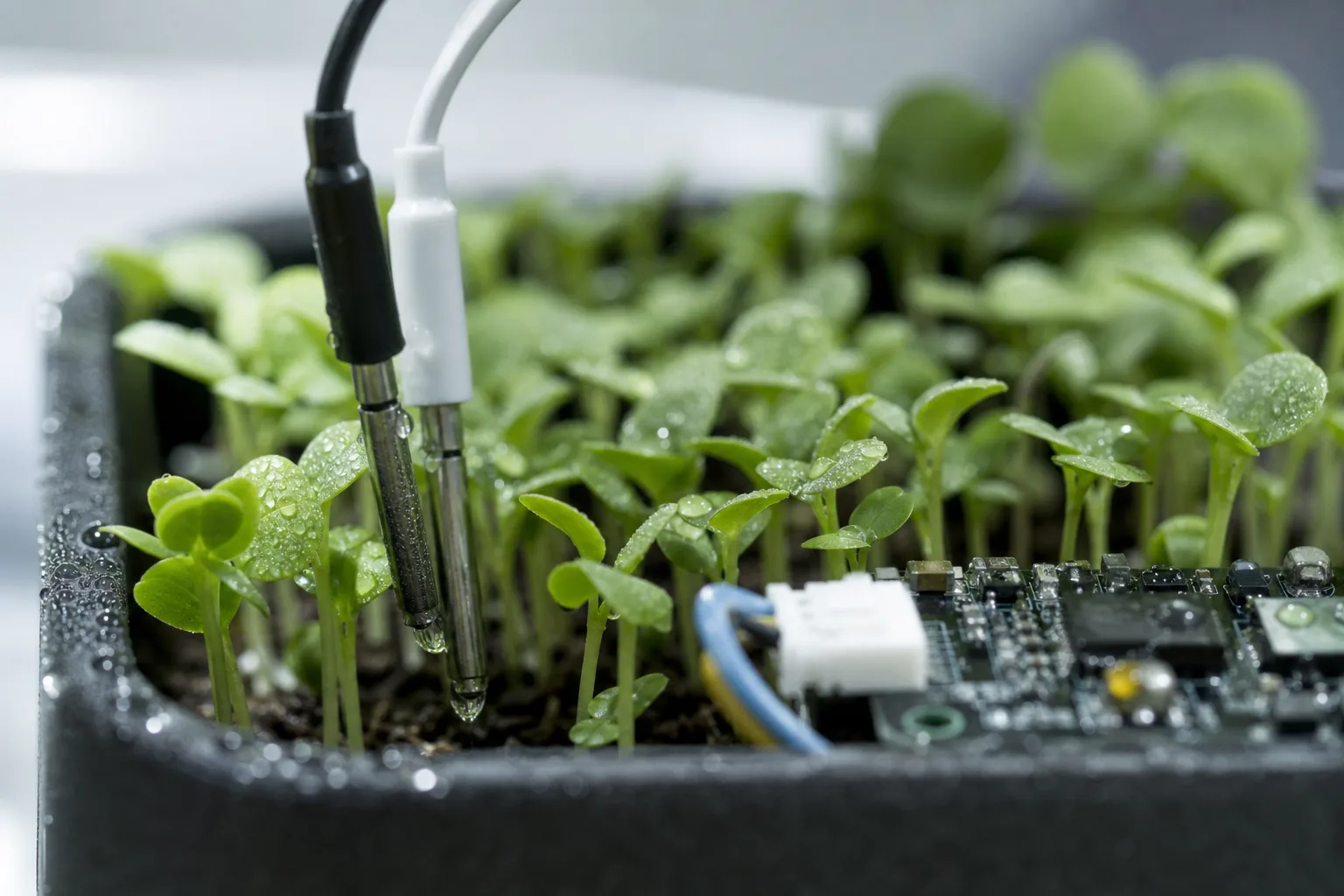
You can't control what you can't measure, so the loop starts with sensors. In a greenhouse the usual suspects are indoor air temperature, humidity, and carbon dioxide. Researchers also track surfaces a plant feels but a person ignores, such as wall, ceiling, and floor temperatures, because those quietly push the air around them. In one Cornell model the agent watched six values at once: several indoor temperatures plus the outdoor temperature and a short forecast.
A countertop chamber watches a smaller, tighter set: air temperature, humidity, how much light is actually reaching the leaves, and moisture at the root zone. The numbers it reads are the raw truth the rest of the loop depends on. Garbage in, garbage out, so good sensing matters more than any clever algorithm downstream.
Step two: the model that sees a few minutes ahead
Here's the part that separates AI control from a plain thermostat. A thermostat reacts only to now: too cold, turn on heat. A model-driven controller asks a better question, "given where things are headed, what should I do so conditions are still right a few steps from now?"
There are two main ways to build that foresight, and they have real trade-offs:
| Approach | How it learns | Strength | Watch-out |
|---|---|---|---|
| Model predictive control (MPC) | Uses a physics model of the chamber to simulate the near future | Respects hard limits; easy to interpret | Only as good as its model; real chambers are messy |
| Reinforcement learning (RL) | Learns from experience by trial and reward | Adapts to surprises and bad forecasts | Needs data; pure versions can be a black box |
MPC is like a chess player thinking three moves ahead using the rulebook. Reinforcement learning is like a player who has lost a thousand games and now just knows what tends to work. Modern systems increasingly blend the two: the Delft team wrapped an MPC controller inside a reinforcement-learning agent, so it kept MPC's respect for safe limits while learning to correct for an imperfect model. The payoff was fewer constraint violations without sacrificing crop growth.
Step three: deciding with a reward in mind
A model can predict the future, but it still needs a goal to choose between options. In these systems the goal is written as a reward function, a simple score the software tries to maximize.
The reward almost always balances two things in tension: keep the plant happy, and don't waste energy. In the Cornell greenhouse the reward subtracted the energy spent and added a penalty whenever the temperature drifted outside the target range. The controller couldn't just blast the heat to stay cozy, because the energy cost would tank its score. It also couldn't ignore the plants, because temperature violations were punished. So it learned the cheapest path that still kept conditions in bounds.
That balance is why automated growers can be both effective and efficient. In the Cornell results, a Q-learning controller used 61% less energy than a competing method while earning higher overall returns. Same plants, far less power, just by deciding more cleverly.
| What the system juggles | Typical target for greens | Why it matters |
|---|---|---|
| Air temperature | ~22–25°C (tomato example) | Too hot or cold stalls growth |
| Humidity | Kept below a safe ceiling | High humidity invites mold and disease |
| Light (daily dose) | Tuned per crop and stage | Drives growth; overdoing it wastes energy |
| Energy use | Minimized | Lower running cost, smaller footprint |
If mold is your nemesis, that humidity ceiling is doing quiet heroics; more on that in why microgreens keep molding.
Step four: acting through heaters, fans, lights, and pumps
A decision is useless until something physical happens. That's the job of actuators. In greenhouse research the main levers are heating, ventilation, and CO2 injection. On a countertop the levers are gentler but the idea is identical: LED lights, a small fan for airflow, a heater or cooler, and a water pump or wick.
One subtle but important detail: good controllers think in smooth, continuous moves, not just on/off. Older RL methods had to chop actions into coarse steps, which is clumsy. Newer methods handle a continuous range, so the system can apply, say, 38% power instead of slamming between zero and full blast. That smoothness is easier on equipment and on plants, and it's a big reason these controllers feel less twitchy than a basic thermostat.
Why this beats a timer (and your busy schedule)
A timer is open-loop: it does the same thing at the same hour regardless of what's actually happening. If the room is unusually warm, a timer doesn't know or care. A closed-loop AI controller closes that gap by constantly checking reality and adjusting.
That matters most when the outside world misbehaves. Greenhouse temperatures wobble with weather, wind, and sun, and forecasts are never perfect. The whole reason researchers reach for reinforcement learning is that it handles this uncertainty by learning from data instead of trusting a flawless prediction. The Delft team even added random noise to their training weather on purpose, so the controller would learn to cope with messy, real-world conditions rather than a tidy lab version.
For you, the upside is practical. The chamber absorbs the day-to-day variability so your harvest stays consistent, and you don't have to babysit it. That's the heart of how Luya works: the sense-think-decide-act loop runs in the background so you mostly just plant and harvest. If you'd rather grow the old-fashioned way, how to grow microgreens at home shows the manual version, and grow vs buy microgreens weighs the trade-offs.
What this means for your greens
The reason all this engineering is worth it comes down to the food. Steady temperature, controlled humidity, and tuned light don't just keep plants alive; they shape flavor, texture, and nutrition. Dialed-in conditions are part of why fresh, just-harvested microgreens can taste brighter and pack more of the good stuff than the tired clamshells at the store. The science behind that nutrition is its own rabbit hole, well covered in microgreens nutrition and are microgreens good for you.
The bigger picture: precise, automated growing is a quiet revolution in controlled environment agriculture, shrinking from warehouse-scale farms down to a box on your counter. The same loop scientists use to wring crop yield out of a greenhouse is what lets a small chamber give you restaurant-quality greens with almost no effort.
The takeaway
An AI growing chamber isn't sorcery, it's a tight feedback loop: sense the conditions, predict where they're heading, decide the move that keeps plants thriving without wasting energy, then act, and repeat. Whether the brain is model predictive control, reinforcement learning, or a blend of both, the goal is the same, hands-off growing that's more consistent and more efficient than a timer or a busy human could manage. Understanding the loop won't make you do the work yourself, and that's rather the point. The chamber handles the thinking so you can just enjoy the harvest.