If you want fresh greens fast, the easiest microgreens to grow at home are also some of the most rewarding. The beginner-friendly varieties below sprout within a day or two and are ready to harvest in about a week — no garden, no green thumb, and very little that can go wrong. They also pack a real nutritional punch: research summarized in peer-reviewed reviews (MDPI Plants) and USDA data suggests microgreens can be roughly 2 to 3.5 times more nutrient-dense than their full-grown counterparts, gram for gram.
That combination — fast, forgiving, and genuinely good for you — is why microgreens are the rare houseplant that ends up on your plate. This guide walks you through seven dependable crops, what to expect from each, the exact timing to plan around, and the simple habits that keep your first tray from failing.
What makes a microgreen easy to grow?
Before the list, it helps to know what "easy" actually means. The easiest microgreens to grow share three traits:
- Fast, reliable germination. Seeds that sprout in 1–3 days give mold and rot less time to take hold, and they reward you quickly enough to keep you motivated.
- Short cycles. A 5–10 day window means less daily fuss and fewer chances for a busy week to derail you before harvest.
- Forgiving seeds. Larger or hardier seeds tolerate beginner mistakes like uneven watering, slightly heavy seeding, or a warm room.
The most common reasons a first tray fails aren't exotic. They come down to three M's: mold (too much moisture, poor airflow, overcrowded seeds, and warmth working together), mess (loose potting soil scattered across the counter), and maintenance (microgreens need daily attention across roughly a 10-day cycle, and one skipped stretch can end a tray). Picking the right crop reduces all three risks at once. If you want a deeper troubleshooting walk-through, see our guide on why microgreens keep molding.
The 7 easiest microgreens to grow
Here are seven dependable starters, roughly ordered from fastest to most flavorful. Each one is a great first project, and none requires special equipment beyond a shallow tray, a spray bottle, and a sunny spot.
1. Radish
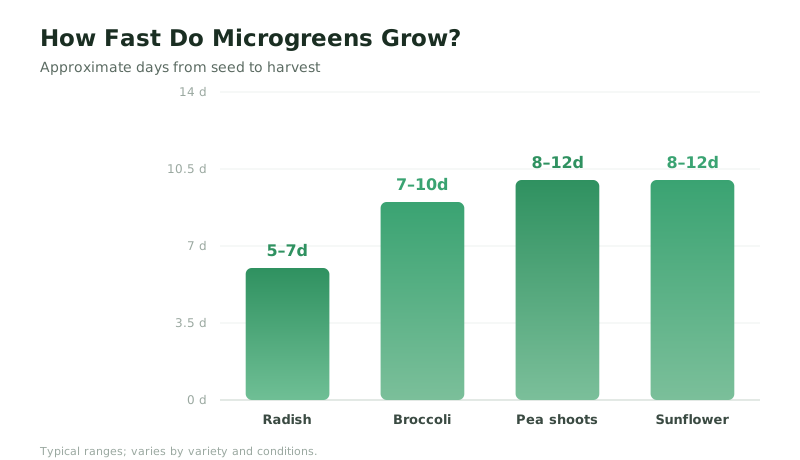
Radish is the gold standard for beginners. Seeds germinate in just 1–2 days and are ready to harvest in about 5–7 days — among the quickest of any crop. The flavor is a bright, peppery bite that wakes up tacos, sandwiches, and eggs. Radish microgreens are also frequently reported as the most nutrient-dense of the common varieties, so you get speed and substance in one tray. If your first attempt is a radish tray, you're stacking the odds heavily in your favor. Read more in our profile of radish microgreens.
2. Pea shoots
Pea shoots are big, sturdy, and forgiving, with a sweet, fresh-pea taste that even skeptical kids tend to like. The large seeds are nearly impossible to over-handle, and a quick overnight soak speeds germination. They're also a standout for plant-based protein — one of the more protein-dense microgreens and a strong plant-based protein source. Learn more in our deep dive on pea shoots.
3. Broccoli
Broccoli microgreens are mild, slightly sweet, and easy to grow, but their real claim to fame is nutritional. They contain roughly 10 to 100 times more glucoraphanin — the sulforaphane precursor — than mature broccoli (Johns Hopkins research), though the finished sulforaphane you actually get varies widely by variety, growing conditions, and harvest timing. Sulforaphane is the compound behind much of broccoli's research buzz — learn why in what is sulforaphane.
4. Sunflower
Sunflower shoots are crunchy, nutty, and substantial — closer to a snack than a garnish. The large seeds are easy to handle and germinate reliably, and a gentle weight placed on the tray for the first day or two helps the shoots push off their hulls cleanly. They make a satisfying early win and add real texture to salads and bowls.
5. Red cabbage
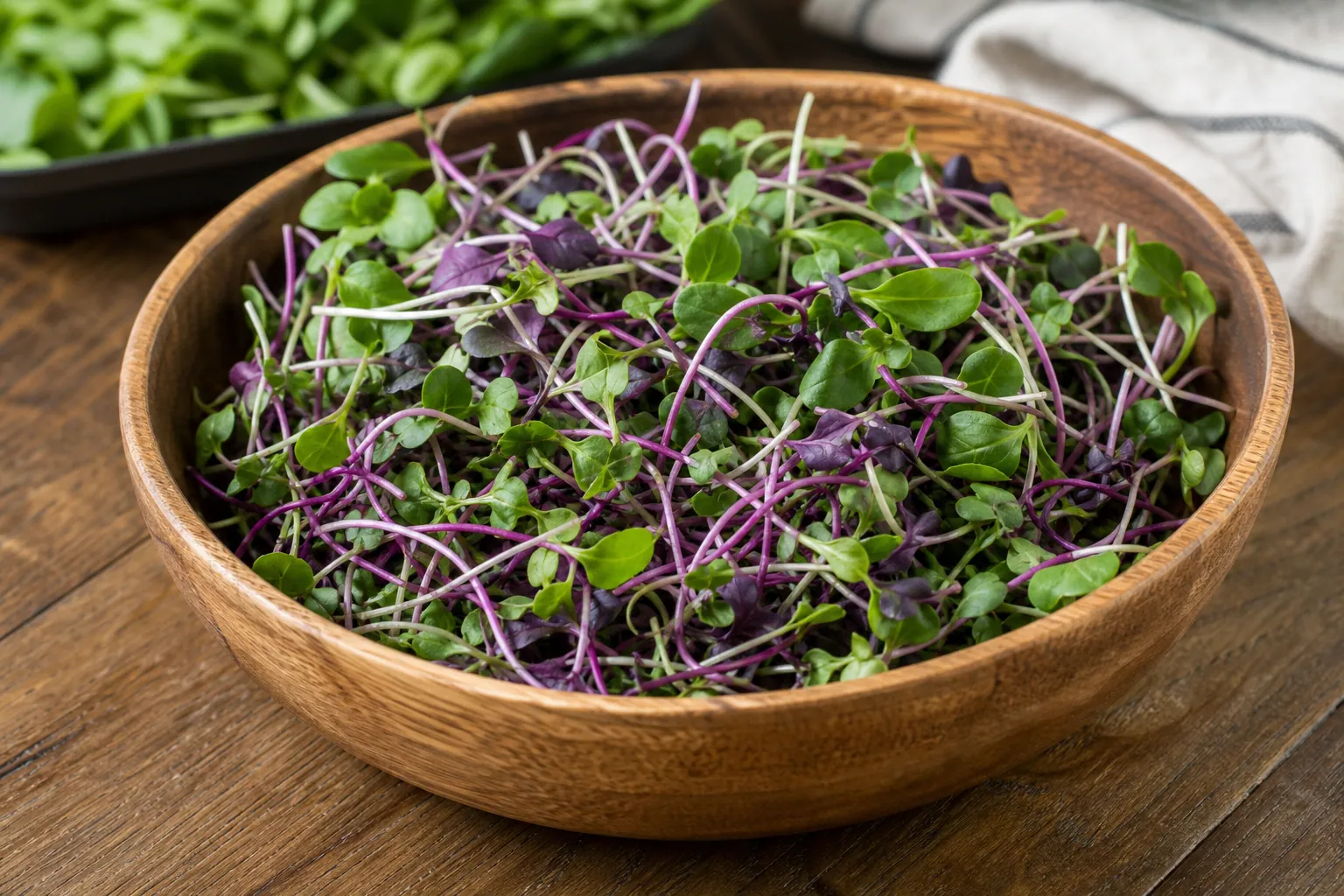
Red cabbage microgreens add striking purple stems and a gentle, sweet-peppery flavor. In an early animal (mouse) study cited by the USDA, red cabbage microgreens lowered LDL and liver cholesterol (and inflammatory markers) in mice on a high-fat diet, along with reduced weight gain. That's promising, but it's still early animal research — not proof of the same effect in people. Treat it as one more reason to enjoy a colorful tray, not a prescription.
6. Kale
Kale microgreens are mild and tender, far gentler than mature kale and free of the bitterness that puts some people off. They're rich in vitamins C, K, and E plus antioxidant polyphenols, and they germinate dependably, which makes them a low-stress choice for a second or third tray once you have the rhythm down.
7. Cabbage and other brassicas
Beyond red cabbage, the broader brassica family (green cabbage, mustard, kohlrabi, and similar) tends to germinate well and grow quickly, giving you room to experiment once you've nailed your first crop. Mustard adds a wasabi-like kick; green cabbage stays mellow. These are the crops to play with after radish and peas have built your confidence.
Quick comparison table
| Microgreen | Germination | Harvest | Flavor | Beginner notes |
|---|---|---|---|---|
| Radish | 1–2 days | 5–7 days | Peppery | Fastest; very forgiving |
| Pea shoots | 2–3 days | 8–10 days | Sweet, fresh | Big seeds, high protein |
| Broccoli | 2–3 days | 7–10 days | Mild | 10–100× the glucoraphanin of mature broccoli |
| Sunflower | 2–3 days | 7–10 days | Nutty, crunchy | Hearty, snackable |
| Red cabbage | 2–3 days | 8–10 days | Sweet-peppery | Vivid purple stems |
| Kale | 2–3 days | 8–10 days | Mild | Tender, vitamin-rich |
| Cabbage/brassicas | 2–3 days | 8–10 days | Mild-spicy | Reliable, flexible |
How to grow them without the usual headaches
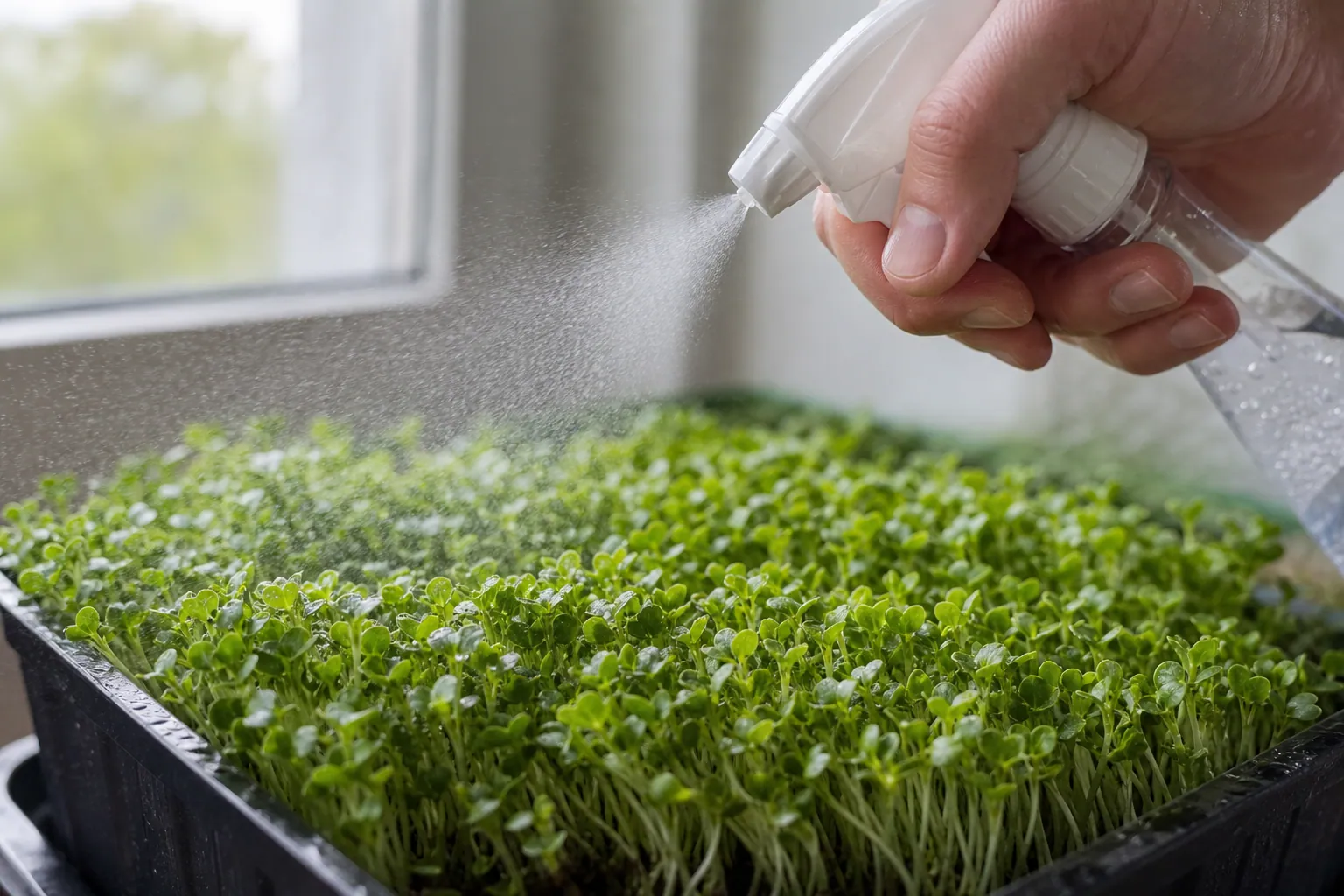
The mechanics are simple. Spread seeds evenly in a single layer (resist the urge to crowd — overcrowding is the number-one cause of mold), keep them lightly and consistently moist with a spray bottle rather than a heavy pour, give them airflow, and move them into bright light once they sprout. Most beginner crops follow a 7–10 day cycle from seed to harvest, and you cut them with scissors just above the soil line when the first true leaves appear.
The hard part isn't the technique — it's consistency. Manual trays have a real failure rate, and it's almost always a maintenance problem rather than a skill problem: a travel weekend, a forgotten morning watering, or stagnant air in a warm kitchen invites mold and ends an otherwise healthy tray. Keeping the payoff in mind helps, because a successful tray delivers far more nutrition than the same greens bought mature:
For a full step-by-step, see our complete guide to how to grow microgreens at home. Once you've harvested, our roundup of ways to eat microgreens will help you actually use the harvest before it wilts — because microgreens are best eaten raw and fresh, when their nutrients and flavor peak.
A simpler path for busy beginners
If the daily upkeep is what worries you, you're not alone — maintenance is the single biggest reason first trays fail, and it has nothing to do with how good a grower you are. That's exactly the problem Luya was built to solve. The Luya countertop "food computer" uses pre-seeded trays you simply drop into a sealed, ventilated, climate-controlled chamber that keeps mold out and handles watering, temperature, and nutrients automatically across each 7–10 day cycle. You harvest only what you need, and the rest keeps growing alive on your counter. Think of it like a Nespresso, but for greens.
Whether you start with a tray and a spray bottle or let an appliance do the chores, radish and pea shoots are the perfect first step. Pick one, give it a week, and taste the difference fresh makes — most people are surprised how much better a just-cut microgreen is than anything from a clamshell at the store.
Ready to skip the mold and the mess? See exactly how it works, or keep reading with our guide to growing microgreens without soil.
References
- Fahey JW, Zhang Y, Talalay P. Broccoli sprouts: an exceptionally rich source of inducers of enzymes that protect against chemical carcinogens. PNAS. 1997;94(19):10367–10372. https://doi.org/10.1073/pnas.94.19.10367
- Kyriacou MC, Rouphael Y, Di Gioia F, et al. Micro-scale vegetable production and the rise of microgreens. Trends Food Sci Technol. 2016;57:103–115. https://doi.org/10.1016/j.tifs.2016.09.005