
This article is for general education only and is not medical advice. Talk with your doctor before changing your diet, medication, or diabetes management plan.
If you live with type 2 diabetes, you have probably learned to read food through one lens: what does it do to my blood sugar? That is exactly why the research on microgreens diabetes connections has caught so much attention. These tiny greens are unusually nutrient-dense, and one compound found in some of them, sulforaphane, has become a real focus of blood-sugar research. The science is still early, but it is genuinely interesting, and the practical takeaway is simple and low-risk: more fresh, fiber-rich, non-starchy greens on the plate.
Let's walk through what we actually know, what we don't, and how to use microgreens sensibly as part of an overall eating pattern.
Why microgreens diabetes research keeps growing
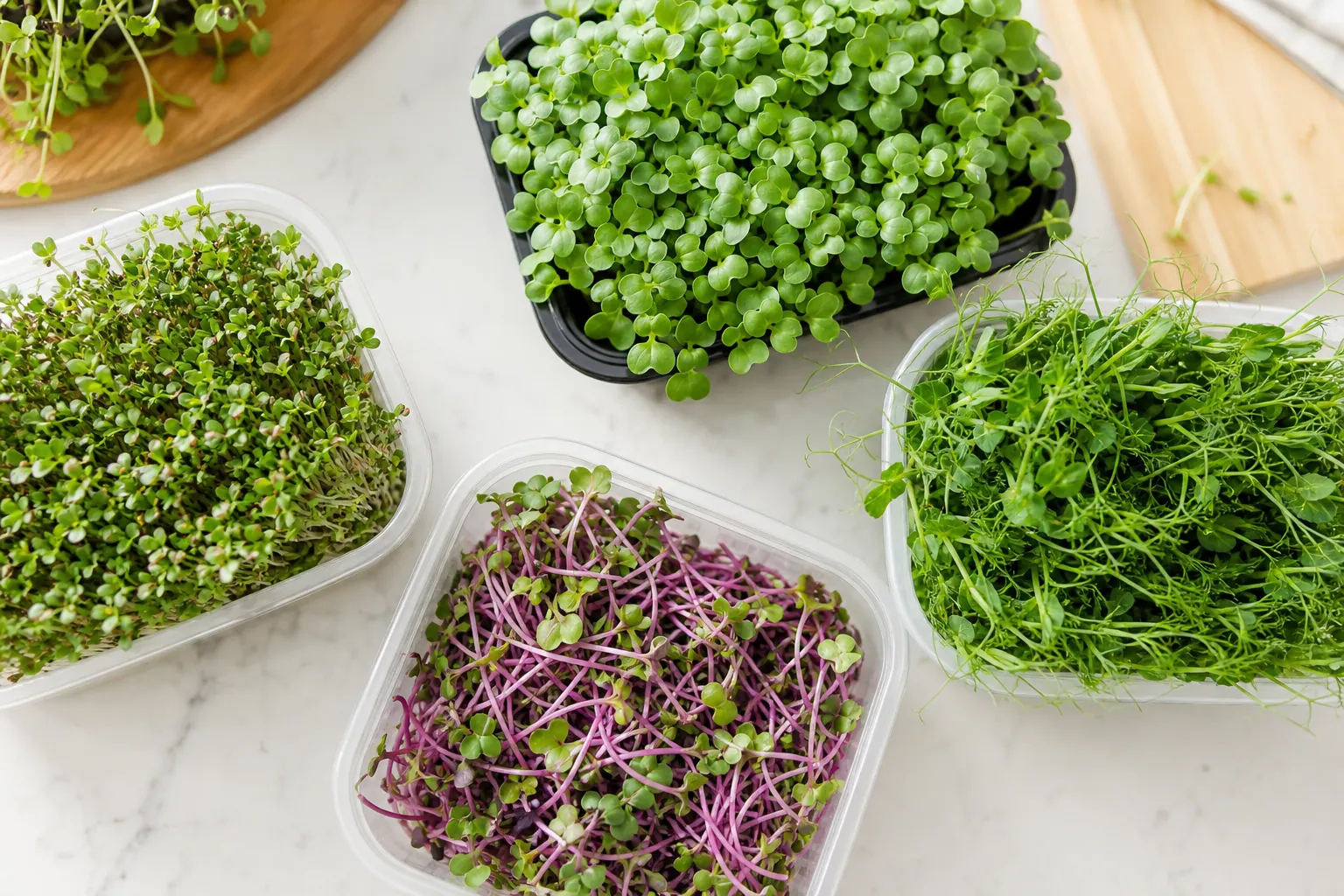
Microgreens are young vegetable seedlings harvested about 7 to 14 days after germination, just after the first true leaves appear. Despite their size, they punch far above their weight. Peer-reviewed reviews (MDPI Plants) and USDA data suggest microgreens can be roughly 2 to 3.5 times more nutrient-dense than the same plant grown to maturity, with radish microgreens often near the top.
For people managing blood sugar, two qualities stand out. First, microgreens are non-starchy greens, so they add vitamins, antioxidants, and plant compounds without a heavy carbohydrate load. A typical handful (around 25 grams) contributes meaningful vitamin C, vitamin K, and polyphenols while adding almost no usable carbohydrate, which is exactly the profile a type 2 diabetes eating pattern leans on. Second, certain varieties carry specific compounds that researchers are studying for metabolic effects.
| Nutrient highlight | Found richly in | Why it may matter for diabetes |
|---|---|---|
| Sulforaphane precursor | Broccoli microgreens | Studied for blood-sugar regulation and cellular defense |
| Vitamin C, K, E | Most microgreens | Antioxidant support; part of a balanced diet |
| Polyphenols/antioxidants | Radish, red cabbage, broccoli | Linked to reduced oxidative stress in research |
| Plant protein | Pea shoots (one of the more protein-dense microgreens) | Protein with little impact on blood sugar |
This is not a claim that microgreens treat diabetes. It is a reason researchers keep returning to them.
The sulforaphane connection
Most of the diabetes interest traces back to one molecule: sulforaphane. It is an isothiocyanate that forms when a compound called glucoraphanin meets an enzyme called myrosinase, which happens when you chew or chop the plant. Once formed, sulforaphane activates the body's Nrf2 pathway, a kind of internal switch that turns on antioxidant and detoxification defenses.
This is where broccoli stands out. Johns Hopkins research found that broccoli microgreens and sprouts can contain dramatically more glucoraphanin (the sulforaphane precursor) than mature broccoli, on the order of 10 to 100 times more, though the finished sulforaphane you actually get varies widely by variety, growing conditions, and harvest timing. To put that in perspective, you would have to eat a large amount of fully grown broccoli to approach what a small serving of the microgreens can provide. Sulforaphane itself has been studied specifically for blood-sugar regulation, inflammation, and cellular defense, which is why a molecule from a salad garnish keeps appearing in metabolic research. For a side-by-side look at broccoli microgreens versus capsules, see broccoli microgreens vs sulforaphane supplements.
Two important caveats, though.
This is research-stage science, not a proven cure. Sulforaphane is being studied, not prescribed. It does not replace medication, and results in early or laboratory research do not automatically translate to your kitchen.
And how you eat it matters a lot. Heat and overcooking degrade myrosinase, the enzyme that makes sulforaphane in the first place. So raw, fresh, and well-chewed is the way to get the most. If you want to go deeper on this, we cover it in what is sulforaphane and in our guide to maximizing sulforaphane.
What the animal and early research actually says
It helps to be precise about what kind of evidence exists, because "studies show" can mean very different things.
Some of the most cited microgreen findings come from animal research. In one USDA-linked study, red cabbage microgreens fed to mice on a high-fat diet lowered LDL ("bad") cholesterol and liver cholesterol, along with less weight gain and lower inflammatory markers. That is encouraging, but it is a mouse study. It points to a direction for future research, not proof of what happens in humans.
The honest summary looks like this:
| Claim | Evidence level | How to read it |
|---|---|---|
| Microgreens are more nutrient-dense than mature greens | Lab/nutrient analysis | Well supported |
| Sulforaphane influences blood-sugar pathways | Early human + lab research | Promising, not settled |
| Red cabbage microgreens lower LDL and inflammation | Animal (mouse) study | Early signal only |
| Microgreens "treat" type 2 diabetes | No | Not a treatment |
For diabetes specifically, the strongest practical case is not any single miracle compound. It is that microgreens fit neatly into the eating pattern doctors already recommend: more non-starchy vegetables, more fiber, more antioxidants, and fewer refined carbohydrates. If you want the broader picture of their nutrition, see are microgreens good for you.
How to actually add microgreens to a diabetes-friendly plate
You do not need to overhaul anything. Microgreens work best as a steady habit, not a one-time experiment.
A few simple, blood-sugar-aware ways to use them:
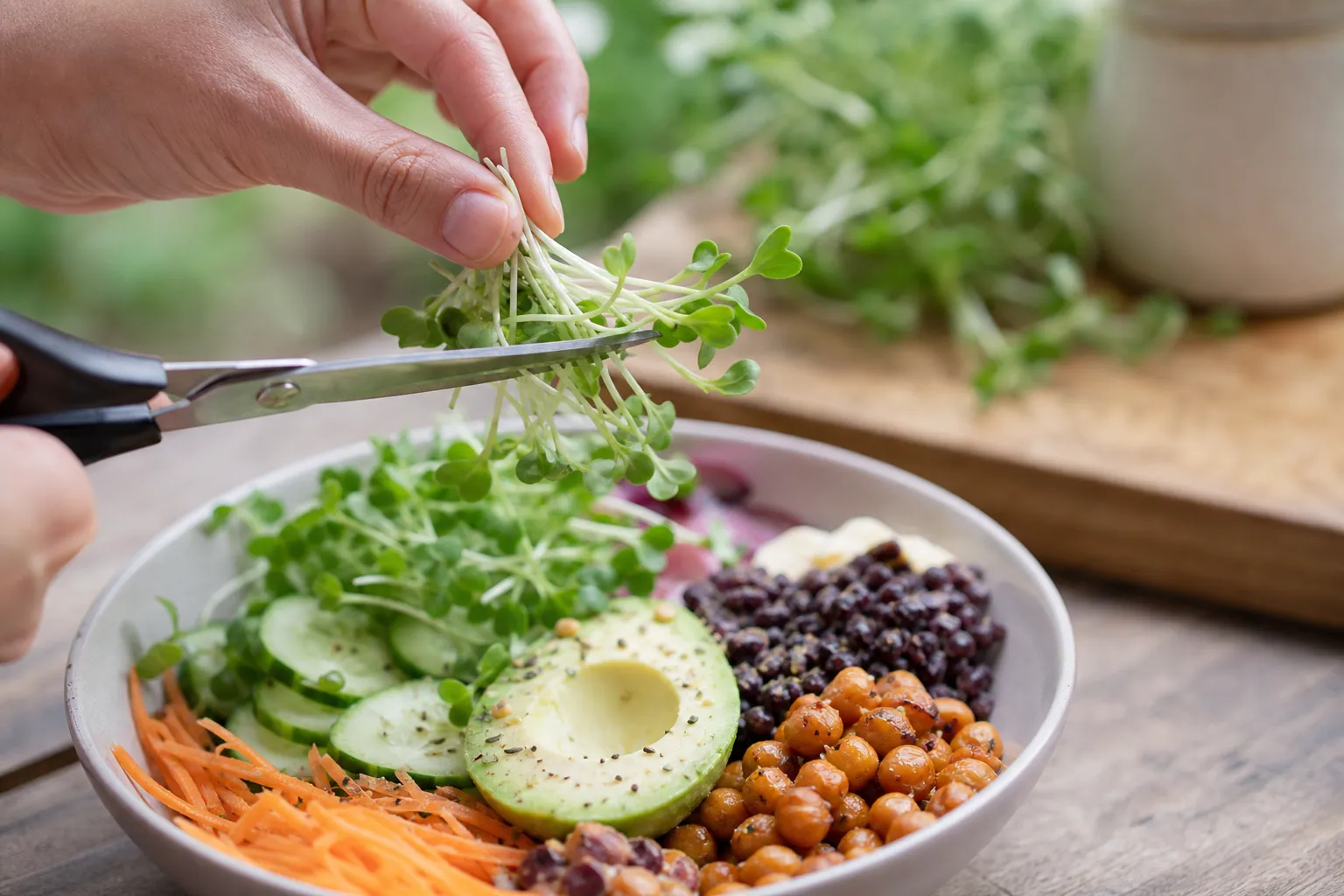
- Pile a handful onto eggs, avocado toast, or a savory breakfast bowl.
- Fold them into a salad or grain bowl after cooking, so they stay raw.
- Add them at the end to soups or stir-fries, off the heat, to protect the enzymes.
- Blend pea shoots or broccoli microgreens into a low-sugar green smoothie.
Pairing matters too. Combining greens with protein and healthy fat, rather than refined carbohydrates, supports steadier blood sugar overall. Pea shoots are a useful trick here: they are one of the more protein-dense microgreens and a strong plant-based protein source, so a handful adds a little staying power along with the greens. There is also a practical timing note worth remembering. Because heat destroys the myrosinase enzyme, the way you serve microgreens decides whether you get the sulforaphane benefit at all. The table below is a quick cheat sheet.
| How you use them | Enzyme preserved? | Best for |
|---|---|---|
| Raw on top of a finished dish | Yes | Maximum sulforaphane |
| Stirred in off the heat | Mostly | Soups, stir-fries, grain bowls |
| Blended raw into a smoothie | Yes | Easy daily habit |
| Cooked into the dish | No | Flavor only, not the active compounds |
For recipe inspiration, our microgreens salad ideas and microgreens smoothie recipes are good starting points.
A practical reality check: freshness and consistency are everything. Microgreens are most valuable when they are eaten fresh and raw, but store-bought clamshells are expensive (often $4 to $6 per 2 oz, roughly $30 to $50 per pound) and frequently arrive days into a long supply chain, wilting fast. Growing your own avoids that, though manual trays come with their own challenges, mainly mold, mess, and the daily watering that a busy week can easily derail.
This is the gap Luya is built to close. Luya is a countertop appliance, a bit like a Nespresso but for greens, with pre-seeded trays you drop in and a sealed, climate-controlled chamber that keeps mold out while it grows. You harvest only what you need, seconds before eating, so the sulforaphane-friendly "fresh and raw" ideal is the easy default rather than a chore. If consistency has been your sticking point, that automation is the point.
The bottom line
Microgreens are not a cure for type 2 diabetes, and no honest article should pretend otherwise. What the evidence supports is more modest and more useful: microgreens are nutrient-dense, low in carbohydrates, and a convenient way to add antioxidants and fiber to your day. The sulforaphane research, especially around broccoli microgreens, is a genuinely promising area worth watching, while you keep your medication and care plan exactly as your doctor advised.
Treat microgreens as a small, sustainable upgrade to an already-balanced plate, and let the science continue to catch up.
Want fresh microgreens without the mold, mess, or daily watering? See how it works to learn how Luya grows them on your counter, harvest-fresh and raw. To dig deeper into the science, read our guide on microgreens and inflammation.
Selected sources
- Johns Hopkins Medicine — research on broccoli sprouts, glucoraphanin, and sulforaphane (hopkinsmedicine.org)
- USDA — microgreen nutrient analysis and red cabbage microgreen research (usda.gov)
- MDPI Plants — peer-reviewed reviews of microgreen nutrient density (mdpi.com)
- National Institutes of Health / PMC — sulforaphane and metabolic research (ncbi.nlm.nih.gov)
- Cleveland Clinic and Healthline — consumer health guidance on diabetes nutrition (clevelandclinic.org, healthline.com)
References
- Axelsson AS, et al. Sulforaphane reduces hepatic glucose production and improves glucose control in patients with type 2 diabetes. Sci Transl Med. 2017;9(394):eaah4477. https://doi.org/10.1126/scitranslmed.aah4477
- Fahey JW, Zhang Y, Talalay P. Broccoli sprouts: an exceptionally rich source of inducers of enzymes that protect against chemical carcinogens. PNAS. 1997;94(19):10367–10372. https://doi.org/10.1073/pnas.94.19.10367
- Xiao Z, Lester GE, Luo Y, Wang Q. Assessment of Vitamin and Carotenoid Concentrations of Emerging Food Products: Edible Microgreens. J Agric Food Chem. 2012;60(31):7644–7651. https://doi.org/10.1021/jf300459b