
A good microgreens salad isn't a regular salad with a fancy tuft on top. When you treat microgreens as a real ingredient—matching their flavor to the right base, fat, and acid—they turn a forgettable side into a bowl you actually look forward to. They also happen to be nutritional standouts: many varieties carry roughly 2 to 3.5 times the nutrient density of their full-grown counterparts, according to peer-reviewed reviews (MDPI Plants) and USDA data. That means a small handful pulls more weight than a heaping pile of mature lettuce.
Below are flavor-first ideas for building microgreens salads that taste great, a crop-to-pairing reference, and the simple dressing ratios that hold the whole thing together. No garnish-for-garnish's-sake.
Why Microgreens Belong in Your Salad Bowl
Microgreens are young vegetable and herb seedlings, harvested about 7 to 14 days after sprouting, just as their first true leaves appear. Despite their size, they tend to be intensely flavored and surprisingly dense in vitamins C, K, and E, plus antioxidants and polyphenols. That concentration is the whole point: a small handful delivers real flavor and real nutrition without crowding the plate.
Different crops bring different strengths. Radish microgreens often rank highest for overall nutrient density, while broccoli microgreens are notable for sulforaphane—an isothiocyanate your body forms when glucoraphanin meets the enzyme myrosinase as you chew or chop the greens raw. Sulforaphane activates the body's Nrf2 antioxidant and detox pathway and is being studied (research-stage, not proven cures) for blood sugar, inflammation, and cellular defense. If you want the deeper science, see our guide to microgreens nutrition and the primer on what is sulforaphane.
Here's the part that makes salads ideal: heat degrades myrosinase, so cooking quietly cancels out one of the most interesting compounds. Salads keep the greens raw, fresh, and well-chewed—exactly the conditions that preserve the good stuff. A salad isn't just a nice way to eat microgreens; it's arguably the most nutritionally efficient one.
Match the Microgreen to the Salad
Flavor matching is what separates a thoughtful microgreens salad from a sad pile of greens. Each crop has a distinct personality, and the trick is pairing peppery with cool, sweet with sharp, and nutty with bright. Build from this reference:
| Microgreen | Flavor profile | Best salad pairing | Standout nutrition |
|---|---|---|---|
| Radish | Peppery, sharp | Avocado, citrus, cucumber | Often the most nutrient-dense |
| Pea shoots | Sweet, fresh, crisp | Grain bowls, mint, lemon | One of the more protein-dense microgreens |
| Broccoli | Mild, slightly bitter | Tomato, olive oil, feta | Rich in sulforaphane precursor |
| Sunflower | Nutty, hearty, crunchy | Roasted veg, tahini, beets | Satisfying texture and bulk |
| Red cabbage | Mild, earthy, colorful | Slaws, apple, vinaigrette | Vibrant color and antioxidants |
A simple rule of thumb: peppery radish wants cooling fat (avocado, yogurt) to soften its bite; sweet pea shoots love acid and herbs (lemon, mint) to stay lively; nutty sunflower stands up to bold, creamy dressings like tahini; and mild red cabbage microgreens add color and crunch to almost anything without fighting the other flavors. For a deeper crop breakdown, our easiest microgreens to grow guide covers radish, pea, broccoli, and sunflower in detail, and radish microgreens goes deep on the one most people start with.
Five Microgreens Salad Ideas Worth Repeating
These aren't strict recipes—they're templates. Adjust amounts to taste and use whatever's freshest. Each makes one generous bowl.
1. Radish + Avocado + Citrus. Peppery radish microgreens against creamy avocado and bright orange or grapefruit segments. Add a squeeze of lime, flaky salt, and a glug of olive oil. The fat tames the bite; the citrus keeps it lively. This is the salad that converts microgreen skeptics—start here if you've only ever used them as a garnish.
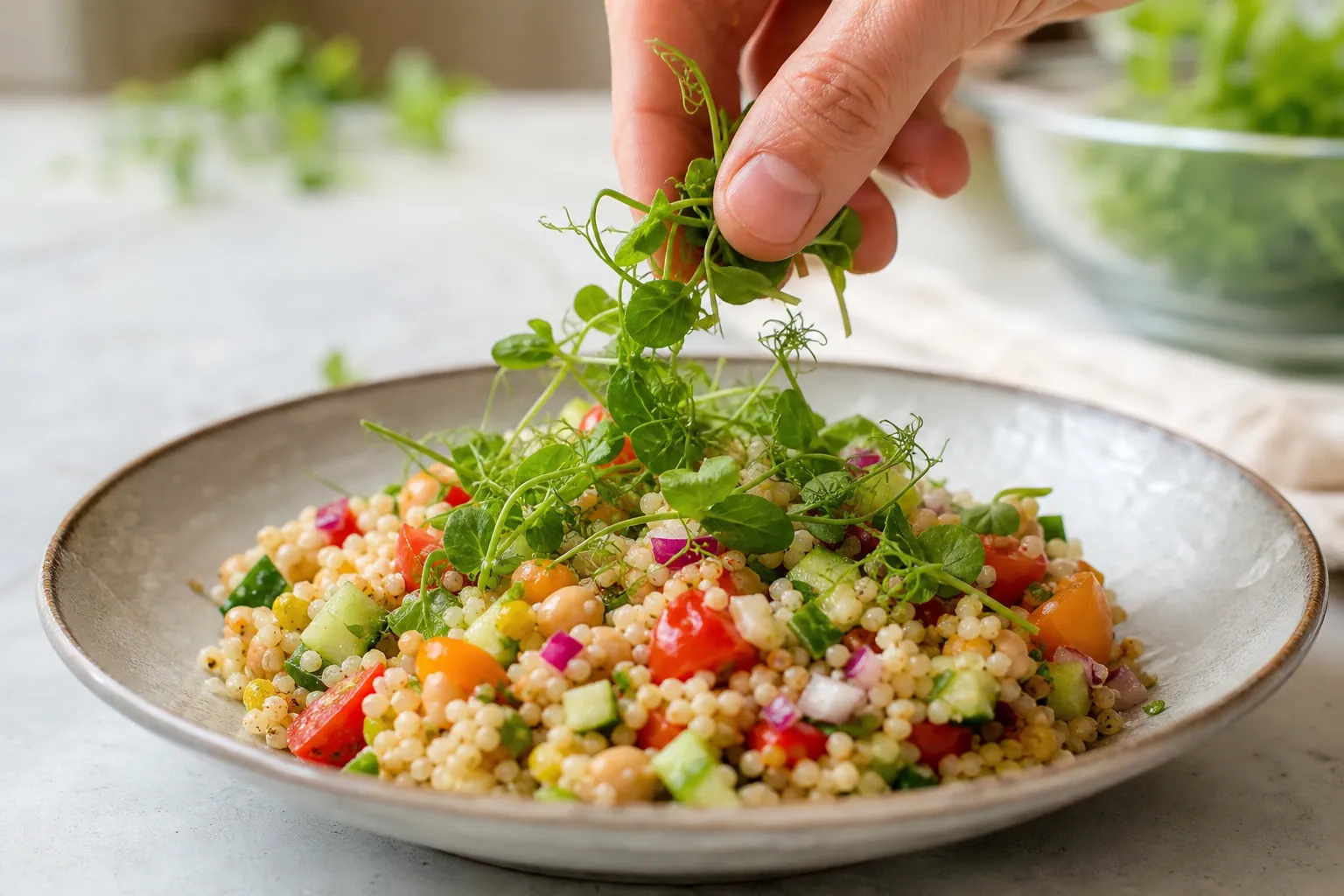
2. Pea Shoot + Grain Bowl. Toss a generous handful of sweet, crisp pea shoots over cooked farro or quinoa with cherry tomatoes, cucumber, and a lemon-mint dressing. Because pea shoots are one of the more protein-dense microgreens, this works as a light meal, not just a side—a real plant-forward win if you're leaning that way. See high-protein microgreens for more on pea shoots' protein punch.
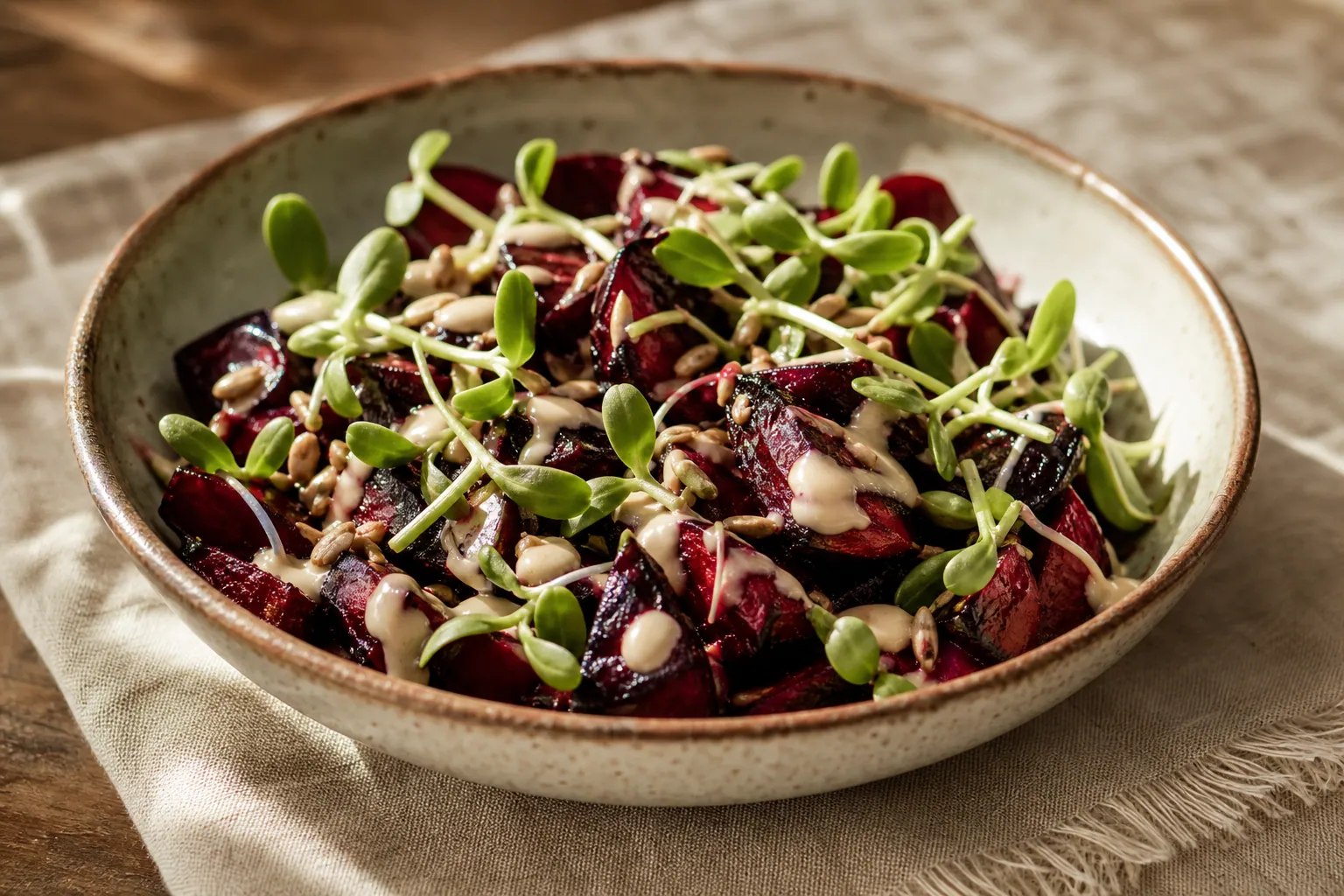
3. Sunflower + Roasted Beet + Tahini. Hearty, nutty sunflower microgreens love roasted beets and a creamy tahini-lemon drizzle. The crunch holds up against the soft beets, and the bowl feels substantial without being heavy. Add toasted seeds if you want even more texture.
4. Broccoli + Tomato + Feta. Mild broccoli microgreens with ripe tomato, crumbled feta, red onion, and good olive oil. Add the greens raw and right before serving so the sulforaphane stays intact—broccoli microgreens can carry roughly 10–100 times more glucoraphanin (the sulforaphane precursor) than mature broccoli, though the finished sulforaphane you actually get varies widely by variety, growing conditions, and harvest timing.
5. Red Cabbage + Apple + Cider Vinaigrette. Thinly sliced apple, shredded carrot, and a tangle of red cabbage microgreens in a quick cider vinaigrette. It's a slaw that doesn't need cabbage chopping, and the color alone earns its place on the plate.
Dressings and Habits That Make It Work
The fastest way to ruin a microgreens salad is to drown it. These delicate leaves wilt under heavy dressing, so keep ratios light and let the greens stay distinct:
| Dressing | Ratio (oil : acid) | Best with |
|---|---|---|
| Lemon vinaigrette | 3 : 1 olive oil to lemon | Pea shoots, radish |
| Tahini-lemon | 2 tbsp tahini : 1 tbsp lemon : water to loosen | Sunflower, beets |
| Cider vinaigrette | 3 : 1 olive oil to cider vinegar | Red cabbage, apple |
A few habits carry every bowl: add microgreens last so they don't wilt under warm or heavy ingredients; dress sparingly, tossing with about a tablespoon at a time; and chew well—especially with broccoli—so the myrosinase can do its job and form sulforaphane. For more ways to work microgreens into meals beyond salads, see how to eat microgreens.
The Freshness Problem (and How to Solve It)
Here's the honest tension with microgreens salads: they're only as good as the greens are fresh. And freshness is exactly where most options fall short.
Store-bought clamshells often run $4 to $6 for just 2 ounces—roughly $30 to $50 per pound—and they've usually spent days moving through the farm-to-truck-to-warehouse-to-store supply chain. By the time they reach your bowl, they can already be wilting, with a short shelf life and a lot of waste. You pay a premium for greens that peaked before you bought them. Our piece on why store-bought microgreens are expensive and not fresh breaks down where the money and the freshness actually go.
Growing your own solves freshness but introduces its own headaches: mold from too much moisture, poor airflow, and overcrowding; soil mess across the counter; and the daily watering that a roughly 10-day grow cycle demands. Miss a few days during a busy week or a trip, and the tray is gone—home growing has a real failure rate, and it's almost always a consistency problem. If you've hit these walls, why microgreens keep molding and the honest grow vs. buy microgreens comparison are worth a read.
| Approach | Cost | Freshness | Effort |
|---|---|---|---|
| Store-bought | $4–6 per 2 oz clamshell | Days old, wilts fast | Low, but wasteful |
| DIY soil trays | Low per serving | Very fresh if successful | High; daily care, mold risk |
| Automated home grow | Cheaper per serving | Harvested seconds before eating | Near zero |
The goal is the best of both columns: garden-fresh greens without the chore or the failure rate.
Bring It All Together
The best microgreens salad starts with greens that were alive minutes ago. That's the idea behind Luya, a countertop "food computer" that grows pre-seeded trays in a sealed, climate-controlled chamber—no mold, no mess, no daily watering. You harvest only what you need for tonight's bowl, and the rest keeps growing. Think of it like a Nespresso, but for greens.
Curious how it works? See how it works, or keep exploring flavors with our guide to microgreens smoothie recipes.
References
- Fahey JW, Zhang Y, Talalay P. Broccoli sprouts: an exceptionally rich source of inducers of enzymes that protect against chemical carcinogens. PNAS. 1997;94(19):10367–10372. https://doi.org/10.1073/pnas.94.19.10367