This article is for general education only and is not medical advice. Talk with your doctor before changing your diet, supplements, or cholesterol treatment.
If you've seen headlines claiming microgreens can lower cholesterol, you're not imagining it. The interest in microgreens cholesterol research traces back to one specific crop and one specific study: red cabbage microgreens. The findings are genuinely intriguing, and they're worth understanding properly, because the caveats almost never survive the trip into a headline.
So let's do this carefully. Below is what the research actually found, what it does not yet prove, why scientists think tiny greens might matter for heart health at all, and how to fit them into a heart-conscious plate without overselling them.
What the red cabbage microgreens study found
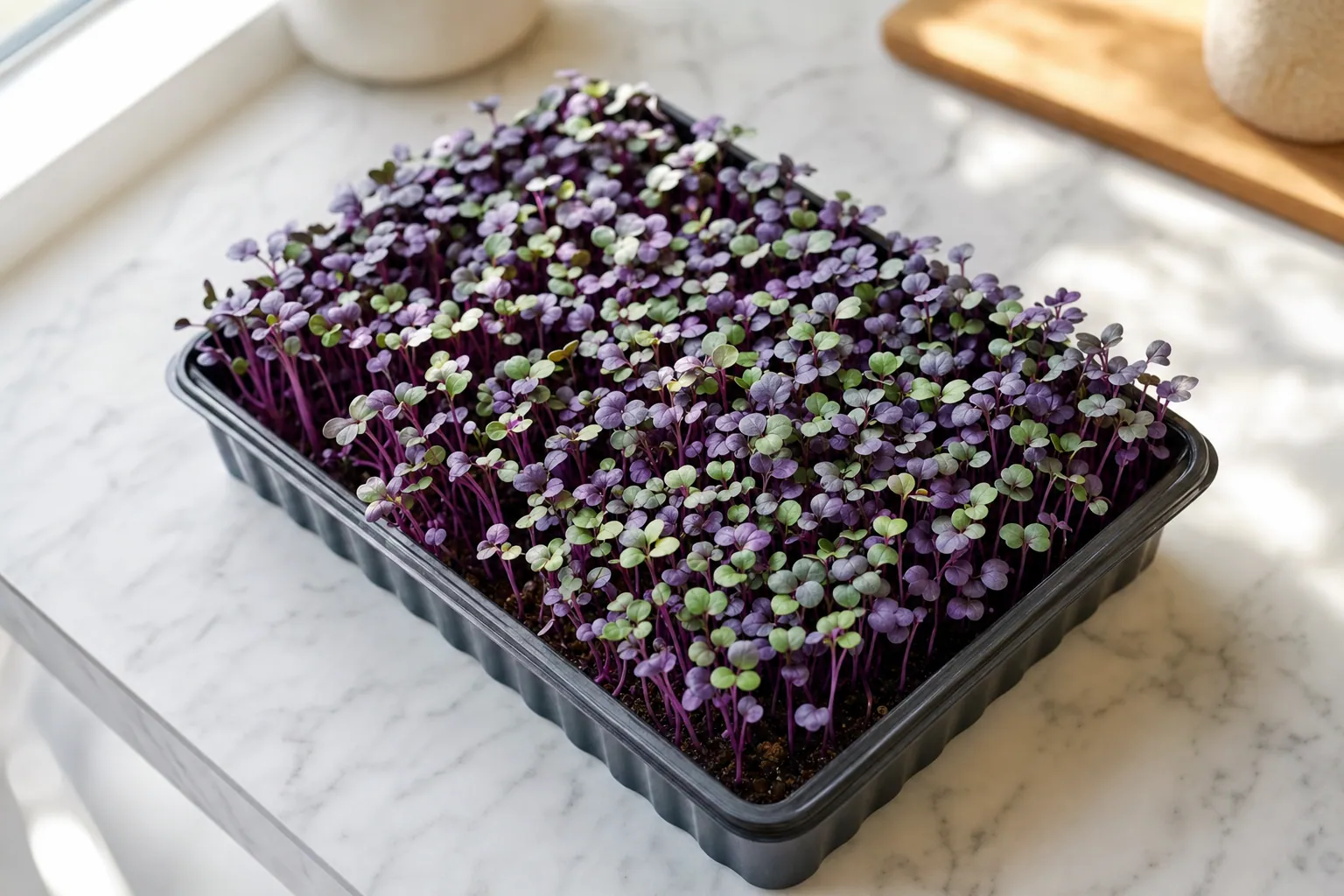
The study that started the conversation, work associated with the USDA, looked at red cabbage microgreens in mice. Researchers fed the animals diets designed to push cholesterol and weight in the wrong direction, then added red cabbage microgreens to some of those diets and tracked markers tied to cardiovascular health.
The results were striking. In that animal study, red cabbage microgreens lowered LDL cholesterol, the "bad" cholesterol most strongly associated with cardiovascular risk, along with liver cholesterol in the microgreen-fed group compared with controls. The same mice also showed reduced weight gain and lower levels of certain inflammatory markers. Several different signals, all pointing the same direction, is exactly the kind of result that makes researchers want to look closer.
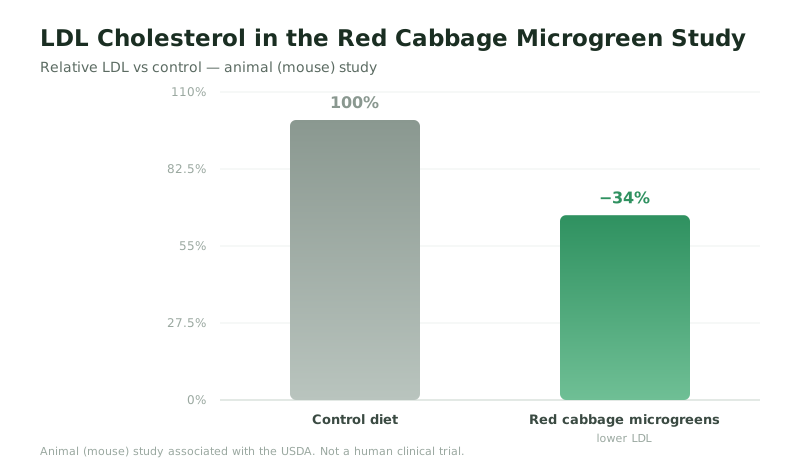
Here's the honest framing, and it matters: this was an animal study, not a human clinical trial. Mice are not people. Their metabolism, their dose relative to body weight, and a tightly controlled lab diet are all very different from your dinner. Early research like this tells scientists where to point the next experiment. It does not prove that eating microgreens will move your own cholesterol numbers.
That distinction is the whole game in nutrition science. A promising signal in mice is a reason to keep studying, not a reason to skip your statin. Plenty of compounds look brilliant in rodents and then do little in humans.
Why microgreens might matter for heart health at all
Even setting the cabbage study aside, there are real reasons researchers find microgreens worth investigating for cardiovascular health.
First, density. Microgreens are roughly 2 to 3.5 times more nutrient-dense than their fully grown counterparts, according to peer-reviewed reviews (MDPI Plants) and USDA data. Radish microgreens often top the charts. A small handful can deliver vitamins and antioxidants out of all proportion to its size, which means you get more of the protective compounds without piling extra calories onto your plate.
Second, the specific nutrients involved. Microgreens are rich in vitamins C, K, and E, plus a broad mix of antioxidants and polyphenols, the plant compounds repeatedly studied in the context of inflammation and cardiovascular health. Red cabbage microgreens in particular carry anthocyanins, the same purple pigments found in blueberries and red wine that have drawn attention for their antioxidant activity.
| Microgreen | Standout compounds | Why heart researchers care |
|---|---|---|
| Red cabbage | Anthocyanins, vitamin C | The LDL / inflammation animal study above |
| Radish | Antioxidants (often most dense) | Highest nutrient concentration vs. its mature form |
| Broccoli | 10–100× the glucoraphanin of mature broccoli | Nrf2 antioxidant pathway; inflammation research |
| Pea shoots | One of the more protein-dense microgreens | Protein without saturated fat |
Third, there's the broader picture. A pattern of eating that is high in vegetables and fiber and lower in saturated fat is one of the most consistently supported approaches to heart health, per guidance from groups like the Cleveland Clinic. Microgreens don't work in isolation, and no single ingredient does. They're a small, concentrated addition to that bigger pattern, not a substitute for it.
If you want to go deeper on the nutrient side, our guide to microgreens nutrition breaks down what these greens actually contain, and are microgreens good for you takes a wider look at the evidence.
Sulforaphane, broccoli, and the inflammation angle
When the conversation turns to microgreens and chronic-disease research, it usually lands on broccoli microgreens and a compound called sulforaphane.
Broccoli microgreens and sprouts can carry dramatically more glucoraphanin, the sulforaphane precursor, than mature broccoli, on the order of 10 to 100 times more, based on research associated with Johns Hopkins. That is a remarkable head start from a crop you can grow in a week, though the finished sulforaphane you actually get varies widely by variety, growing conditions, and harvest timing.
The mechanism is worth knowing because it changes how you should eat them. Sulforaphane is an isothiocyanate. It doesn't exist ready-made in the plant. It forms when a storage compound called glucoraphanin meets an enzyme called myrosinase, and that reaction is triggered physically, when you chew or chop the greens. Once formed, sulforaphane activates the body's Nrf2 pathway, a built-in antioxidant and cellular-defense system that ramps up the cell's own protective machinery.
Researchers have studied sulforaphane in the context of blood-sugar regulation, inflammation, and cellular defense. To be clear, this is research-stage work, not a proven treatment for any condition. But because chronic inflammation is woven into the development of heart disease, the overlap is a big part of why microgreens keep surfacing in cardiovascular research at all.
One practical consequence of that mechanism: heat degrades myrosinase, the very enzyme you need. Overcook broccoli microgreens and you can switch off most of their sulforaphane potential. To get the most, eat them raw, fresh, and chewed well. If you'd like the full mechanism, see what is sulforaphane and maximize sulforaphane; if blood sugar is also on your radar, microgreens and blood sugar covers that branch, and microgreens and inflammation digs into the anti-inflammatory side.
How to use microgreens sensibly (without overselling them)
If you have high cholesterol or another chronic condition, the responsible move is to treat microgreens as a helpful addition to an already heart-conscious diet, not as a substitute for medication or your doctor's guidance.
A few grounded ways to fit them in:
- Add, don't replace. A handful of microgreens on a salad, grain bowl, soup, or sandwich layers in nutrients without displacing your prescribed care or your other vegetables.
- Eat them raw and fresh. Freshness preserves both nutrient content and, for broccoli, the sulforaphane potential that cooking destroys.
- Vary your crops. Red cabbage for the anthocyanins, broccoli for sulforaphane, radish for sheer density, pea shoots for protein. A mix beats betting everything on one "hero" green.
- Keep your expectations honest. No vegetable replaces a cholesterol-management plan. These greens support a pattern; they don't override your labs or your prescriptions.
The catch most people hit isn't motivation, it's freshness and consistency. Store-bought microgreens are expensive, often $4 to $6 per 2 oz clamshell (roughly $30 to $50 per pound), and they've usually spent days moving through a farm-to-truck-to-warehouse-to-store supply chain before they reach you. They wilt fast, which means lost nutrients, a short window to actually eat them, and a lot of mushy waste in the bottom of the fridge.
Growing your own solves the freshness problem in theory, but DIY trays come with their own headaches: mold from too much moisture and poor airflow, soil mess across the counter, and the daily watering grind over roughly 10-day cycles. Miss a week for travel or a busy stretch at work and the tray is gone. If you've fought those battles, why microgreens keep molding will feel familiar, and grow vs buy microgreens weighs both routes side by side.
The bottom line on microgreens and cholesterol
The red cabbage research is a real and encouraging signal: in mice, red cabbage microgreens were linked to lower LDL, less weight gain, and reduced inflammatory markers. But it's early, it's animal-based, and it is not proof that microgreens will lower your cholesterol.
The smart takeaway isn't to chase a single miracle green. It's to lean into a nutrient-dense, antioxidant-rich, higher-fiber eating pattern, keep your greens fresh and raw to protect their most fragile compounds, and keep your doctor in the loop on the things that genuinely move your numbers, including medication if you need it. Microgreens are a small, worthwhile habit on top of that foundation, not a shortcut around it.
If consistently fresh microgreens are the hard part, that's exactly the problem Luya was built to solve. Our countertop grower keeps a sealed, climate-controlled chamber so trays grow themselves, mold-free, while you harvest only what you need, seconds before eating. See how it works, or read more on the science in are microgreens good for you.
Selected sources
- USDA (red cabbage microgreens animal research; nutrient-density data) — usda.gov
- Johns Hopkins (sulforaphane and broccoli sprout research) — hopkinsmedicine.org
- NIH / PMC (peer-reviewed nutrition literature) — pubmed.ncbi.nlm.nih.gov
- MDPI Plants (microgreens nutrient-density reviews) — mdpi.com
- Cleveland Clinic (cholesterol and heart-health guidance) — clevelandclinic.org
- Healthline (general nutrition education) — healthline.com
References
- Huang H, Wang TTY, et al. Red Cabbage Microgreens Lower Circulating LDL, Liver Cholesterol, and Inflammatory Cytokines in Mice Fed a High-Fat Diet. J Agric Food Chem. 2016;64(48):9161–9171. https://doi.org/10.1021/acs.jafc.6b03805
- Kyriacou MC, Rouphael Y, Di Gioia F, et al. Micro-scale vegetable production and the rise of microgreens. Trends Food Sci Technol. 2016;57:103–115. https://doi.org/10.1016/j.tifs.2016.09.005