This article is for general education and is not medical advice. Talk to your doctor before changing your diet for a health condition or if you take medication.
Bite into a peppery radish shoot or a slightly bitter broccoli sprout and you are tasting chemistry that the plant never strictly needed to grow. The sugars, proteins, and fats a seedling builds to stay alive are called primary metabolites. Everything else — the heat, the color, the faint pungency, the antioxidant punch — comes from a second tier of compounds that plants make to defend themselves, attract or repel insects, and cope with their environment. Scientists call these secondary metabolites, and they are a big part of why microgreens are good for you.
The interesting twist is that plants don't make a fixed amount of these compounds. They dial production up or down depending on conditions, especially light. That means how a microgreen is grown can change its chemistry as much as which seed you planted. Here is what these compounds actually are, why they matter on your plate, and how growing conditions shift the numbers.
What "secondary metabolite" actually means
A secondary metabolite is a small organic molecule a plant produces under specific conditions but doesn't strictly need for basic growth. Think of primary metabolites as the building materials and fuel, and secondary metabolites as the tools a plant reaches for to survive a tough neighborhood: chemicals that fend off pests, shield tissue from harsh sun, and signal stress.
Plant scientists usually sort them into a few broad families. The ones that matter most for microgreen eaters are phenolics (including flavonoids and anthocyanins), terpenoids (including carotenoids), and the sulfur compounds called glucosinolates that give brassicas their bite. Vitamins like C, E, and K and provitamin pigments round out the picture. These are the same molecules nutrition researchers study for their antioxidant and metabolic effects, which is why microgreens keep showing up in microgreens nutrition studies.
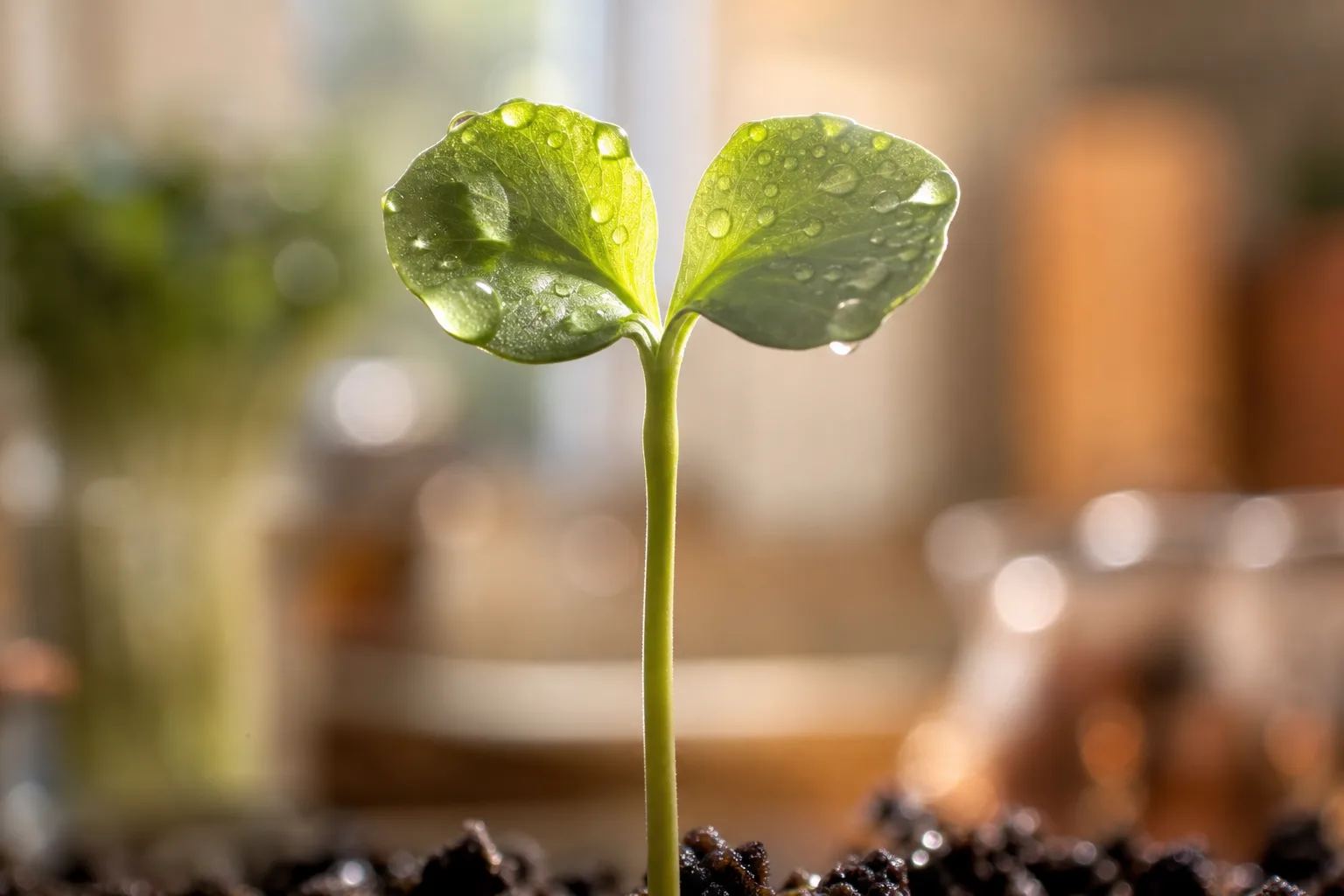
Glucosinolates: the source of the bite
Glucosinolates are sulfur-containing compounds concentrated in the brassica family — broccoli, radish, mustard, cabbage, kale, and arugula. On their own they are fairly inert, but when you chew or chop the plant, an enzyme called myrosinase converts them into active products. In broccoli, that conversion yields sulforaphane, one of the most studied plant compounds in human health research. If you want the deeper dive, we cover it in what is sulforaphane and how to protect it during prep in maximize sulforaphane.
Why care at the seedling stage? Because young brassica shoots can carry a strikingly high concentration of glucosinolate precursors relative to the mature vegetable. A small tray of broccoli microgreens can deliver a meaningful dose in a few grams. And growing conditions move the needle: research on Brassica crops shows that gentle UV-A and UV-B exposure and a well-timed photoperiod can push glucosinolate biosynthesis genes to express more strongly, raising the compounds the plant accumulates.
Phenolics and anthocyanins: color you can taste
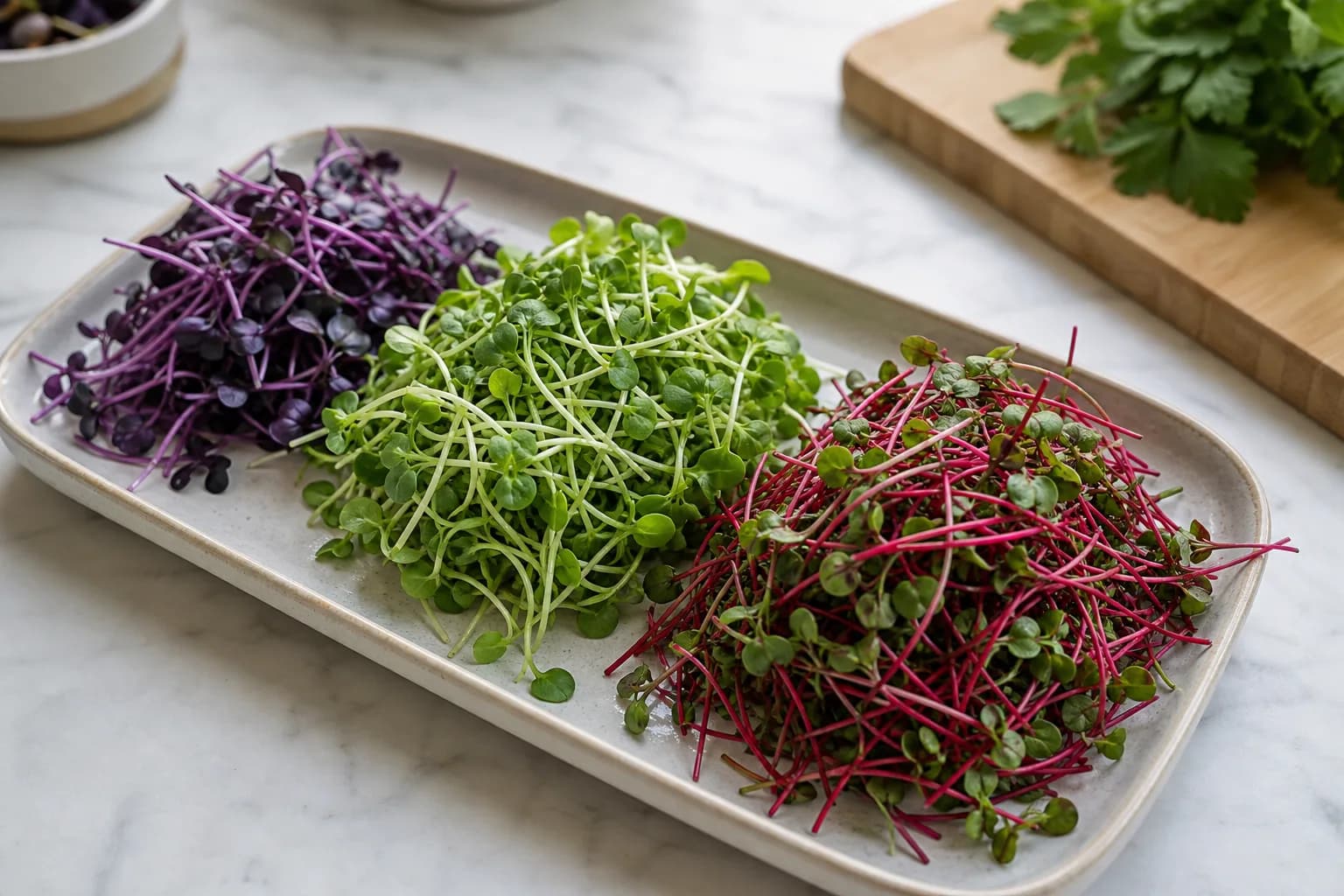
Phenolics are the largest and most diverse family, and they are the workhorses behind much of a microgreen's antioxidant capacity. Flavonoids and anthocyanins belong here — anthocyanins are the red, purple, and blue pigments you see in red cabbage, radish microgreens, and amaranth.
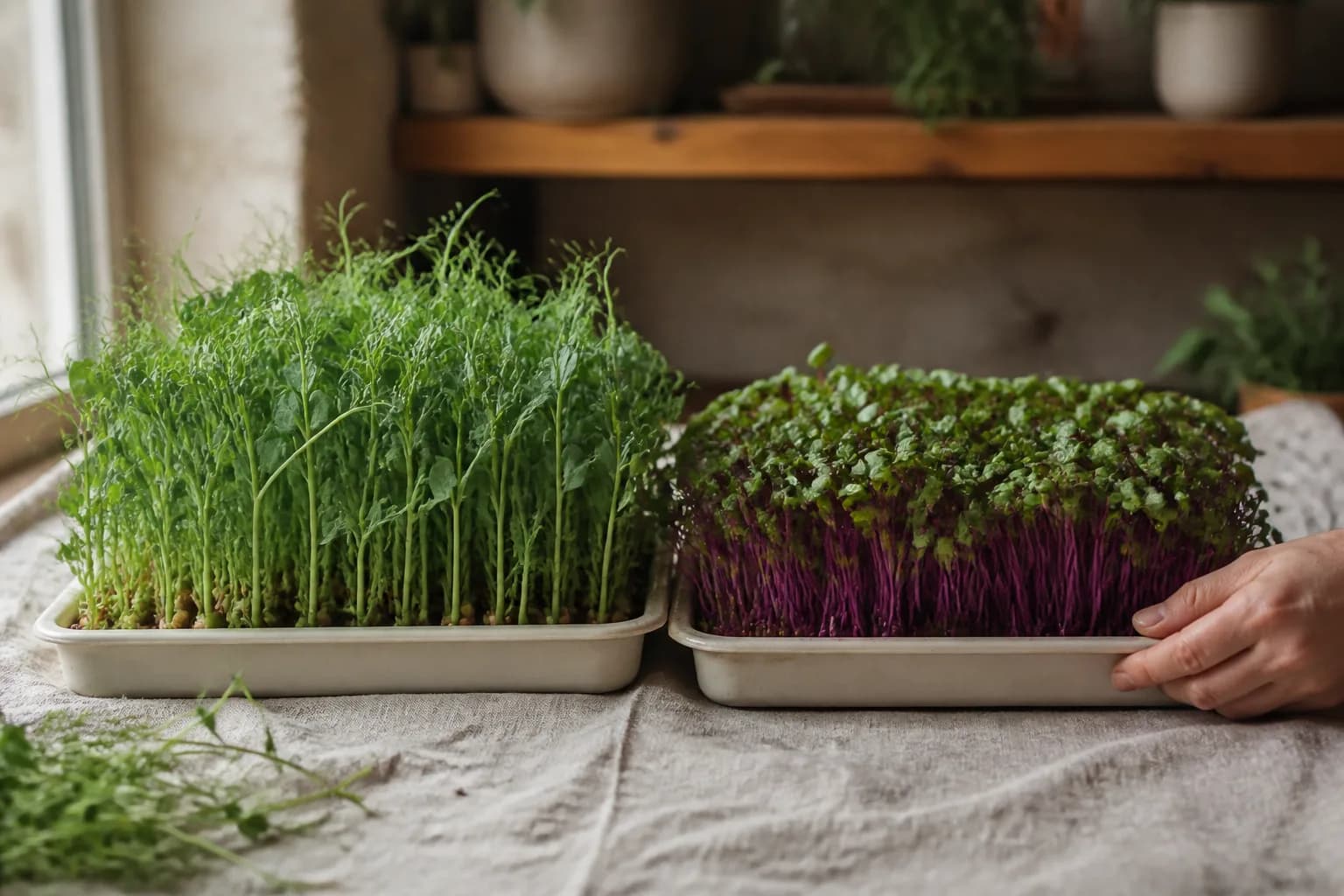
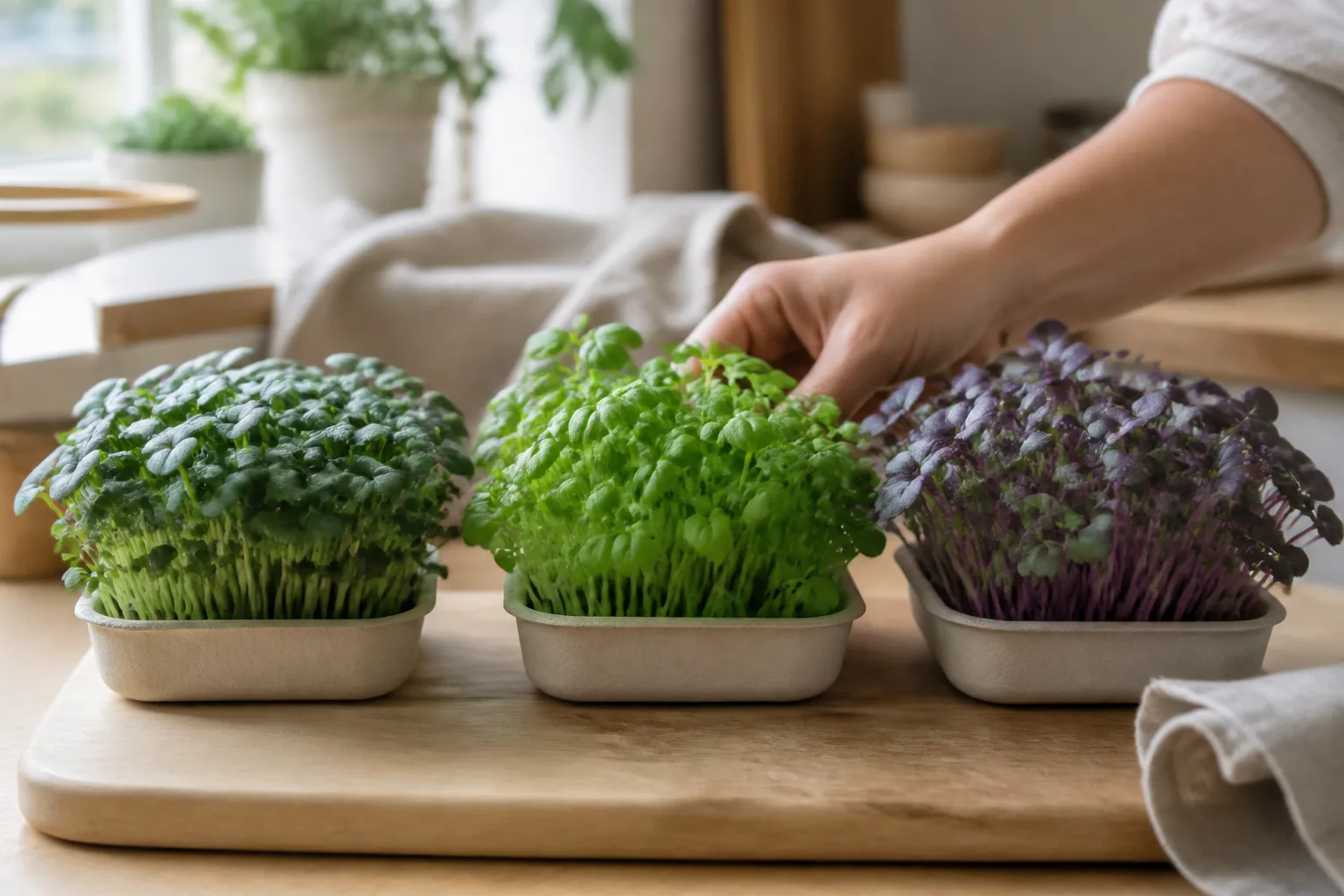
These pigments aren't just decoration. Plants build them, in part, as a sunscreen: when light is bright or carries more ultraviolet, the seedling ramps up anthocyanin and flavonoid production to protect its tissue from oxidative stress. That is the same protective chemistry your body draws on when you eat them. As a rough rule, the more vivid and deeply colored a microgreen, the more of these compounds it has accumulated — color really is a signal of taste and chemistry at once.
Carotenoids and vitamins: the supporting cast
Carotenoids are terpenoid pigments — the yellows, oranges, and contributors to deep greens — and they double as antioxidants and provitamin A sources. Microgreens also concentrate vitamins C, E, and K well, which is a major reason peer-reviewed reviews have found young seedlings can be several times more nutrient-dense than their full-grown counterparts. Light shapes this group too: brighter conditions and specific wavelengths can lift carotenoid content, while too little light suppresses it.
Here is a simplified map of the main compound families, what they do, and where they show up most:
| Compound family | What it is | Found richly in | Why it matters |
|---|---|---|---|
| Glucosinolates | Sulfur compounds; precursors to sulforaphane | Broccoli, radish, mustard, cabbage | Studied for cellular defense and metabolic health |
| Phenolics / flavonoids | Broad antioxidant family | Most microgreens, especially colorful ones | Major share of antioxidant capacity |
| Anthocyanins | Red/purple/blue pigments | Red cabbage, radish, amaranth, beet | Plant "sunscreen"; potent antioxidants |
| Carotenoids | Yellow/orange terpenoid pigments | Sunflower, broccoli, kale | Provitamin A; antioxidant support |
| Vitamins C, E, K | Essential micronutrients | Nearly all microgreens | Everyday nutritional value |
How growing conditions change the chemistry
This is where home growing gets genuinely interesting. The amount of these compounds in a microgreen is not set in stone — it responds to the environment, and light is the loudest signal.
A few patterns hold up across the research:
- Light quality (color). Different wavelengths flip different genetic switches. Blue light tends to boost flavonoids and phenolics by activating the plant's phenylpropanoid pathway. Red light supports growth and can lift certain phenolics and pigments. A modest dose of UV acts like a controlled stressor, nudging the plant to make more anthocyanins, flavonoids, and glucosinolates as a defense response.
- Light intensity. There is a sweet spot. Too little light and the plant can't gather enough energy to invest in secondary metabolism, so antioxidant levels stay low. Within an optimal range, brighter light fuels more pigment and phenolic production. Push past the plant's tolerance, though, and you get photoinhibition — stress that damages the seedling and backfires.
- Photoperiod (day length). Plants run on a circadian clock, and the rhythm of light and dark coordinates when biosynthesis genes switch on. Extended or continuous light has been shown to raise total phenolics and flavonoids in some crops, while the right light-dark timing keeps the plant's metabolic rhythm healthy.
The catch with chasing maximum compounds is that more is not always free. Heavy UV or harsh intensity that boosts one compound can stress the plant, slow growth, or hurt yield. The real goal is a balanced recipe tuned to each crop — enough light pressure to build rich chemistry without tipping into damage. This is precisely the kind of trade-off that benefits from controlled-environment agriculture, where the light recipe is dialed in on purpose rather than left to a sunny or cloudy week.
What this means for growing at home
You don't need a lab to put this to use. The takeaways are practical:
- Color is your cheat sheet. Vivid reds and purples mean the plant has built up anthocyanins and flavonoids. If your shoots look pale and stretched, they are likely light-starved — which also means thin chemistry. (If yours keep coming out leggy, our guide on how to grow microgreens at home walks through fixes.)
- Give them honest light. A bright windowsill helps, but consistent, well-aimed light does more for both flavor and nutrient density than a weak, intermittent source.
- Eat them fresh and raw when you can. Many of these compounds — vitamin C and the myrosinase enzyme that unlocks sulforaphane especially — are heat-sensitive. Raw shoots in a salad or smoothie preserve the most. For ideas, see how to eat microgreens.
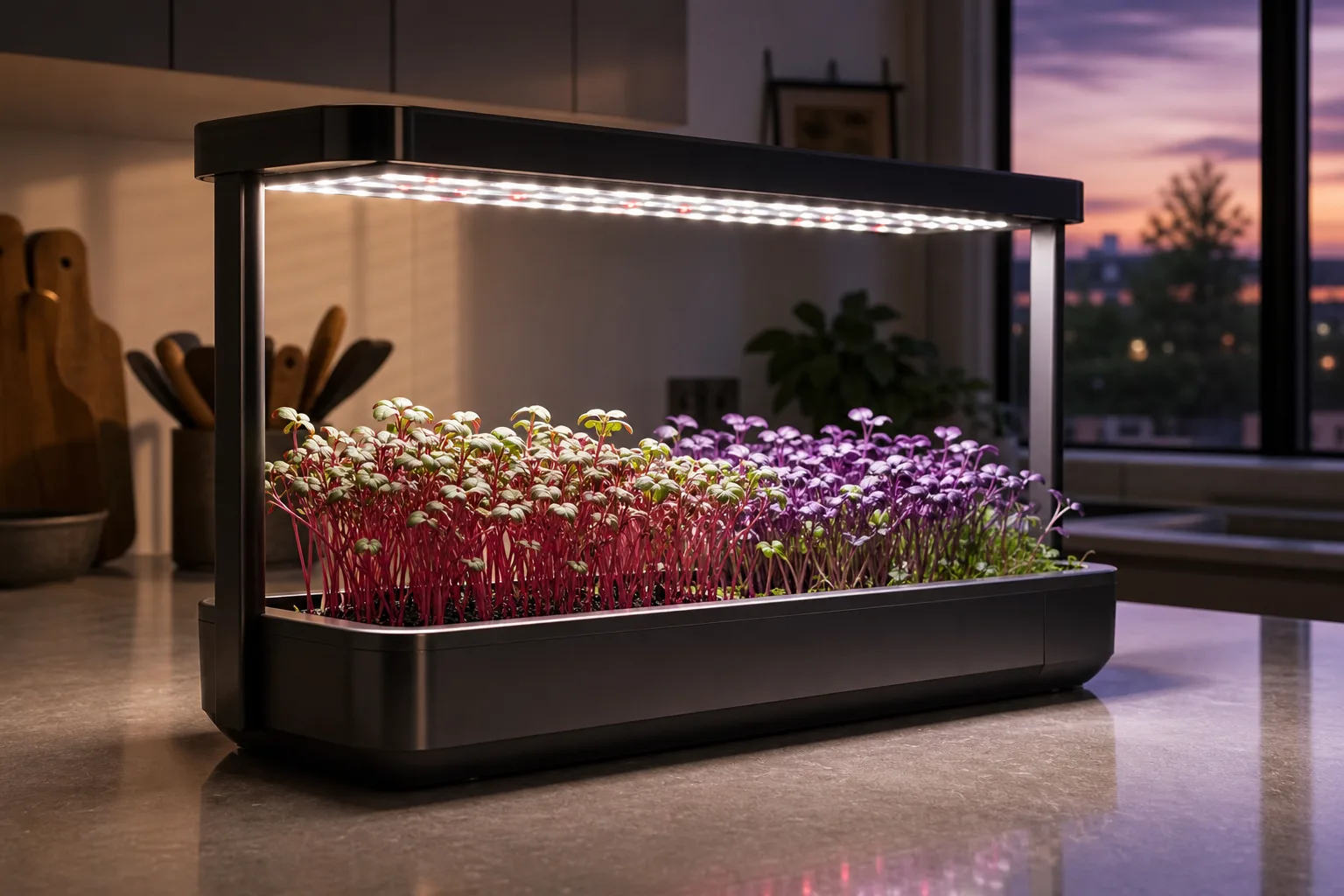
This is also the quiet advantage of growing your own. A purpose-built countertop grower like Luya holds the light recipe steady — wavelength, intensity, and day length tuned for the crop — so the chemistry you get is consistent rather than a roll of the dice. It is the difference between hoping for a good batch and growing one on purpose.
The bottom line
Secondary metabolites are the reason microgreens taste like more than just baby leaves and the reason they earn their reputation as nutritional overachievers. Glucosinolates bring the bite and the sulforaphane story, phenolics and anthocyanins supply color and antioxidant power, and carotenoids and vitamins fill out a dense little package. None of it is fixed — light quality, intensity, and timing all shape how much a plant builds.
So when you grow microgreens, you are not just sprouting seeds. You are shaping their chemistry. Give them good light, harvest them young, eat them fresh, and you get the fullest version of what these tiny plants have to offer.
References
- Effect of Different Ratios of Blue and Red LED Light on Brassicaceae Microgreens under a Controlled Environment. Plants (Basel). 2021;10(4):801. https://doi.org/10.3390/plants10040801
- Kyriacou MC, Rouphael Y, Di Gioia F, et al. Micro-scale vegetable production and the rise of microgreens. Trends Food Sci Technol. 2016;57:103–115. https://doi.org/10.1016/j.tifs.2016.09.005