This article is for general education and is not medical advice. Talk to your doctor before changing your diet for a health condition or if you take medication.
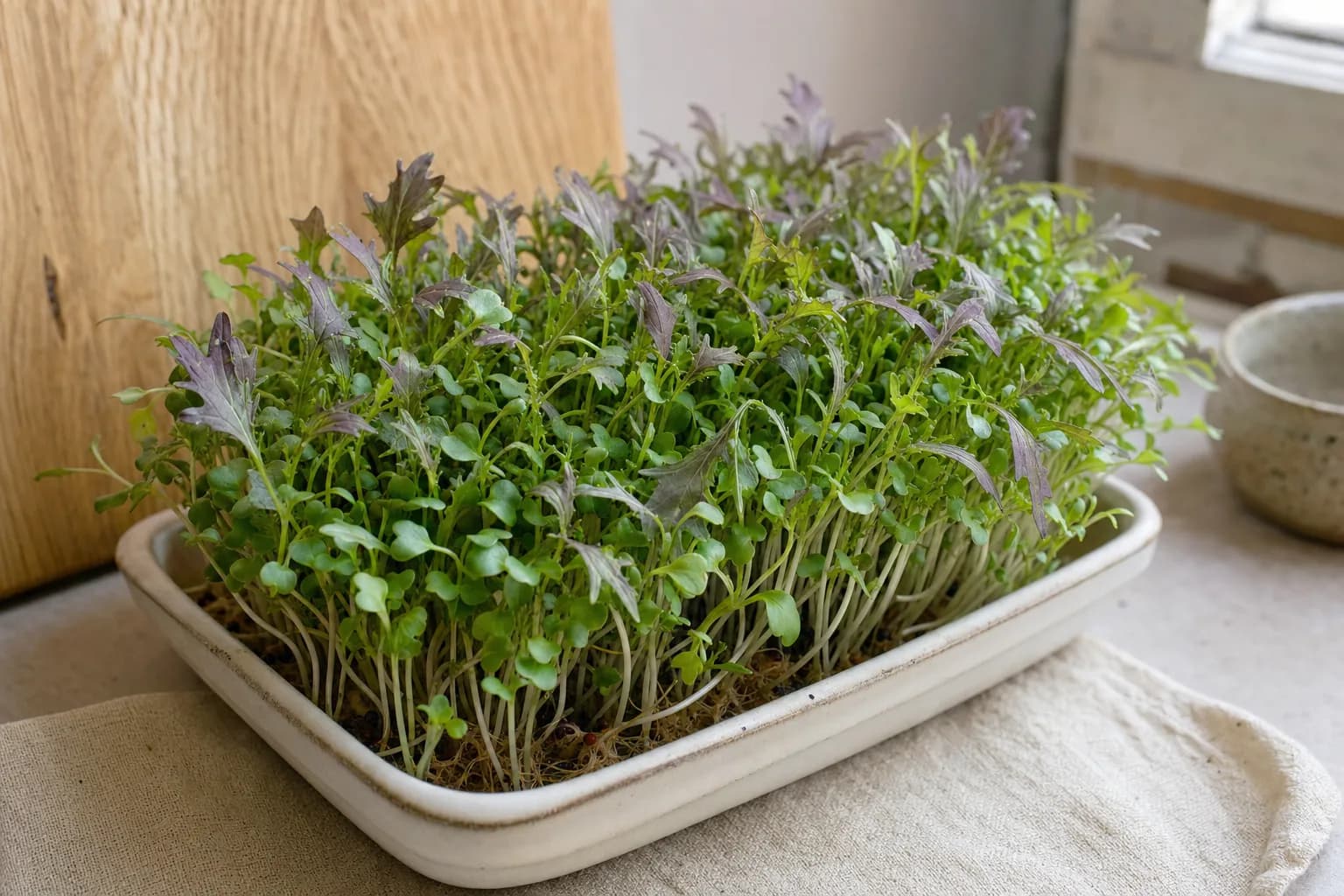
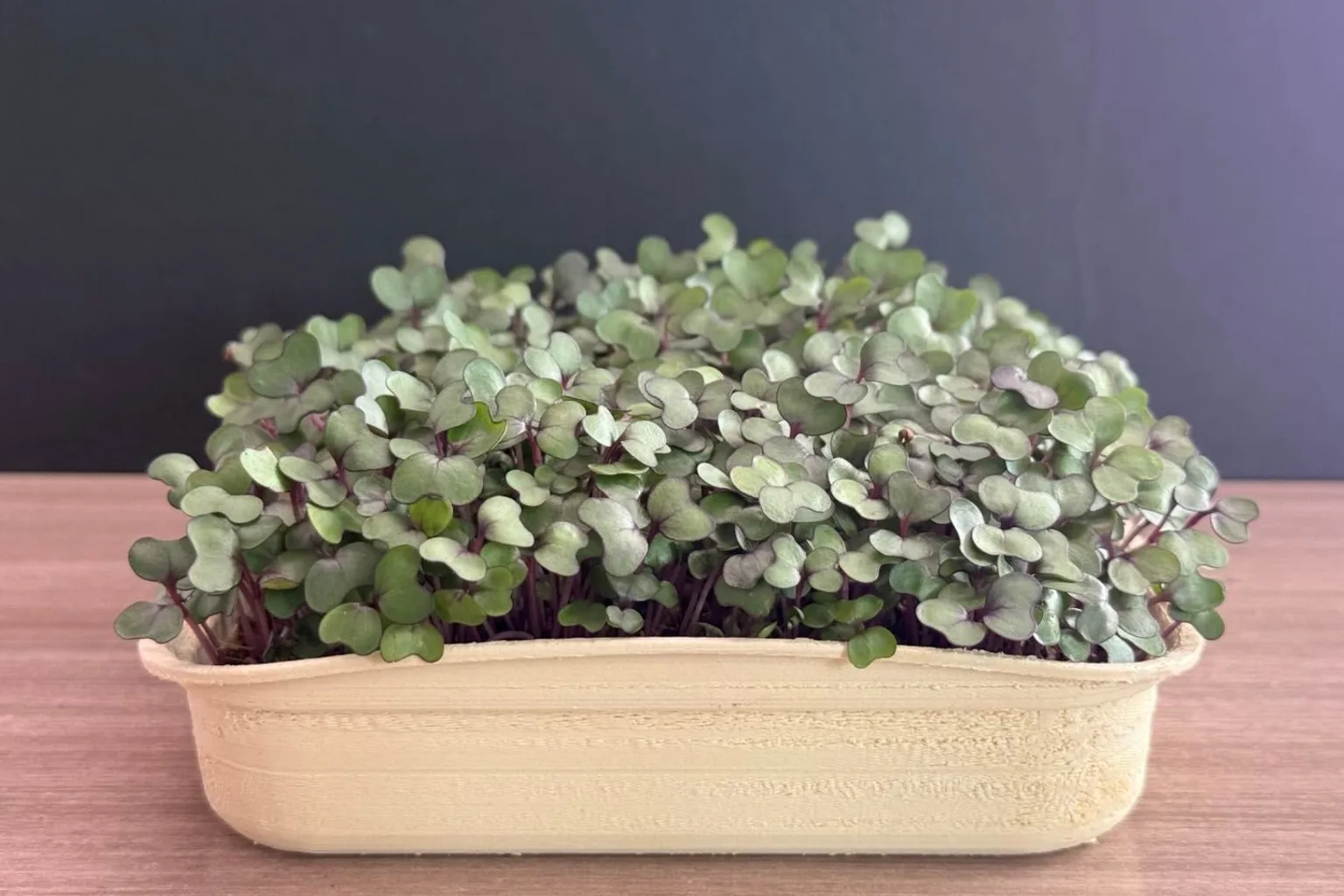
Cabbage gets a reputation it does not quite deserve. People picture boiled heads and that faint sulfur smell, and they move on. Cabbage microgreens are a completely different experience. Snipped young, just as the first true leaves appear, they taste clean, mild, and faintly sweet, with none of the heaviness of the mature vegetable. And if you grow the red variety, you get something the grown-up head can only hint at: stems streaked in deep magenta, courtesy of the same antioxidant pigments that color blueberries and red wine.
If you have wanted a brassica green that does not fight you on flavor, this is the one.
What Are Cabbage Microgreens?
Microgreens are vegetables harvested very young, usually within one to two weeks of sprouting, right after the seed leaves open and the first true leaves begin to show. Cabbage microgreens are simply cabbage seeds grown to that point and cut at the stem. They are not sprouts, which you eat whole, seed and root included, after only a few days of soaking. If that distinction is fuzzy, our guide on microgreens vs sprouts lays it out clearly.
Cabbage belongs to the Brassicaceae family, the same group that gives us broccoli, kale, radish, arugula, and cauliflower. As seedlings, all of these brassicas share strikingly similar heart-shaped seed leaves, which is why a tray of young cabbage and a tray of young broccoli microgreens look almost identical at first. The differences show up later, in the true leaves and, more importantly, on your palate.
What makes the whole category compelling is concentration. Peer-reviewed reviews and USDA comparisons suggest microgreens can run roughly 2 to 3.5 times more nutrient-dense than the fully grown vegetable, depending on the crop. A small handful, in other words, can carry meaningful nutrition. Our overview of what are microgreens covers the science in more depth.
The Mild Flavor That Makes Them Easy to Love
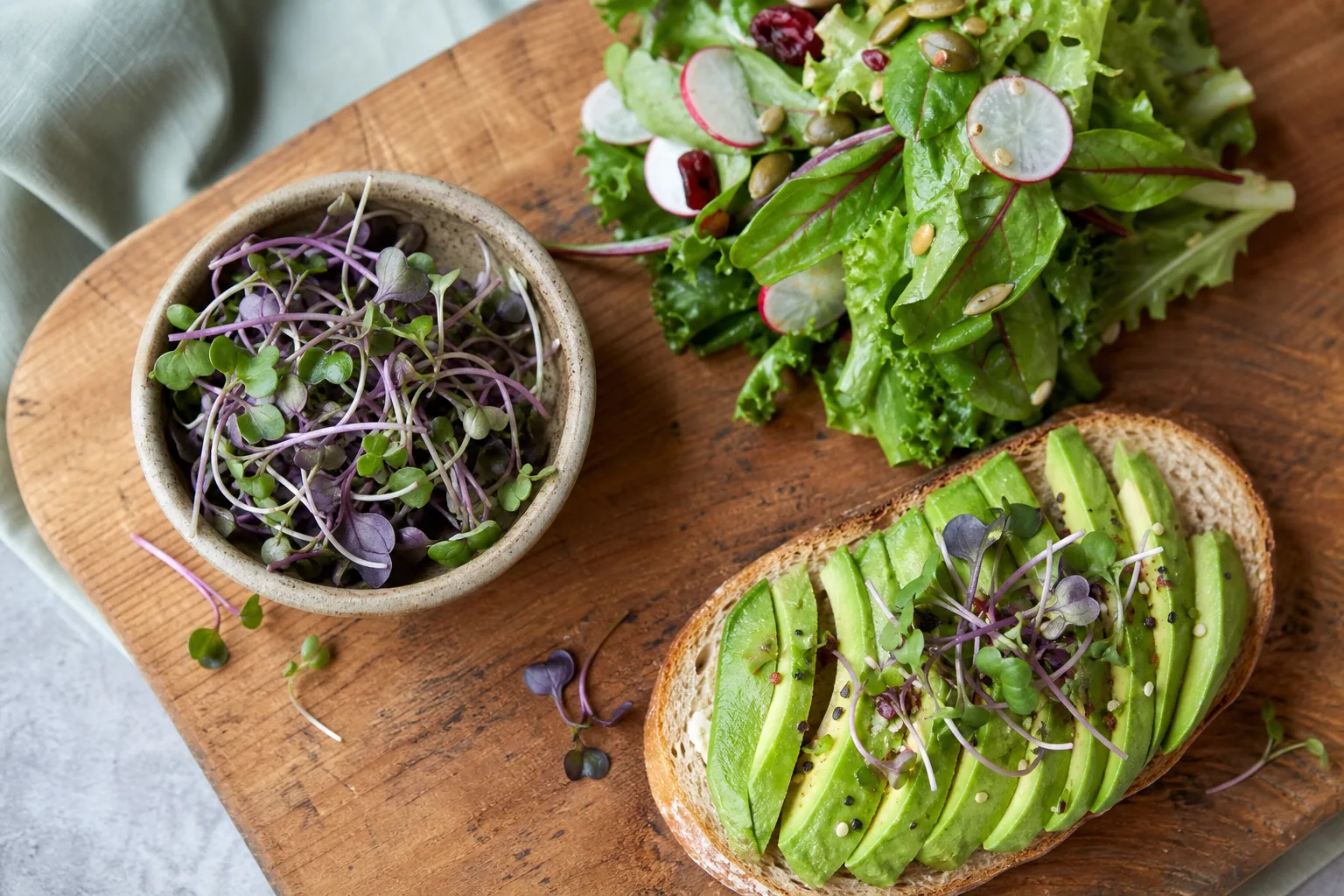
Most brassica microgreens share a family signature: a mix of sour, slightly bitter, and astringent notes, sometimes with real heat. Radish and mustard sit at the bold end of that spectrum. Cabbage sits at the gentle end. The flavor reads as fresh and lightly sweet, closer to a young salad green than to anything pungent.
That mildness is a practical advantage. Spicy greens demand a dish that can stand up to them; cabbage microgreens slide into almost anything without taking over. They are a natural starting crop for the same reason: forgiving in flavor, forgiving in the kitchen. If you are mapping out the broader taste landscape, our microgreens flavor profiles guide places cabbage alongside its spicier and nuttier cousins so you can build a rotation that suits your palate.
| Brassica microgreen | Flavor intensity | Taste notes |
|---|---|---|
| Cabbage | Gentle | Mild, fresh, faintly sweet |
| Broccoli | Mild–medium | Clean, slightly green and peppery |
| Kale | Mild | Sweet, cabbage-like |
| Radish | Bold | Sharp, spicy, peppery |
| Mustard | Bold | Hot, sinus-clearing |
Red Cabbage, Anthocyanins, and Nutrition
Color in a microgreen is rarely just decoration. The magenta in red cabbage stems comes from anthocyanins, the same family of plant pigments found in purple and blue produce. Anthocyanins act as antioxidants, helping protect cells from the oxidative damage that everyday metabolism produces. If pigment chemistry interests you, we go deeper in microgreens anthocyanins, and the broader link between color and plant compounds is covered in microgreens color and taste.
Red cabbage microgreens have earned a place in nutrition research specifically. In one study measuring beta-carotene, lutein, and vitamins C, E, and K across 25 commercial microgreens, red cabbage stood out as one of the richest in vitamins C, E, and K. That trio matters: vitamin C supports immune function and collagen, vitamin K plays a role in blood and bone health, and vitamin E is a fat-soluble antioxidant.
Red cabbage has also shown up in early heart-health work. In animal studies, red cabbage microgreens were associated with lower LDL cholesterol, less weight gain, and reduced triglycerides compared with controls. These are encouraging signals, not proof for humans, so read them as research-stage rather than a promise. We summarize the wider evidence in microgreens and cholesterol and are microgreens good for you.
| Nutrient angle | Why it matters | Where cabbage micros fit |
|---|---|---|
| Vitamin C | Immune support, collagen | Red cabbage ranks among the highest measured |
| Vitamin K | Blood and bone health | Notably high in red cabbage |
| Vitamin E | Fat-soluble antioxidant | Concentrated in red cabbage |
| Anthocyanins | Cell-protecting antioxidants | Found in the magenta stems |
| Glucosinolates | Precursors to sulforaphane | Present, as in all brassicas |
As a brassica, cabbage also carries glucosinolates, the precursor compounds that convert into sulforaphane and related isothiocyanates when the tissue is crushed by chewing or chopping. Broccoli is the family's headline act here, but the same machinery is at work across the group. Our explainer on what is sulforaphane covers how this pathway works.
How to Eat Cabbage Microgreens
The mild flavor makes cabbage micros one of the most flexible greens you can keep on hand. The one rule worth following applies to every brassica: keep them raw. Heat degrades both heat-sensitive vitamin C and the enzyme that turns glucosinolates into sulforaphane, so the most nutrition comes from eating them uncooked, fresh, and well chewed.
A few easy ways to work them in:
- Pile them onto avocado toast or tuck a handful into a sandwich or wrap.
- Scatter them over a finished bowl, taco, or plate of eggs as a fresh, crunchy topping.
- Fold them into a cold salad, where their gentle flavor blends rather than competes. Our microgreens salad ideas has a few starting points.
- Drop a small handful into a smoothie; the mild taste disappears entirely while the nutrition rides along. See microgreens smoothie recipes for combinations.
For more on technique and timing, how to eat microgreens goes further. The practical trick is to keep the tray near where you actually plate food, so adding a pinch becomes a reflex instead of a chore.
How to Grow Cabbage Microgreens at Home
Cabbage is one of the friendlier crops to start with. The seeds are small, germinate readily, and do not need pre-soaking. Here is the basic process.
- Prep the tray. Spread an even layer of moist growing medium across a shallow tray with drainage.
- Sow densely. Scatter the small cabbage seeds in a thick, even layer across the surface.
- Blackout. Cover the tray to keep the seeds dark and lightly humid for the first few days while they germinate. This blackout stage encourages even sprouting.
- Uncover and light. Once the seedlings stand up on their own, move the tray into bright light so the leaves green up and the red stems color.
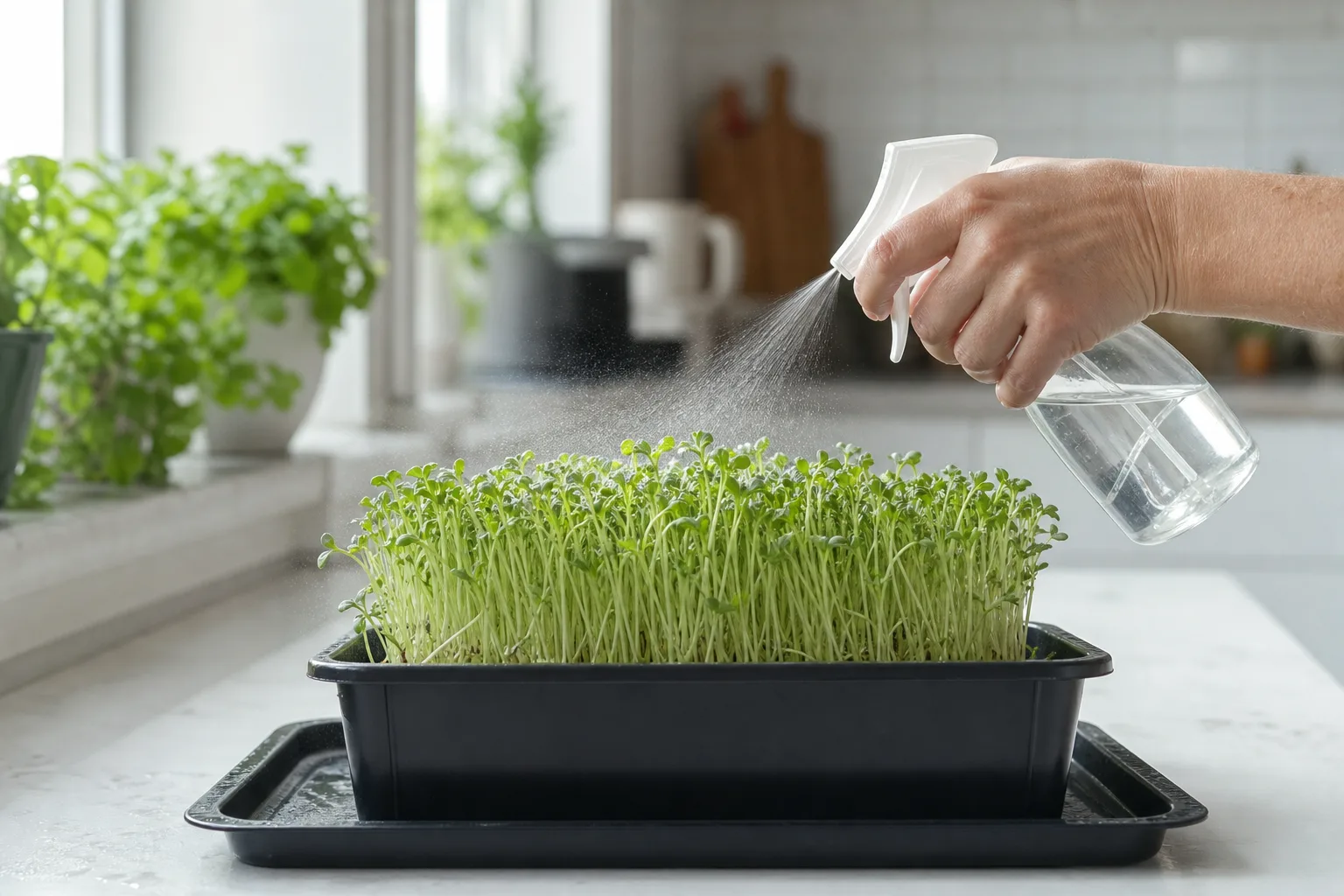
- Water gently. Keep the medium moist but never soggy, watering from the bottom when you can to keep the leaves dry and discourage mold.
- Harvest. When the first true leaves appear, usually within seven to ten days, snip just above the soil line.
For a full walkthrough that applies to any variety, see how to grow microgreens at home, and if you want to skip the loose soil entirely, grow microgreens without soil covers hydroponic options.
| Stage | Roughly when |
|---|---|
| Germination (blackout) | Days 1–3 |
| Uncover, first light | Days 3–5 |
| Greening and coloring up | Days 5–8 |
| Harvest | Days 7–10 |
The honest catch
Good growing advice names the failure points. The classic three are mold, mess, and maintenance. A dense, warm, humid seed tray with weak airflow is exactly the environment mold likes, which is why microgreens keep molding for so many first-timers. Loose soil makes a mess indoors. And maintenance is the quiet dealbreaker: a tray needs daily attention across that ten-day cycle, so one busy week or a short trip can undo it. None of this means you should not grow your own, only that consistency is the real skill.
This is the gap Luya is built to close. The Luya countertop grower, sometimes described as a Nespresso for greens, uses a sealed, ventilated, climate-controlled chamber to keep mold out, with automatic nutrient dosing and precise temperature control so the daily-chore problem largely disappears. You drop in a pre-seeded tray and harvest only what you need, while the rest keeps growing alive until the moment it reaches your plate. If that idea appeals, meet the Luya countertop food computer.
The Bottom Line
Cabbage microgreens are an easy yes: mild enough to go with anything, quick to grow, and genuinely nutritious, with the red variety adding anthocyanins and standout levels of vitamins C, E, and K. They are forgiving for beginners and flexible in the kitchen, which makes them a smart anchor crop in any microgreen rotation. Grow them by hand if you enjoy the daily ritual, or let an automated system handle the mold, mess, and timing so a fresh tray is simply always there. Either way, you get a small, vivid green that does a lot more than its size suggests.